In Gnostic theology, Sophia is the active, divine personification of Wisdom and the central protagonist of the Gnostic creation myth. As an Aeon (a divine emanation), she is the youngest and lowest entity to emerge from the ultimate divine source, occupying a precarious position at the outermost edge of the Pleroma (the spiritual realm of divine fullness).
The Fall and Creation of the Material World

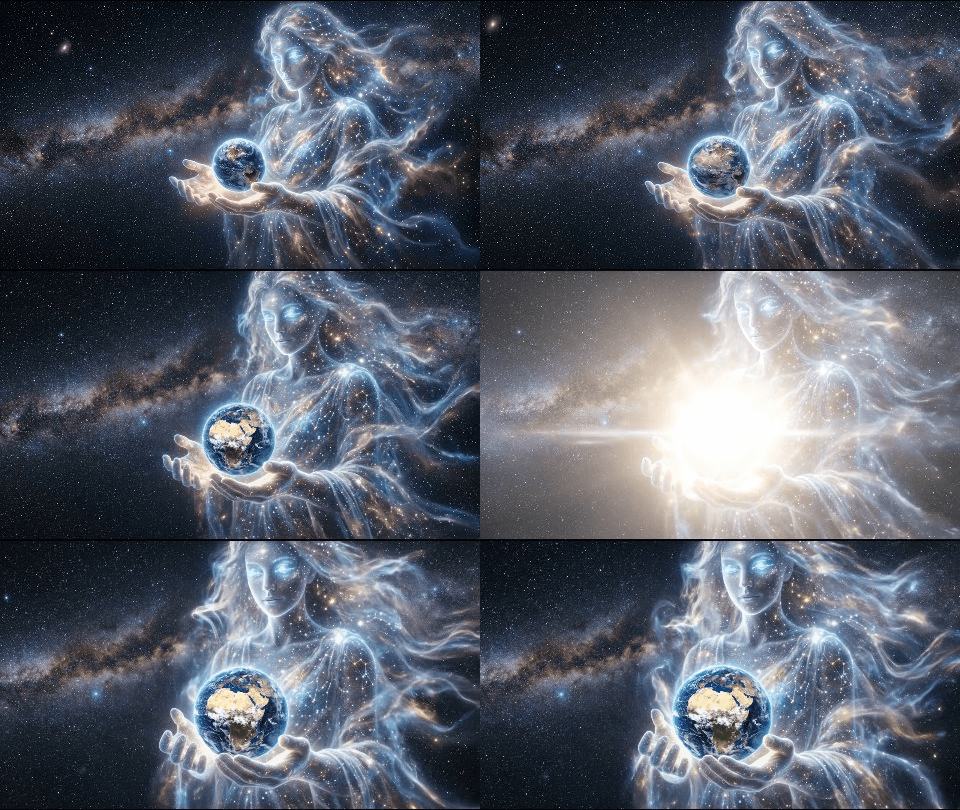
Sophia is fundamentally responsible for the transition from a perfect, immaterial divinity to a flawed, material existence. Driven by a passionate desire to comprehend the unknowable ultimate source, she attempted to create an image from herself without the consent of the Invisible Spirit and without her male consort. This unauthorized, independent creative act produced a formless, ignorant offspring known as Yaldabaoth, or the Demiurge. Sophia cast him out of the Pleroma into the void, where he subsequently fashioned the physical world and the material cosmos out of his own arrogance and ignorance.
Higher and Lower Sophia

To reconcile her divine origin with her fallen state, Gnostic systems like the Valentinian school bifurcated her identity:
- Higher Sophia (Pleromatic Sophia): The aspect of her that remained in the upper spiritual world, acting as the “Mother of the Living” and preserving the divine blueprint.
- Lower Sophia (Sophia Achamoth): The exiled world-creative power residing in the “Middle” realm. According to the myth, her intense emotions during her exile literally formed the physical elements of our reality: her grief became the seas, her fear became the earth, and her longing for the light became air and fire.
Her Role as Redeemer of Humanity

Sophia’s primary mission became the redemption of the divine light (pneuma) that she unknowingly allowed to become trapped in matter. To accomplish this, she infused a “spiritual spark” into humanity, ensuring that the material world would always retain a hidden link to the divine. Acting as a “Midwife” to spiritual individuals, she provides the secret knowledge (gnosis) necessary to wake humanity from their spiritual slumber and liberate their trapped light. She is even identified in some traditions as the “Serpent” in Eden, who encouraged Adam and Eve to eat from the Tree of Knowledge so they might recognize their inherent divinity.
The Pistis Sophia and Her Return
In the 3rd-4th century Coptic text Pistis Sophia (which translates to “Faith-Wisdom”), Sophia represents the archetypal faithful, repentant soul. The text describes her being found by the resurrected Jesus in a state of profound distress, pursued and tormented by dark emanations that seek to strip her of her remaining light. Through a series of thirteen metanoiai (repentances), she undergoes a gradual, initiatory process of purification, eventually achieving final liberation and permanent restoration to her higher spiritual realm. Ultimately, Gnostic eschatology promises that when Sophia retrieves every spark of light from matter, she will reunite with the Savior, and the physical world (created from her tears and fear) will dissolve into nothingness.
Modern Interpretations
Beyond ancient Gnosticism, the concept of Sophia has been reimagined throughout history:
- Russian Sophiology: 19th and 20th-century thinkers like Vladimir Solovyov viewed her as the “Eternal Feminine” and the “World-Soul,” representing the spiritualization of matter and the perfect prototype of creation that eternally exists within God.
- Contemporary Esotericism: Today, she is often discussed not as a mythic figure of the past, but as an active, global “Sophia Consciousness” associated with the Age of Aquarius. In this context, her “return” represents the resurgence of the Divine Feminine and the harmonic balancing of intuition and receptivity against patriarchal structures.
This research paper, titled “The Divine Aeon: A Comprehensive Analysis of Sophia in Gnostic Cosmogony and the Eschatology of Her Return,“ explores the pivotal and complex role of Sophia (Wisdom) within Gnostic theology and her enduring influence on modern spirituality.
The paper investigates Sophia’s journey from a divine entity within the spiritual “Fullness” to her instrumental role in the creation of the material world and her eventual restoration. View it here on desktop or download it via the link.
1. Ontological Origins and the Pleroma

Sophia is an Aeon and a divine emanation from the Monad, residing in the Pleroma, the highest spiritual realm. As the youngest Aeon, she represents both innocence and wisdom while navigating the balance between eternal light and the void. Her journey involves exploring her role in the cosmic order and understanding the effects of her knowledge, which not only enriches her essence but also influences the universe and guides others through the mysteries of existence.
2. The “Fall” and the Birth of the Demiurge

The transition from immaterial divinity to flawed material existence is sparked by the “Fall of Sophia”. Driven by a desire to create independently without her male counterpart or the Monad’s consent, Sophia brought forth an “incomplete” being. This offspring is Yaldabaoth, the Demiurge, a lion-headed serpent who, in his ignorance, fashioned the physical world and trapped “divine sparks” of light within matter.
The Bifurcation of Sophia

To explain how she can be both divine and fallen, Gnosticism often splits her identity:
- Higher Sophia: Remains in the Pleroma, representing the divine blueprint.
- Lower Sophia (Achamoth): Exists in the “Middle,” acting as the source of divine sparks in humanity.
3. The Path to Redemption and Return

The paper outlines several frameworks through which Sophia—and by extension, the human soul—seeks to return to the divine source:
- Pistis Sophia: A 3rd–4th century text detailing Sophia’s 13 repentances (metanoiai), which serve as a blueprint for the soul’s purification and ascent back to the higher realms.
- Russian Sophiology: 19th and 20th-century thinkers like Vladimir Solovyov reimagined her as the “Eternal Feminine,” viewing her “return” as the spiritualization of the entire material world.
- Modern “Sophia Consciousness”: Contemporary movements view her return as a global shift toward the “Divine Feminine,” involving the activation of a “divine genetic code” within individuals to balance patriarchal structures with intuition and compassion.
4. The Consummation of the Age

The research concludes with the “Consummation of the Age,” an eschatological event where Sophia’s voice, like thunder, signals the end of the material defect. In this final “return,” the physical world is dissolved, and all divine sparks are reunited with Sophia in the Pleroma, restoring the universe to its original perfection.
How does the concept of the “divine spark” within humanity change your perspective on our relationship with the material world?




Leave a Reply