In the silent theater of the subatomic world, particles seem to possess a strange kind of stage fright. When we aren’t looking, they dance in a haze of infinite possibilities; the moment we turn our gaze toward them, they snap into a single, definite position.
Is this just cold, hard physics—or is it the scientific mechanism behind the ancient idea of “willing” reality into existence?
1. The Science: Collapsing the Wave Function

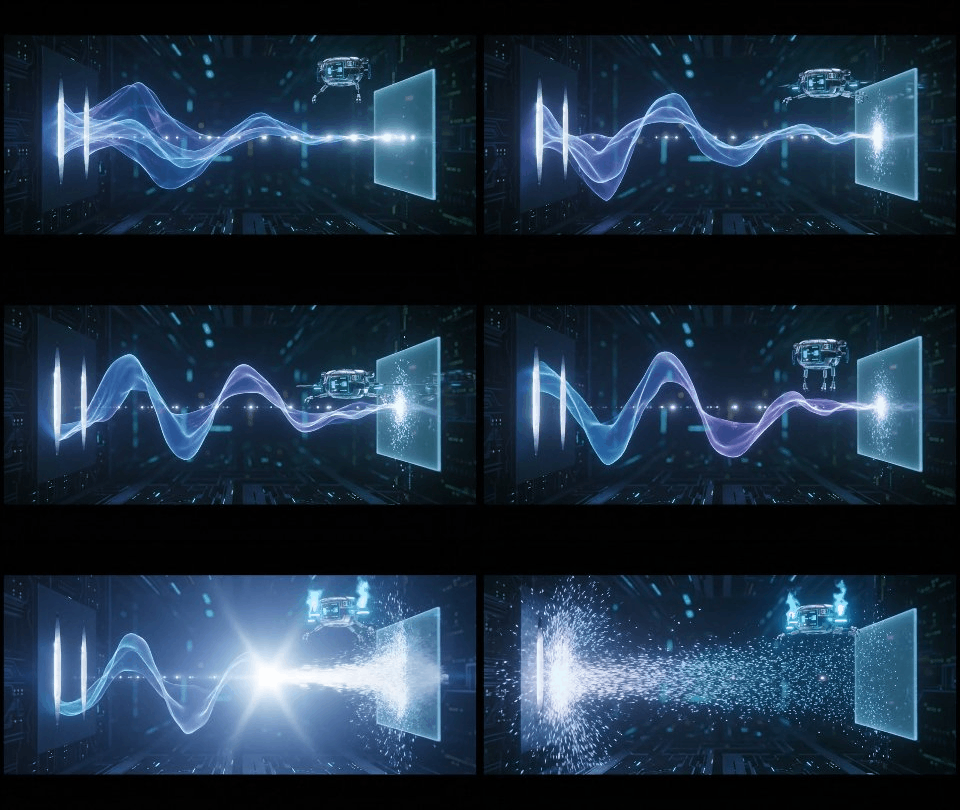
In the famous Double-Slit Experiment, quantum objects (like electrons) act as waves when unobserved, passing through two slits simultaneously and interfering with themselves. This state of “both-and” is known as superposition.
However, the moment a measurement device—an observer—is introduced to see which slit the particle actually goes through, the wave pattern vanishes. The particle “chooses” one path. In physics, we call this the collapse of the wave function: the transition from a mathematical spread of possibilities to a single physical reality.
2. The Esoteric: The Magician’s Will

For centuries, hermetic and esoteric traditions have argued that Mind is localized within Matter. The “Magician” or the practitioner of manifestation believes that through focused intent (Will), one can select a specific outcome from the chaos of the “Aether.”
3. The Bridge: Is Manifestation Just Quantum Selection?

The parallel is tempting. If looking at an electron forces it to “decide” its state, does our collective consciousness force the “unformed” future to crystallize into our present?
- The Scientific Nuance: Most physicists argue that “observation” doesn’t require a human mind—just an interaction with a macroscopic environment (decoherence).
- The Philosophical Leap: If the universe is fundamentally a quantum system, then nothing is truly “fixed” until it is witnessed.

Whether you call it collapsing the wave function or the Magician’s Will, the core mystery remains: the universe behaves differently when it knows it’s being watched. This phenomenon raises profound questions about the nature of reality, suggesting that observation itself plays a critical role in shaping our universe. The implications of this idea extend far beyond the realms of quantum physics; they delve into the very fabric of consciousness and our understanding of existence. As if the cosmos is conscious, it seems to respond to our awareness, hinting at a deep connection between the observer and the observed. This interplay invites us to reconsider not only how we perceive reality but also the inherent power we possess as conscious beings navigating the vast complexity of the universe.




Leave a Reply