
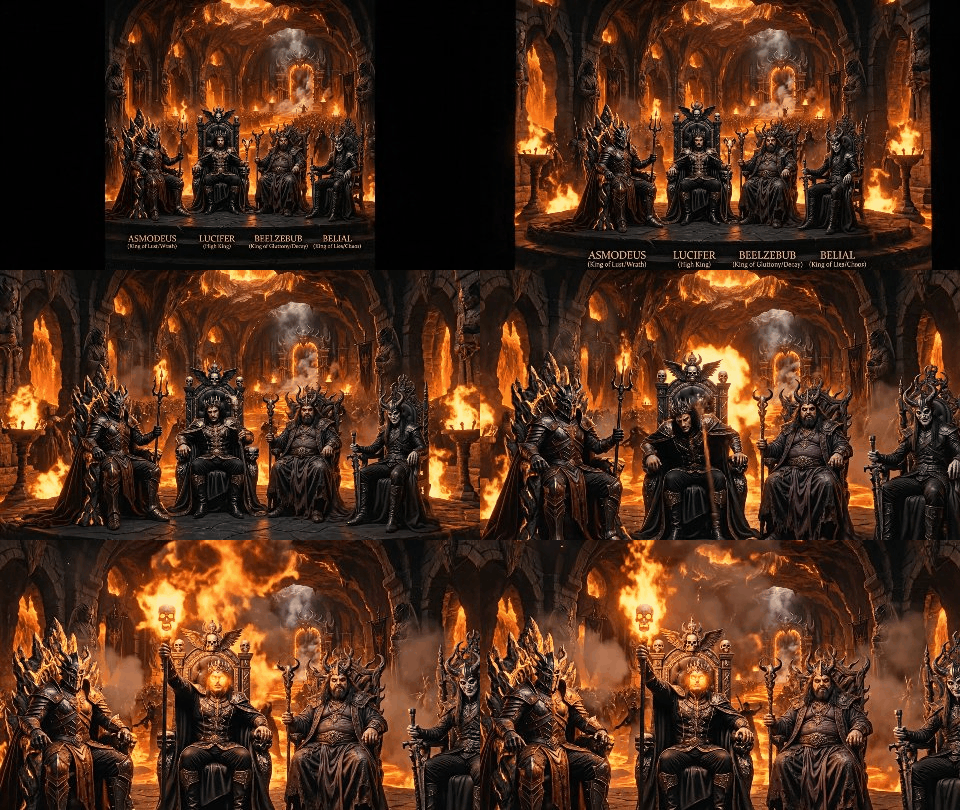
If you thought mapping Hell’s hierarchies in one of my older posts, The Infernal Realm was an intense ride, grab a glass of ice water. We established that the underworld is an intricately organized machine with its own kings, duchesses, and distinct ministries. But a government is nothing without its infrastructure.
How do these grand dukes actually govern? Where do they reside, and what are the operational laws of the abyss?
Today, we are peeling back another layer of the cosmic shadow. From the fiery fortifications of the four cardinal directions to the transactional bureaucracy of infernal pacts, let’s explore the terrifyingly orderly architecture of the infernal realm.
1. The Four Altitudes and the Cardinal Seats of Evil

In earthly geopolitics, geography dictates power. The same holds true in the esoteric mapping of Hell. While early theological accounts describe a singular, chaotic pit, traditional grimoires like the Ars Almadel and the Theurgia-Goetia outline a highly structured, spatial alignment built around the Four Cardinal Altitudes of the World.
Hell is effectively carved into four massive continental empires, each anchored to a compass point and overseen by a supreme, primordial Emperor:

- The East (Oriens / Amaymon): Associated with the rising sun, but inverted into a blinding, consuming spiritual light. This quarter governs intellectual corruption, false enlightenment, and the initial spark of pride.
- The South (Paymon / Amaymon): The absolute seat of intense, suffocating heat. The spirits under this altitude are fiercely tied to the element of Fire. They control grand illusions, deep-seated desires, and the hidden arts of seduction and charisma.
- The West (Egyn / Corson): Bordering the great watery abysses, the Western gate controls the element of Water. It handles the darker, emotional deep currents—melancholy, maritime plagues, and the slow, drowning rot of despair.
- The North (Ziminiar / Belial): The cold, heavy, and silent quarter of Earth. The Northern altitude rules over the material world, buried treasures, the literal decay of the physical body, and the rigid, unyielding structures of tyranny.
When an occult practitioner of old stood inside a magic circle, they weren’t just shouting into a void; they had to physically turn toward these specific coordinates. To command a spirit of the North without acknowledging Ziminiar’s domain was considered a quick way to find yourself entirely defenseless.
2. The Bureaucracy of the Pact: The Cosmic Courtroom

We often think of “selling your soul” as a dramatic, blood-spattered horror movie trope. But historic grimoires—such as the notorious Grimoire of Honorius or Dr. John Faust’s Black Raven—portray it as something far more mundane and terrifying: pure, unyielding legalism.
The architecture of Hell operates on absolute contractual law. Because demons are understood to be fallen celestial intelligences, they retain an obsessive respect for hierarchy, titles, and legal parameters. They cannot simply take what they want; they must negotiate for it.
In these historic traditions, an infernal transaction mirrors an earthly courtroom or executive board:

- The Intermediary: High-ranking emperors like Lucifer or Belial rarely manifest for petty human demands. Instead, they operate through Paladins or Familiar Spirits—the corporate middle managers of the underworld who act as messengers, executing daily tasks while reporting back to the crown.
- The Constraint: Grimoires are essentially legal handbooks. By using highly specific divine names, sacred geometry, and exact astrological timing, the operator attempts to “sue” or bind the demon under cosmic law, forcing them to provide wealth, philosophy, or protection without the operator forfeiting their soul.
- The Loophole: The terror of the infernal pact isn’t that the demon breaks the contract; it’s that they follow the literal text too perfectly. They exploit vague language, human greed, and emotional instability, waiting for the exact moment the magician slips up in their ritual parameters to collect their cosmic dues.
3. The Clashing of Elements: Spiritual Physics

How does a purely spiritual entity interact with our physical universe? According to Cornelius Agrippa’s Three Books of Occult Philosophy, the answer lies in a dark reflection of physics.
Demons utilize a “harmoniacall spirit”—a heavy, condensed psychic mist derived from dense elements. They don’t just exist in a fiery cave underground; they inhabit the very atmosphere around us.
- The Aerial Powers hijack the air to manifest thunder, lightning, and airborne pestilence.
- The Terrestrial and Subterranean Spirits anchor themselves to dense physical locations—cemeteries, ruined castles, and deep cavernous vaults—using the residual vapors of the dead or buried gold to project their presence into our reality.
This elemental entanglement means that the landscape of Hell is constantly bleeding into our own, utilizing the natural architecture of the Earth to anchor its grand hierarchy.
The Names for spell casting
The spiritual correspondences for the cardinal directions—North, South, East, and West—are detailed across multiple esoteric texts, encompassing hierarchies of demonic kings, angelic princes, and elemental winds.
The Four Great Infernal Kings The most prominent system across the sources divides the world into four domains ruled by demonic or infernal kings:
- East: Ruled by Oriens (also called Urieus or Uriens). According to esoteric geography, the East is associated with the rising sun, intellectual corruption, false enlightenment, and the initial spark of pride. The Grimoire of Honorius names the Eastern king Magoa.
- South: Ruled by Amaymon (or Amaimon). This altitude is the absolute seat of intense, suffocating heat and is fiercely tied to the element of Fire, governing grand illusions, deep-seated desires, seduction, and charisma. The Grimoire of Honorius alternatively names the Southern king Egym.
- West: Ruled by Paymon (or Paimon). Bordering the great watery abysses, the Western gate controls the element of Water and handles darker emotional currents, melancholy, maritime plagues, and the slow rot of despair.
- North: Ruled by Egyn (or Egin/Ariton). The Northern altitude is cold, heavy, and silent, ruling over the element of Earth, the material world, buried treasures, physical decay, and the rigid structures of tyranny. The Grimoire of Honorius names the Northern king Amaymon.
Alternative names and hierarchies for these four chief spirits appear in various traditions:
- The Goetia lists the four great kings as Amaymon, Corson, Zimimay (or Ziminair), and Gaap. It also notes that rabbinical traditions call the rulers of the four quarters Samael, Azazel, Azael, and Mahazael.
- In the Theurgia-Goetia, the supreme emperors of the compass points are named as Carnesiel (East), Caspiel (South), Amenadiel (West), and Demoriel (North).
- The Book of Oberon assigns four sub-spirits, described as “bishops,” who serve under the four kings: Teltrion (East), Spyrion/Speryon (West), Boytheon/Boetherion (South), and Mayeryon (North).
The Four Angelic Princes In opposition to the infernal kings, there are four great princes of the angels set over the four winds and parts of the world:
- East: Michael.
- West: Raphael.
- North: Gabriel.
- South: Nariel (sometimes called Ariel or Uriel).
These angels are further aligned with four elemental rulers: Cherub for Air, Tharsis for Water, Ariel for Earth, and Seraph (or Nathaniel) for Fire.
The Four Winds The cardinal directions are also strongly associated with specific winds and elemental temperaments:
- East (Eurus): Known as the Eastern wind (or Apeliotes), it is waterish, cloudy, and ravenous.
- South (Notus): A cloudy, moist, warm, and sickly wind, sometimes referred to as the “butler of the rains”.
- West (Zephyrus): Considered a fruitful wind.
- North (Boreas): A fierce, roaring wind that dispels clouds, makes the air serene, and binds water with frost.
In the practice of ceremonial magic, different days of the week are governed by specific kings of the air whose spirits are subject to these winds. For example, Sunday’s spirits are subject to the North wind, Monday’s and Friday’s to the West wind, Tuesday’s to the East wind, Thursday’s and Saturday’s to the South wind (or Southwest), and Wednesday’s to the Southwest wind.
Orders Out of Chaos

Whether you interpret these old books literally or view them as an ancient psychological mapping of the human shadow, one truth remains: humans have an insatiable need to categorize their fears. We didn’t just invent a monster under the bed; we gave him a crown, assigned him a cardinal direction, and wrote a 500-page legal contract detailing his exact job description.
Which part of the infernal layout captures your imagination the most? Are you fascinated by the strict legal boundaries of the grimoires, or the idea of an empire divided by the compass points?
Let me know your thoughts in the comments below, and don’t forget to subscribe for more journeys into the bizarre and the arcane!




Leave a Reply