
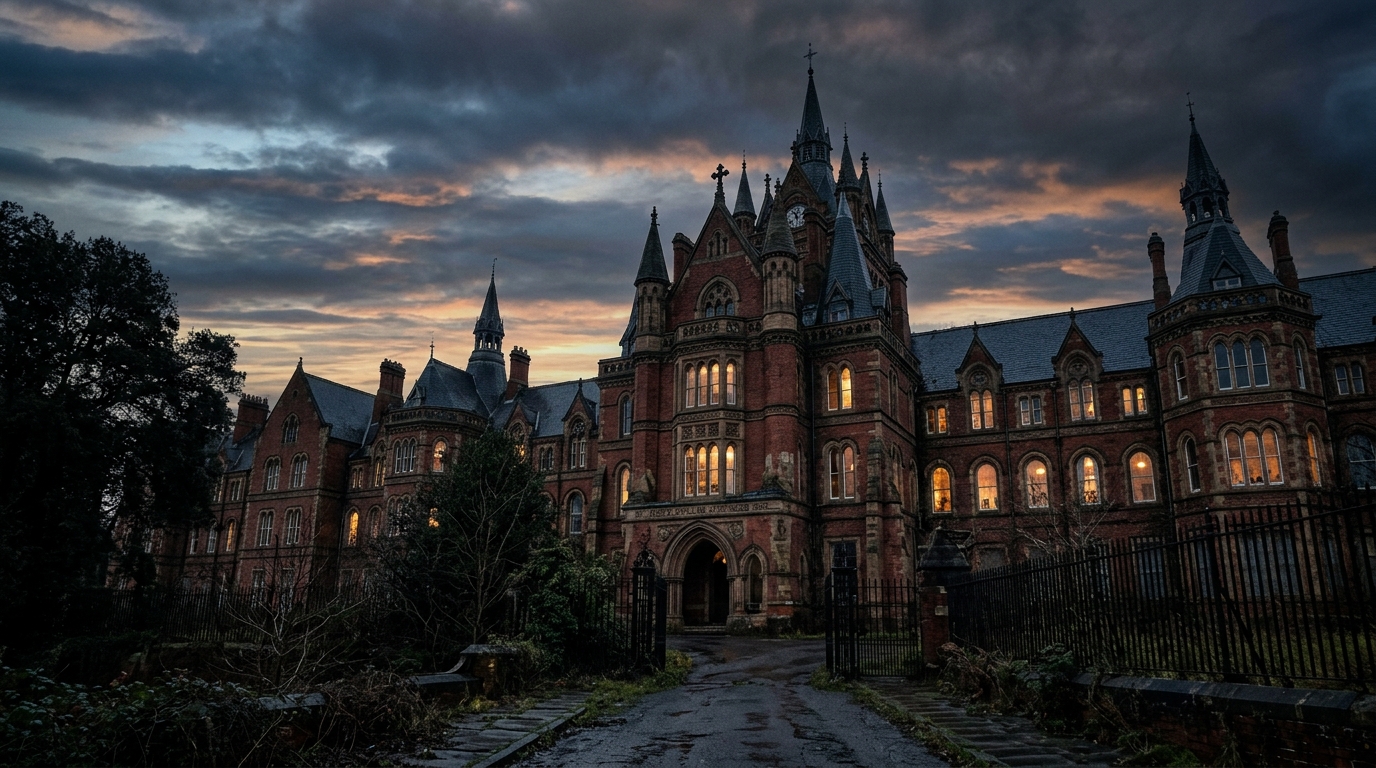
Have you ever scrolled past a video claiming that the grand, gothic-style psychiatric hospital down the road was actually built by an ancient, global civilization—and that our modern history is just a cover-up?
Welcome to the rabbit hole of “Tartaria.”
It’s one of the internet’s most persistent, aesthetic-driven revisionist theories. It posits that a highly advanced, unified empire called “Grand Tartarie” existed until about 1800, at which point it was erased, its architecture “found” and repurposed by an inferior successor society.
It’s a fascinating story. But as we love to do here at Nicole Explains It All, let’s look past the vibes and examine the evidence. Is this a suppressed truth, or just a case of misinterpreting history? Let’s break it down.
The “Old World” Narrative: Asylums as Time Capsules
The core of the Tartaria theory is that 19th-century asylums—those massive, brooding, red-brick buildings—weren’t built by the Victorians at all. Proponents argue they were discovered by them and used as part of a grand re-education campaign to silence people who “remembered” the old world.
The lore points to specific “evidence”:
- Speed of Construction: Theorists argue structures like the State Asylum for the Insane at Morristown (built 1876) were built too quickly to be authentic.
- The “Unqualified” Architect: Take Richard Snowden Andrews. When he was commissioned for Western State Hospital in 1858, he was relatively green. How, theorists ask, could he design something so complex?
- The Purpose: The theory claims these were “torture houses” designed to force people to forget. They point to odd 19th-century admission reasons—like “laziness” or “greediness”—as proof that these weren’t medical facilities, but instruments of social control.
The Reality Check: When we look at the historical records, we see a world of rapid industrialization, not magic. Architecture in the 19th century was often standardized through pattern books. Architects like Samuel Sloan weren’t working in a vacuum; they were part of a massive movement of pattern-based construction that allowed for the rapid assembly of these facilities.
The Star Fort Obsession

You’ve likely seen the maps of “Star Forts”—geometric, fortress-like structures spanning from Italy to Indonesia. The theory suggests these are the power plants or remnants of a global ancient power grid.
The Reality Check: A “Star Fort” (trace italienne) isn’t a magical power grid; it’s a brilliant military response to the invention of gunpowder. When cannons became the dominant weapon of war, flat medieval walls crumbled. The star shape allowed for overlapping fields of fire, meaning no attacker could get near the wall without being hit from multiple angles. It’s not “ancient tech”—it’s 16th-century ballistics.
So, What Actually Was “Grand Tartarie”?

If it wasn’t a global empire, why does it keep showing up on old maps?
The answer is simple, though perhaps less exciting: Cartographic Ignorance.
In the eyes of European mapmakers, “Tartaria” was a placeholder. Much like “Terra Incognita” (Unknown Land), it was a label used to describe the vast, unexplored stretches of the Eurasian heartland. As European exploration expanded, the “Tartaria” label shrank. It was never a political entity—it was an “investigative field” for the unknown.
The Paper Trail: Real History in the Baikal Region
If we want to see how borders actually change, we don’t need conspiracy; we have the collapse of the Russian and Qing Empires. Between 1917 and 1923, the Baikal region was a hotbed of competing ideas, from Buryat ethnic autonomy to Ungern-Sternberg’s dream of a “Pan-Asian Kingdom.”
This era is incredibly well-documented. We see engineers struggling to build the Circumbaikal Railway—a project that was physically vulnerable and politically exhausting. It wasn’t an inherited grid; it was hard-fought, steel-and-sweat infrastructure. Archaeologists using modern GIS mapping have even found 89 ancient nomadic city ruins in this region—and they are exactly what you’d expect: ruins. They were not intact, functional, pre-built cities.
The Verdict: Research Field or Suppressed Truth?
The Tartaria narrative persists because it touches on something very human: we love the idea that the world is more mysterious than it seems. The “aura” of those old, hauntingly beautiful hospitals is real, but that aura comes from our own history—our struggles with mental health, our architectural evolution, and our shift from empires to nation-states.
“Tartaria” isn’t a secret history; it’s a window into the limits of 18th-century European geography. When we bridge the gap between “myth” and “map,” we find a history that is, quite frankly, just as fascinating as the conspiracy.




Leave a Reply