If you know me, I love pop art and Warhol. That said, the moderately affordable fine art alternative is Steven Alan Kaufman, famously nicknamed “SAK” by his mentor Andy Warhol, who was a pivotal figure in the second generation of American Pop Art. His work resonates with a sense of bold colors and iconic imagery that draws inspiration directly from the vibrant culture surrounding him.

Entering the serious art world in his late teens, Kaufman met Warhol in 1981 and became an assistant at his legendary New York studio, The Factory, where he absorbed invaluable lessons about creativity and self-expression. This experience not only honed his artistic skills but also fostered a unique style that set him apart, allowing him to capture the essence of modern life through his compelling and often provocative pieces.

Under Warhol’s guidance, Kaufman mastered the technique of silkscreening with long-lasting oils—a traditional method he vowed to maintain throughout his career, famously rejecting modern digital giclée prints. From Warhol, Kaufman inherited the core philosophy of making art accessible to the masses, but he eventually adapted these mass-production techniques for his own unique era and purpose.
A Studio Built on Second Chances: The Ex-Gang Member Initiative

While he shared Warhol’s pop-culture sensibilities, Kaufman uniquely intertwined his commercial art with profound social activism, most notably through his massive hiring of ex-gang members,. After establishing his own SAK Studio in New York—where he initially hired homeless individuals to assist him—Kaufman relocated his studio to Los Angeles in 1993,.
In Los Angeles, Kaufman actively partnered with parole officers in South Central LA to recruit youths who had recently been released from prison. He provided them with employment as studio assistants, transforming his workspace into a hub for social rehabilitation and community outreach. This initiative grew exponentially; what began as a program for 100 ex-gang members quickly scaled to over 200, earning Kaufman an award from Los Angeles Mayor Richard Riordan. By 1997–1998, the program had employed 546 ex-gang youths, and by 2001, the number of formerly incarcerated assistants hired by his studio swelled to over 759.
Greatest Works and Artistic Legacy


Kaufman’s artistic portfolio is vast and eclectic, spanning traditional canvases, monumental murals, and unconventional mediums like motorcycles and boxing gloves. Some of his greatest and most notable works include:
- Comic Book Pop Art: In 1993, Kaufman pioneered a style he called “Comic Book Pop Art,” taking classic superheroes like Superman, Batman, and Spider-Man and elevating them into fine art,.
- “Mozart State II” and Historic Portraits: Kaufman painted vibrant, hand-embellished portraits of historical and pop culture icons, including Marilyn Monroe, Beethoven, Frank Sinatra, and the Beatles,. His 1997 painting “Mozart State II” earned him the immense distinction of being the first American artist added to the permanent collection at the Internationale Stiftung Mozarteum in Salzburg, Austria.
- The Muhammad Ali Olympic Portrait: Kaufman created a renowned portrait of Muhammad Ali for the 1996 Olympics. For the first time, Ali signed a limited edition with both his given name, Cassius Clay, and his Muslim name.
- Monumental Murals and Activism: Driven by his humanitarian spirit, Kaufman created 55 “Racial Harmony” murals featuring Malcolm X across New York subway cars, retaining walls, and abandoned buildings. He also created the AIDS Memorial in New York City and draped the “D” of the Hollywood sign in red cloth to honor victims of the AIDS epidemic.
- The Caesars Palace Epic: In 2001, he completed a massive 20-by-500-foot series of paintings to commemorate the 35-year history of Caesars Palace in Las Vegas, a monumental installation that drew 10 million visitors in its first four months.

Ultimately, Kaufman took the foundation of Pop Art he learned at The Factory (Warhol’s famous art collective) and expanded its scope. By combining iconic imagery with a relentless dedication to charity, he proved that the mass-production studio model could be used not just to reflect culture, but to actively heal and employ marginalized communities.
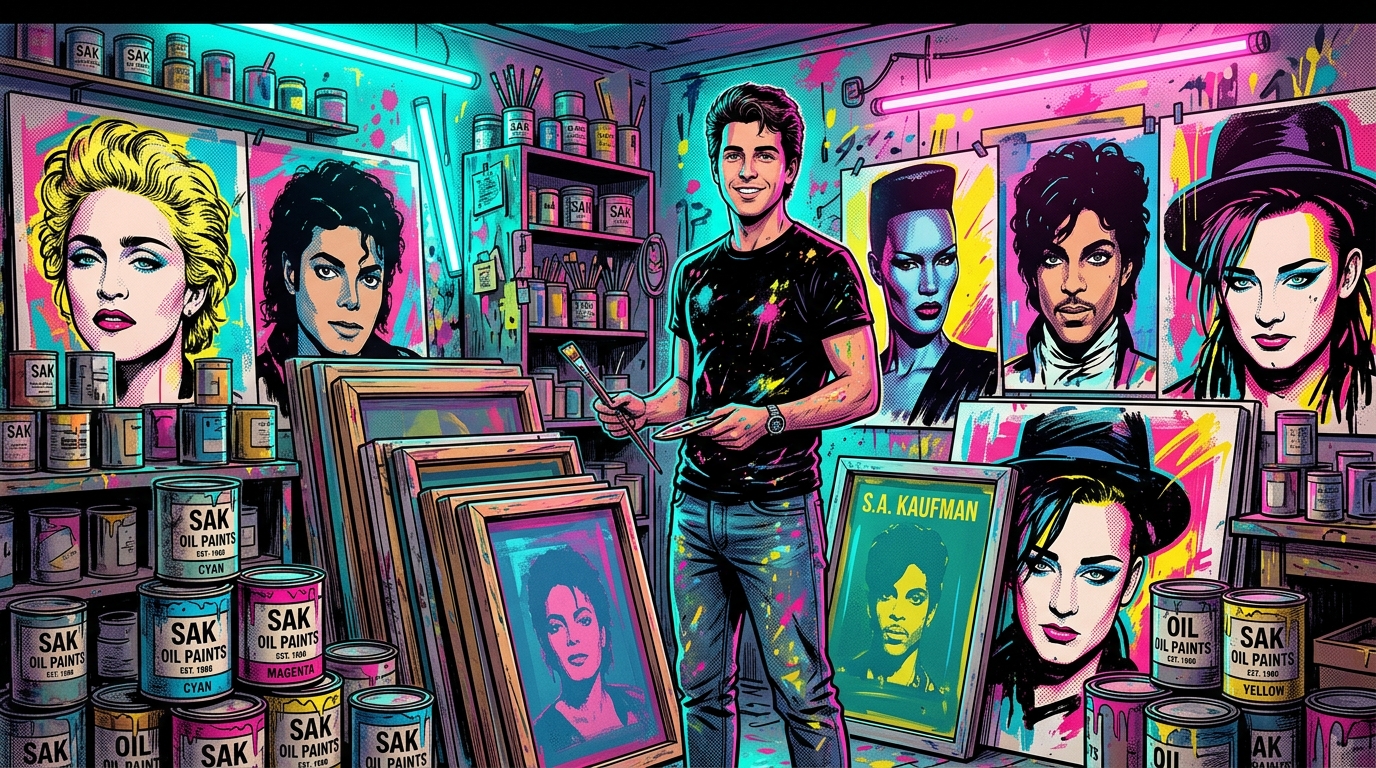
*Real SAK artwork was not used in the article to avoid copywrite infrengment laws.




Leave a Reply