Part III: A Spectrum of Magical Practice

6. Theurgy: The Pursuit of Divine Knowledge
At the highest end of the magical spectrum lies Theurgia. The Lemegeton provides a direct definition, stating that certain orders of spirits “are Good, and to be sought for by Divine seeking, etc., and are called THEURGIA.” It is a form of ceremonial magic focused on the elevation of the soul, the acquisition of divine knowledge, and communion with benevolent celestial intelligences. Its methods eschew coercion and command in favor of prayer, piety, and purification, seeking to make the operator a worthy vessel for divine grace and wisdom.
The quintessential example of a theurgical system is found in the Ars Notoria, or The Notory Art of Solomon. This text presents a complex method for acquiring the Liberal Arts and Theology not through conventional study but through the recitation of a series of long, intricate Orations. The entire framework is explicitly Christian, and its success is predicated on the operator’s devotion and faith. The Orations are prayers addressed to the “omnipotent and eternal God,” imploring Him to “illuminate and fill my Heart with the grace of thy Holy Spirit.” The goal is not worldly power but inspired knowledge, a gift bestowed by God upon the worthy supplicant. The text attributes this art to King Solomon, who, having received it, deemed it “wickedness to reveal them to unbelievers,” underscoring its sacred and exclusive nature.

A similar, though more compact, theurgical practice is detailed in the Ars Almadel, the fourth book of the Lemegeton. This operation centers on an “Almadel,” a square tablet of pure white wax inscribed with divine names. By using the Almadel on an appropriate day and with the correct fumigations, the operator can invoke the angels ruling one of the four “Altitudes,” or regions of the zodiac. The goals of this practice are explicitly constructive and non-malicious. For example, the angels of the First Altitude have the power “to make all things fruitful, and increase both animals and vegetables in creation and generation, advancing the birth of children, and making barren women fruitful.” The communication is humble and respectful, with the operator praying to the invoked Angel to enjoy and obtain all things “according to my wishes and desires,” so long as they are just and lawful.
The lofty spiritual and intellectual ambitions of Theurgia stand in stark contrast to the more tangible and worldly goals sought through the darker arts of Goetia.
7. Goetia: The Coercion of Infernal Spirits

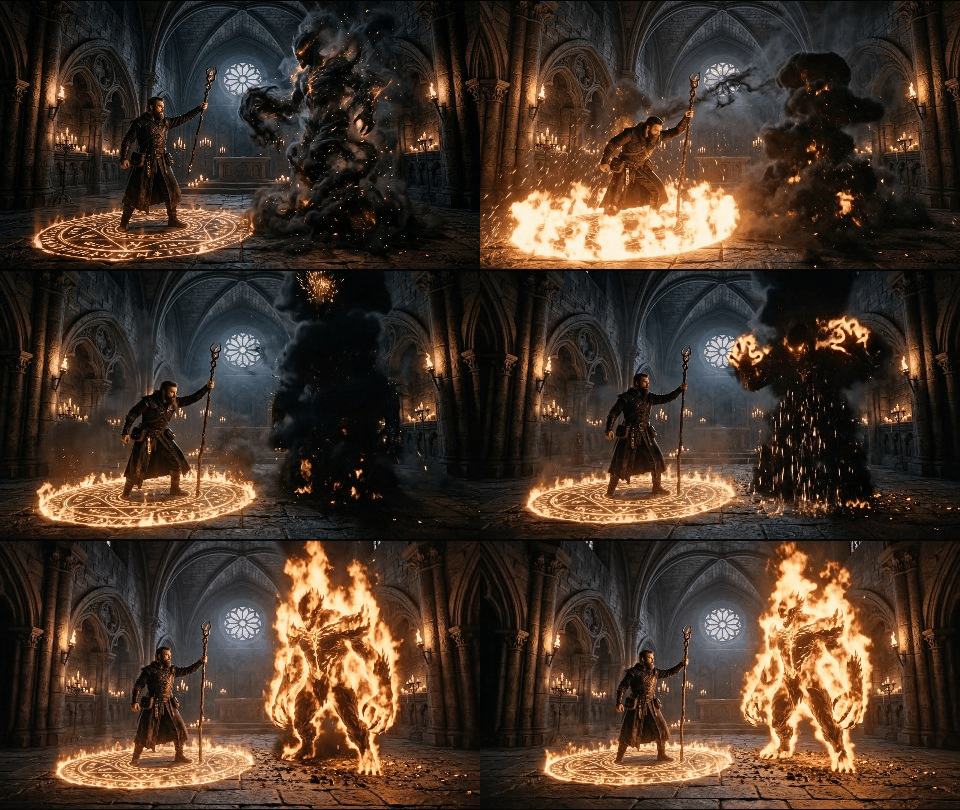
Where Theurgia seeks to elevate the soul through supplication to the divine, Goetia aims to satisfy worldly desires through the coercion of the infernal. The strategic purpose of Goetic magic, as presented in texts like the Lemegeton and the Grimoire of Honorius, is the art of binding and compelling preternatural, often demonic, spirits to perform services, provide knowledge, and deliver tangible results for the operator. This branch of magic operates not through reverence but through authority, using the power of divine names as weapons to force obedience from spirits of a lower order.

The most famous and systematic exposition of this art is the Lemegeton I, commonly known as the Goetia. This grimoire presents a highly organized infernal hierarchy of 72 spirits, complete with their names, ranks (Kings, Dukes, Marquises, etc.), seals, and specific offices. The services these spirits provide cover a vast range of human interests. For example, the spirit Barbatos “giveth understanding of the singing of Birds, and of the Voices of other creatures,” while Alloces teaches “the Art of Astronomy, and all the Liberal Sciences.” These spirits are not petitioned but commanded to appear through a series of increasingly forceful conjurations, bound by the operator who is protected within a magic circle.

The methods of coercion are even more explicit in texts like the Grimoire of Honorius. Its conjurations are exercises in spiritual dominance, wherein the operator invokes a spirit with uncompromising authority: “I call, invoke, exorcise, and conjure thee, by the virtue and power of the Creator…” The text employs a litany of sacred names and symbols as instruments of force, threatening the disobedient spirit with divine retribution. This framework positions the magician as an agent of divine power, using the authority of heaven to command the legions of hell for personal ends.

The practical applications offered in the Goetic grimoires are often starkly materialistic and amoral, as illustrated in the table below.
| Grimoire | Spirit Example | Stated Office / Power |
| Grimoirum Verum | Frimost | “has power over women and girls, and will help you to obtain their use.” |
| Grimoirum Verum | Mersilde | “has the power to transport anyone in an instant, anywhere.” |
| Lemegeton I (Goetia) | Camio (Caim) | “to give unto Men the Understanding of all Birds, Lowing of Bullocks, Barking of Dogs…” |
| Lemegeton I (Goetia) | Barbatos | “breaketh the Hidden Treasures open that have been laid by the Enchantments of Magicians.” |
This focus on binding spirits to service represents one of the darkest shades of magical practice, but the grimoiric tradition describes an even more direct and perilous form of transaction: the formal pact.
8. The Pact: A Transactional Framework

The magical pact represents the most explicit form of transactional magic, moving beyond the coercion of spirits for individual tasks to the establishment of a formal, binding contract. As detailed in The Grand Grimoire, this practice involves a ritualized negotiation between the operator and a powerful infernal entity, typically for the exchange of long-term services—most notably wealth and power. The pact is a strategic enterprise, a high-stakes bargain that requires meticulous preparation and unwavering resolve from the magician.
The Grand Grimoire lays out a complete, step-by-step process for making a pact with Lucifuge Rofocale, the “infernal Prime Minister who possesses the power that Lucifer gave him over all worldly riches and treasures.” The procedure is an elaborate ceremony grounded in blood, divine names, and contractual obligation.
- The Sacrifice: The process begins with the ritual sacrifice of a kid. Its skin is carefully removed to be prepared as the parchment for the pact. The rest of the body is put in the fire “until it is reduced to ashes, which you will gather and throw to the rising Sun.”
- The Tools: The operator must fashion a “fulminating rod” from a branch of hazel, capped with magnetized steel blades from the sacrificial knife “which will still be tainted with its blood.” This, along with the kidskin and other implements, is brought to the site of the operation, where a great “KABBALISTIC CIRCLE” is drawn for protection.
- The Conjuration: Standing within the circle, the operator performs the grand conjuration, directly addressing the spirit and demanding his appearance. The request is unambiguous: “I request that you abandon your dwelling… to come and speak with me… so that you make me rich as soon as possible.“
- The Agreement: Upon the spirit’s appearance, the operator states his demand and presents the pact, written on the prepared kidskin. While the source text is not explicit, pacts in this tradition are commonly understood to require blood, and the tools themselves are prepared with the blood of the sacrifice. The terms of the exchange are finalized, and the spirit agrees to serve the operator.
- The Dismissal: Once the agreement is made, the operator must safely dismiss the spirit. This involves a formal “Returning of the Spirit,” where the entity is permitted to retire peacefully. The ceremony concludes with a prayer of “Rendering Thanks.”
This structured process shows a belief system where relationships with powerful demonic entities are viewed as binding agreements. This transactional approach, combined with the controlling practices of Goetia and the spiritual focus of Theurgia, showcases the wide range of practices under one esoteric framework.
To wrap up your exploration of the grimoiric tradition, here is a comparative breakdown of these three distinct approaches to the supernatural.
The Spectrum of Esoteric Practice
The differences between these paths lie not just in their methods, but in the intent of the practitioner and the nature of the entities invoked.
| Feature | Theurgia | Goetia | The Pact |
| Primary Goal | Spiritual elevation & divine wisdom | Material gain & worldly services | Long-term wealth & absolute power |
| Entity Type | Angels & Celestial Intelligences | Demons & Infernal Spirits | High-ranking Infernal Ministers |
| Tone | Prayerful, pious, and submissive | Authoritative and coercive | Transactional and contractual |
| Key Mechanism | Purification and Divine Grace | Divine Names as weapons of command | Ritual sacrifice and signed agreement |
| Risk Level | Low (requires worthiness) | Moderate (requires strict protection) | High (requires “unwavering resolve”) |
Summary of the Magical Framework

This classification system demonstrates that the “spectrum” is defined by the direction of the practitioner’s will:
- Theurgia is a vertical ascent toward the light, seeking to improve the self.
- Goetia is a horizontal expansion of power, seeking to manipulate the environment.
- The Pact is a deep descent into a binding partnership, seeking to bypass natural limits through spiritual debt.
Together, these Part III sections illustrate that whether a practitioner sought the “Liberal Arts” through prayer or “hidden treasures” through a demon, they were operating within a highly structured, almost scientific view of the spirit world.
Ultimately, the spectrum of magical practice—from the celestial aspirations of Theurgia to the terrestrial demands of Goetia and the high-stakes bureaucracy of the Pact—reveals a complex human attempt to navigate the unseen. Whether through the humble purification of the soul to reach the divine or the calculated coercion of spirits to master the material world, these traditions share a common foundation: the belief that the universe operates according to hidden laws that can be understood, accessed, and influenced. By categorizing these practices, we see that the grimoiric tradition is not merely a collection of disparate spells, but a structured philosophical and pragmatic framework that seeks to bridge the gap between the finite reach of man and the infinite power of the supernatural.




Leave a Reply