In 1888, H.P. Blavatsky released a work that would forever alter the landscape of modern esotericism: The Secret Doctrine. Subtitled “The Synthesis of Science, Religion, and Philosophy,” these volumes claim to be more than just a book; they are presented as a fragment of the “accumulated Wisdom of the Ages,” verified by generations of seers.
Whether you view it as a masterwork of spiritual insight or a controversial “pseudoscientific” text, its influence is undeniable. To truly understand the “Secret Doctrine,” one must start where Blavatsky herself insisted: the Three Fundamental Propositions found in the Proem.
The Three Pillars of Reality
Blavatsky argued that clear apprehension of these three ideas is “absolutely necessary” before proceeding into the work’s deeper mysteries.
- The One Absolute Reality: The universe originates from an “Omnipresent, Eternal, Boundless, and Immutable Principle”. It is “Be-ness” (Sat) rather than Being, transcending all human thought and expression.
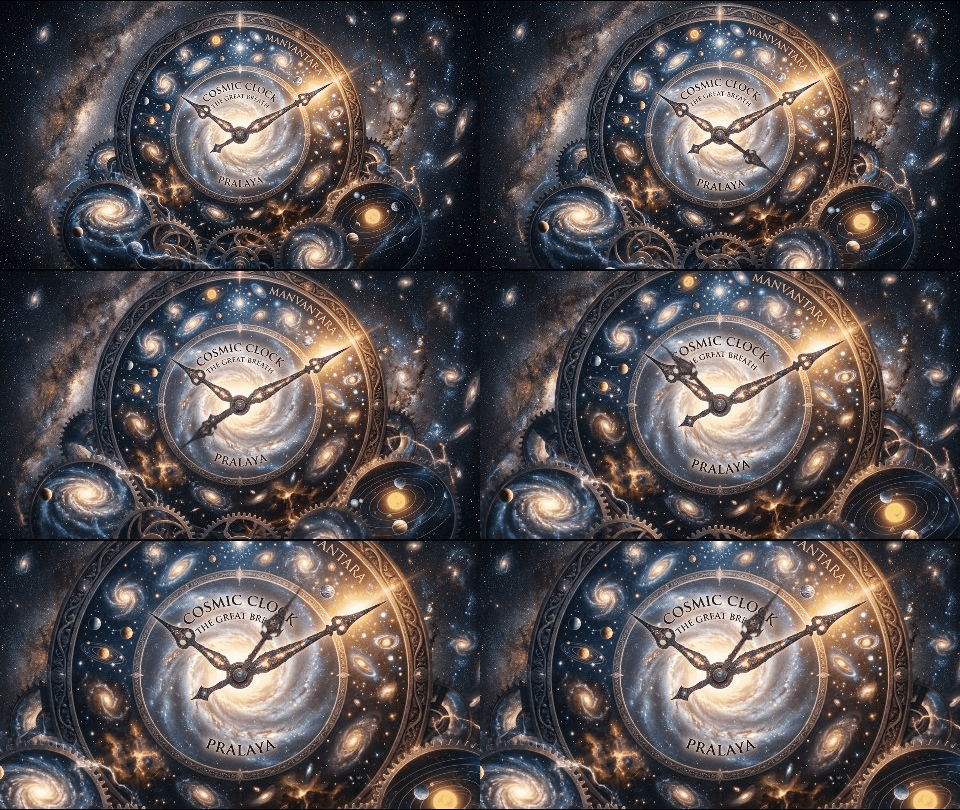
- The Law of Periodicity: The Universe is a boundless plane that acts as a “playground” for numberless universes. It follows an absolute law of flux and reflux—an eternal ebb and flow similar to the alternation of day and night or life and death.
- The Universal Pilgrimage: All souls are fundamentally identical to the “Universal Over-Soul”. Every soul (a “spark”) must undergo an obligatory pilgrimage through a cycle of incarnation, acquiring individuality through personal effort and merit over a long series of reincarnations.
Key Concepts for the Modern Student
To study this work is to engage in what Blavatsky called Jnana Yoga—the yoga of knowledge. Students are encouraged to hold fast to several core ideas while navigating the text:
- No Dead Matter: Every atom in the universe is fundamentally Absolute Being and is, in itself, a “life”.
- The Law of Correspondences: The famous Hermetic axiom “As above, so below” is central. The lower (microcosm) is a copy of the higher (macrocosm); therefore, everything manifested in the universe is worked from within outwards.
- The Microcosm: Man is the microcosm of the universe, meaning all the “Hierarchies of the Heavens” exist within the human being.
A “Triple Production”
The history of the book’s writing is as fascinating as its content. Blavatsky maintained that she did not write it alone. Letters from her teachers, the Mahatmas M. and K.H., describe the work as a “triple production”. They claimed to have dictated or suggested much of the material, correcting erroneous notions from Blavatsky’s earlier work, Isis Unveiled.
The Legacy and the Critics
Despite its status as a foundational theosophical text, The Secret Doctrine has faced significant scrutiny. Critics and skeptics have labeled it a “mass of plagiarism and fakery,” arguing that Blavatsky borrowed heavily from contemporary scientific and orientalist works without credit.
Regardless of these controversies, the work remains a monumental task for any reader. As one student noted after a two-year study, it encourages the seeker to find their own truth and use the writing not as dogma, but as a guide.
“There is no Religion higher than Truth.” — The Theosophical Motto
For those ready to walk the Inward Path, The Secret Doctrine offers a complex, challenging, and ultimately expansive view of our place in the cosmos.
To download the ebooks or check out some analysis, check out my post: Helena Blavatsky’s The Secret Doctrine – A Deep Analysis & PDFs




Leave a Reply