
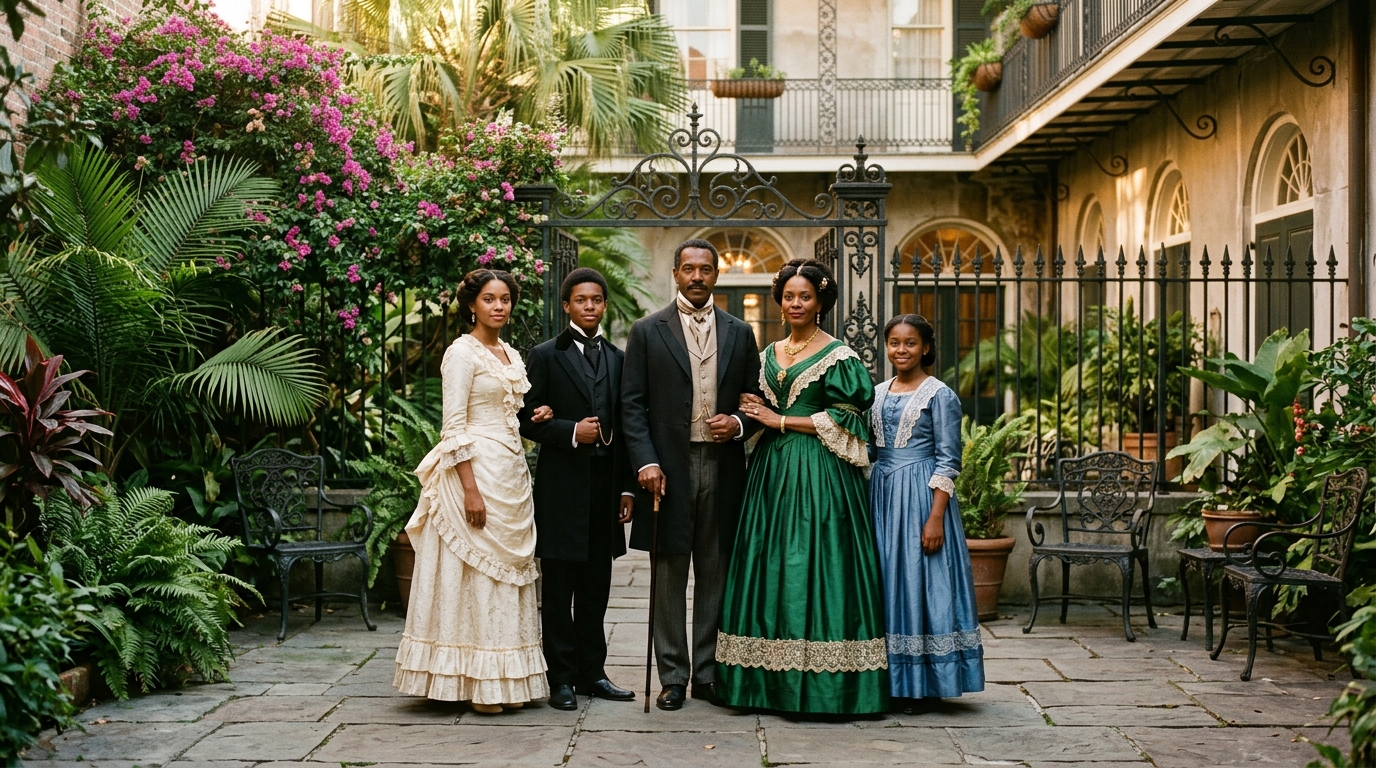
History often paints the pre-Civil War era in stark black and white—enslaved or enslaver. However, nestled within the complex social fabric of the Americas, and particularly within Louisiana, lived a significant group known as the Free People of Color (gens de couleur libres).
This community occupied a unique, often precarious “third space” in society, and for me, this isn’t just a history lesson—it is my personal heritage. Specifically, it is the story of my maternal grandmother’s lineage: the LaBranche family of New Orleans and the German Coast.
Who Were the Free People of Color?

The term “Free People of Color” typically refers to individuals of African or mixed African and European/Indigenous descent who were not enslaved. In Louisiana, this population was shaped by a unique blend of French, Spanish, and Caribbean influences. This community grew through several avenues:
- Manumission: Enslaved individuals who were granted freedom or purchased their own liberty.
- Birth: Children born to free mothers.
- The Creole Connection: In New Orleans, many free people of color were part of the “Creole” elite—a group with deep roots in Louisiana that maintained distinct cultural, linguistic, and professional identities.
The LaBranche Legacy on the German Coast

My own journey into this history leads directly to the German Coast (the Côte des Allemands), a region above New Orleans along the Mississippi River. This is where my ancestors, the LaBranche family, established their roots.
The story is one of fascinating transformation. Originally the Zweig family from Germany/Bavaria, they arrived in 1721 and Gallicized their name to LaBranche. While the broader family history includes prominent sugar planters and political figures like Alcée LaBranche and Alexandre LaBranche, the lineage also reflects the complex intersections of race and status in Louisiana.

As a descendant of the LaBranches, I see a lineage that spans from the early pioneers of the 1700s to a community of Free People of Color who navigated a world of “Black Codes” while simultaneously building homes, businesses, and a lasting cultural footprint in St. Charles Parish and New Orleans.
A Community of “Betweenness”

While they were free, my ancestors did not enjoy the same rights as white citizens. They navigated a world that restricted their movement and their right to vote. Yet, in the face of these barriers, they built thriving, sophisticated communities.
- Economic Impact: Many became successful artisans and property owners. The LaBranche Buildings in the French Quarter still stand today as a physical reminder of the family’s presence and architectural contribution to the city.
- Cultural Pioneers: They were the backbone of Louisiana’s unique culture, contributing to the arts, music, and the French-influenced traditions that define the region.
- Strategic Survival: They were highly resourceful, using their education and social standing to protect their families and maintain their freedom in an era that tried to deny it.
Why This Ancestry Matters

Discovering my connection to the LaBranche family has shifted my perspective on my own identity. To be a descendant of the Free People of Color is to inherit a legacy of intentionality. My ancestors weren’t just “free”; they were architects of their own destinies. They lived in the gray areas of history, proving that even in the most restrictive environments, the human spirit—and the quest for dignity—cannot be contained.
“Knowing where you come from is the first step in deciding where you are going. My ancestors’ lives are a testament to the fact that we have always been here, crafting our own stories against the backdrop of a changing world.”
Honoring the Past
By exploring the German Coast and the streets of New Orleans where the LaBranches once walked, I am reclaiming a piece of my own story. We honor these individuals not as a “middle class” of the past, but as a group who defied the binary of their time.
I stand on the shoulders of the Zweigs/LaBranches—people of grit, elegance, and endurance. Their legacy isn’t just in the archives; it’s in my blood.




Leave a Reply