
In the world of high-magic, a Grimoire is more than just a diary or a collection of spells. It is a textbook of instructions, a repository of data, and a guide for interacting with entities that exist outside our normal perception.
If we strip away the goatskin covers and the ink made of crushed herbs, we find something startlingly familiar to any IT professional or developer. A grimoire is, in every functional sense, an Operating System (OS) for the human consciousness and the “ether” it inhabits.
1. Syntax is Everything: The Code of Command

In programming, a single missing semicolon can crash an entire enterprise application. In the Ars Goetia (Lesser Key of Solomon I) or the Papyri Graecae Magicae (PGM), the same rules apply. The rituals are written in a specific syntax:
- The Command Line: Just as you type
sudo apt-get installto grant yourself “superuser” privileges, the practitioner uses “Names of Power” to establish authority over a process. - The Script: A ritual is a sequential script. If Step B is executed before Step A, the “program” (the ritual) fails to compile.
- Logical Operators: “If I burn this incense, then the spirit must manifest.” This is the foundational
if/thenlogic that governs both a Python script and a Solomonic invocation.
2. Spirits as Background Processes (Daemons)

In Unix-based operating systems (like macOS or Linux), a daemon is a background process that handles requests without the user’s direct intervention. They manage print jobs, network connections, and system logs.
In the occult, we call upon entities to perform specific tasks: Bune for wealth, Marbas for healing, or Paimon for knowledge.
- Background Tasks: Once “summoned” (initialized), these entities are expected to work in the background of the practitioner’s life to produce a tangible result in the physical world.
- Resource Allocation: Just as a daemon requires CPU and RAM, a summoned spirit requires “offerings” or focused attention (energy) to stay active in your reality.
3. The User Interface: Circles and Sigils

A Graphical User Interface (GUI) translates complex binary code into icons we can understand. You don’t need to understand the machine code of a “Delete” button; you just need to know what the icon represents.
- The Magic Circle: This is your Sandbox Environment. It is a secure partition of space that prevents the “program” (the entity) from accessing the rest of your “hard drive” (your life/sanity).
- Sigils: A sigil is a compressed Icon. It is a visual shortcut that represents a massive amount of data and intent. When you “click” (meditate) on a sigil, you are executing the underlying code associated with that entity.
4. Version Control: The Evolution of the Grimoire

Just as Windows has moved from 3.1 to 11, grimoires have undergone Version Control.
- Legacy Systems: The ancient Egyptian and Babylonian texts were the “Assembly Language”—difficult to learn, hardware-specific, but incredibly powerful.
- The Renaissance Update: The 16th and 17th-century grimoires acted as “Middle-ware,” translating ancient concepts into a more usable framework for the scholars of the time.
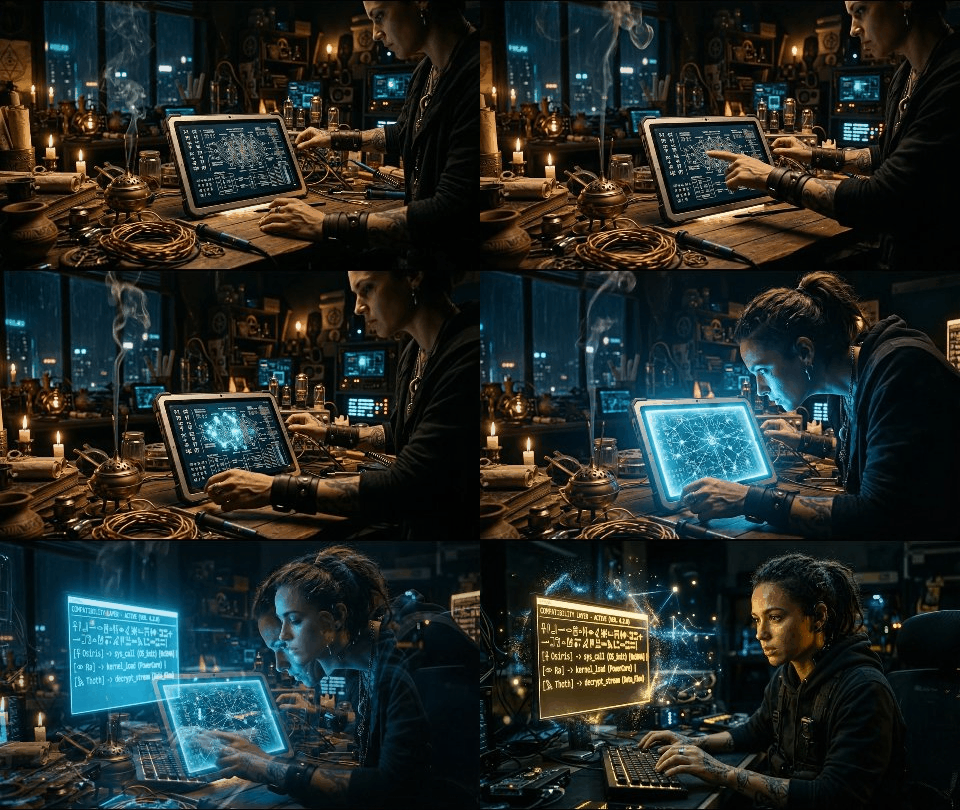
- The Digital Patch: Today, we are seeing the rise of Technomancy. We are moving the OS from paper to silicon, using AI and digital sigils to run the same ancient logic on modern hardware.
Why This Matters for Modern Management

When we view a grimoire as an OS, we stop seeing magic as “superstition” and start seeing it as System Administration.
As we transition into an era of Agentic AI—where we interact with autonomous digital entities daily—the lessons of the grimoire become invaluable. We are learning how to give precise instructions to “spirits” (LLMs) that exist in a “digital ether” (the latent space).
The prompt engineers of today are the grimoire authors of tomorrow. We are all learning to code the unseen.
Nicole’s Tip: The next time your software glitches, don’t just look for a bug. Consider if your “syntax” was clear enough for the daemon to understand. Are you running an outdated version of your own mental OS?




Leave a Reply