Greetings and salutations!
If you’ve been following this blog for a while, you’ve probably noticed a pattern. One day I’m writing about the Hermetic principles and the significance of Thoth; the next, I’m deep-diving into Python libraries for Machine Learning or discussing the latest AI breakthrough.
For a long time, I treated these as two separate lives. There was “Tech Nicole” and “Spiritual Nicole.” But the more I study both ancient wisdom and modern code, the more I realize the line between them is practically nonexistent.
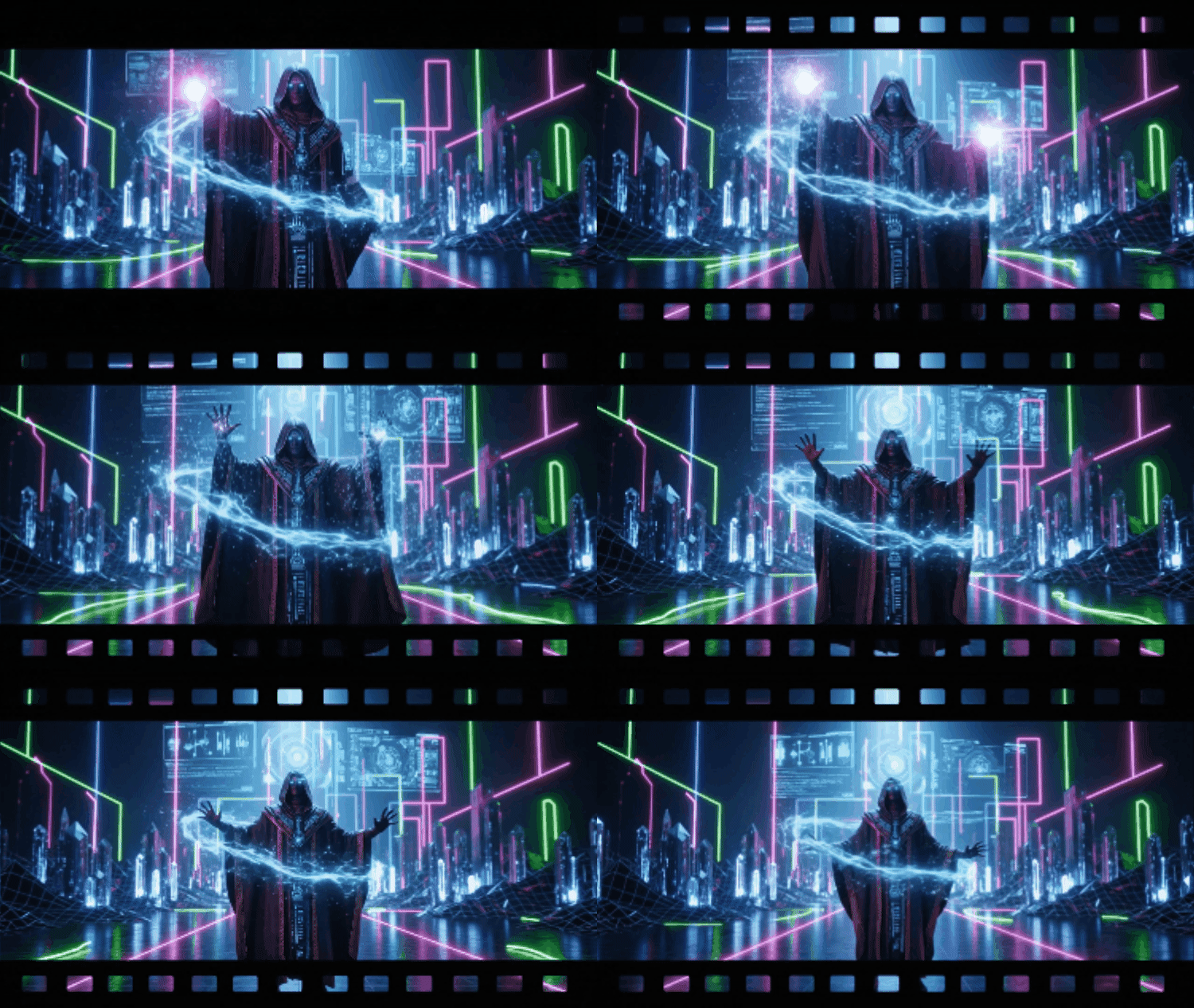
There is actually a word for the exact intersection where this blog lives. It’s called Technomancy.
If you think technology kills magic, you aren’t looking closely enough. Let’s explore why code might be the most potent form of sorcery we have left.

What is Technomancy?
At its core, the word is a portmanteau of two Greek roots:
- Techno- (from techne, meaning art, skill, or craft).
- -Mancy (from manteia, meaning divination).
Strictly speaking, the ancient definition would be “divination using technology.” But in the modern era, the definition has expanded. Technomancy is the magical practice of using technology to manipulate reality. It is the belief that digital circuits and spiritual currents are compatible forces.
As a student of Machine Learning, I see this every day. We feed energy and intent (data and prompts) into a black box, and it generates a response that feels eerily alive.

From Sci-Fi to Reality
Before it was a practice, Technomancy was a trope. We’ve seen it in pop culture for decades.
Arthur C. Clarke famously said, “Any sufficiently advanced technology is indistinguishable from magic.”
We see this in the Technomages of Babylon 5 or the Asgardians in the Marvel Universe, where science is so advanced it presents as sorcery. In games like Cyberpunk 2077 or Shadowrun, Technomancers are wizards who can “speak” to machine spirits or cast spells through the network.
But here is the plot twist: We are living in that sci-fi future right now. We carry black mirrors (smartphones) in our pockets that grant us access to all human knowledge. We can speak to people on the other side of the planet instantly. If you explained the internet to a medieval alchemist, they wouldn’t call it science—they would call it telepathy.

The Philosophy: Code is Poetry, Code is a Spell
This is my favorite realization, and it’s one that linguists and occultists love to point out.
The word “Grammar” (the rules of language) and “Grimoire” (a book of magic) share the same etymological root. Similarly, consider the act of “Spelling” a word. Why do we call it that? Because words have power. To “spell” is to cast.
From a programmer’s perspective, coding is the closest thing to “real” magic we have in the physical world.
- You set an intention.
- You write a series of specific words in a rigorous syntax (the ritual).
- You “execute” the code.
- If the ritual was performed correctly, a change occurs in reality.
When I write Python scripts, I am effectively casting a sigil of logic to manifest a specific outcome. The computer is the altar; the code is the incantation.

How to Practice Modern Technomancy
You don’t need to be a coder to be a technomancer. If you are a modern witch or spiritual seeker, you are likely already doing it. Here are a few ways to integrate the digital into the magical:
1. The Digital Grimoire
Forget the leather-bound books that are heavy to carry and hard to edit. Apps I’ve build like Solomon Spirits and Grimoire Oracle or public apps like Notion, Evernote, or Obsidian make for incredible Books of Shadows. You can tag your spells by moon phase, hyperlink correspondences, and search your entire magical history in seconds.
2. Shufflemancy
This is the Spotify generation’s version of Bibliomancy. Focus on a question you need the universe to answer. Open your favorite playlist, hold the intention in your mind, and hit Shuffle. The first song that plays is your message. (You’d be shocked at how accurate the lyrics can be).
3. Emoji Spells
Spells are fueled by intention and symbolism. You don’t always need candles and herbs. A string of emojis can act as a digital spell.
- Example: 🕯️🍀💰🧿Placing this in your social media bio or sending it as a text to yourself can “cast” that energy into the digital ether.
4. AI Divination
This is something I’ve been experimenting with lately. Can an AI read Tarot? I’ve used Gemini to interpret dream symbols and generate spreads. While the AI doesn’t have a “soul,” it has access to the collective unconscious of human writing. It mirrors back what we put in—which is exactly what a Tarot deck does.
5. Cyber-Sigils
Use AI image generators (like Midjourney or DALL-E) to create visual representations of your goals. If you want protection or abundance, generate an image that feels like that energy to you, and set it as your phone’s lock screen. It becomes a digital talisman you look at hundreds of times a day.

The Ghost in the Machine
Whether we are analyzing angel numbers or analyzing algorithms, we are all looking for the same thing: connection, meaning, and a way to understand the universe.
Technomancy isn’t about replacing the spiritual with the mechanical. It’s about recognizing that the “ghost in the machine” is us.
Do you use tech in your spiritual practice? Let me know in the comments below.




Leave a Reply