
Stoicism is celebrated not just for its practical, rational, and ethical teachings. These teachings embody its vibrant exoteric, or public, side. It is a powerful philosophy that delves deep into a complex physical and metaphysical framework. This intricate structure carries a profound esoteric or inner significance. It resonates deeply with those who seek wisdom and enlightenment. It especially inspires later mystical and occult philosophies.
The esoteric significance of Stoicism doesn’t come from secret initiation rituals. Instead, it comes from its core concepts of the Logos, Pneuma, and Sympatheia. These concepts describe a universe that is a single, living, divine being.
Here’s a breakdown of its esoteric side.

1. The Logos: The Universe is a Single, Divine Mind
To the Stoics, the universe wasn’t a random collection of matter. It was a single, rational, and conscious entity, which they called the Logos (literally “Reason” or “Word”).
- Esoteric Meaning: The Logos is essentially God, but not a god who is separate from the universe. Rather, the Logos is the divine mind or “operating system” that permeates, organizes, and directs all of an_nature. Everything that happens is a direct expression of this universal, providential reason. This includes phenomena from the orbit of a planet to a leaf falling.
- Your Soul is a Fragment of God: The Stoics believed that the human soul is a literal fragment of the divine Logos. They thought it is a physical fragment. It is part of the divine Logos. They maintained that your capacity for reason is a spark of the same divine fire. This fire governs the cosmos. The esoteric goal of Stoicism is not merely to be “calm.” It is to align your personal, fragmented reason with the universal Reason of the Logos. The aim is to essentially “think like God.” In doing so, you achieve a state of harmony with all of existence.

2. Pneuma: The “Breath of Life”
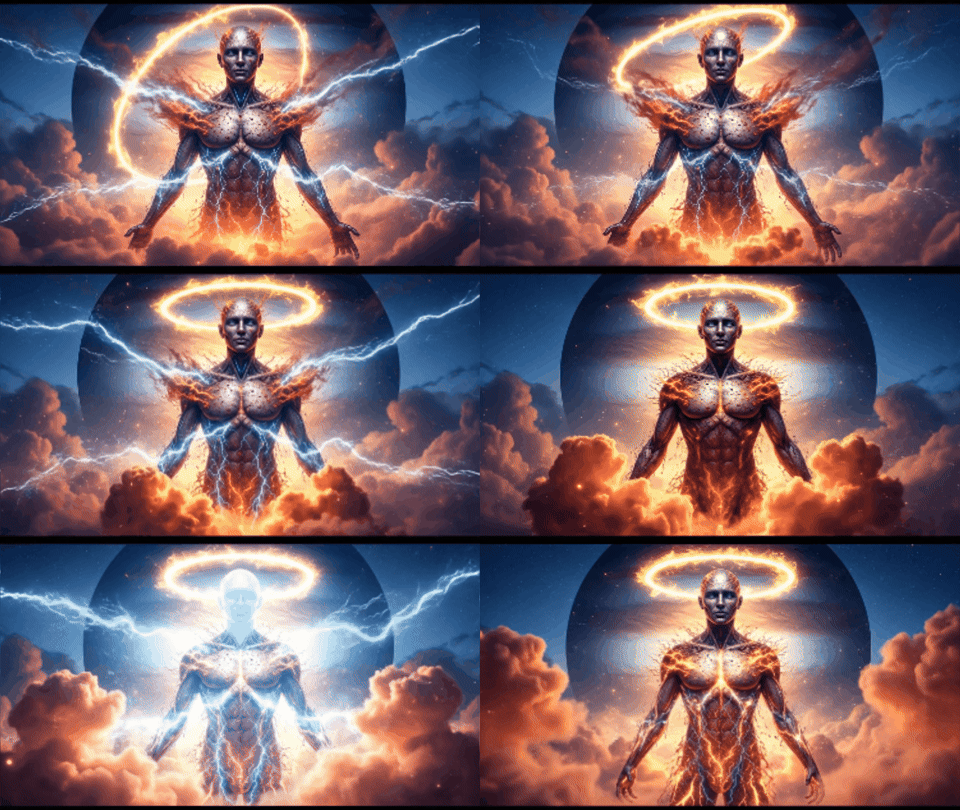
If the Logos is the mind of God, Pneuma is its body. The Stoics were materialists and believed this divine force was a physical substance.
- Esoteric Meaning: Pneuma (Greek for “breath” or “spirit”) was described as a subtle, fiery, intelligent “air” that flows through everything. It’s the force that gives cohesion to a stone, life to a plant, and a soul (psychê) to an animal.
- The “Tension” of Reality: The Stoics believed this pneuma creates tonos (tension), which holds the universe together. This concept directly feeds into later esoteric ideas of “vital force,” “ether,” or the “spirit” that animates all things.

3. Sympatheia: The Universe is Magically Connected
This is perhaps the most significant esoteric contribution of Stoicism. Because the entire universe is one living being (the Logos) connected by one substance (Pneuma), everything is interconnected.
- Esoteric Meaning: The Stoics called this Sympatheia (“sympathy” or “fellow-feeling”). They believed that what happens in one part of the cosmos affects every other part, just as a tug on a spider’s web vibrates the entire web.
- The Basis for Magic and Divination: This idea became the foundational principle for nearly all of Western esotericism. Why does an astrological chart work? Because of the sympatheia between the planets (macrocosm) and the individual (microcosm). Why does a magic ritual use specific herbs or sigils? To create a sympathetic resonance with a desired force. The ancient Stoics themselves believed in divination, seeing it as a rational and natural product of this cosmic sympathy.

4. Allegoresis: The Hidden Meanings in Myths
The Stoics didn’t dismiss the myths of the Greek gods as simple stories. Instead, they practiced allegoresis, or the art of finding hidden, philosophical meanings in them.
- Esoteric Meaning: They taught that myths were not literally true. Instead, myths were allegorical “veils” hiding deeper truths about the Logos, physics, and ethics. For example, they might interpret Zeus as the Logos and Hera as the material element of air. This practice of “reading between the lines” refers to finding a secret teaching. It is a hallmark of esoteric and mystical traditions. These include practices from Gnosticism to Kabbalah.
In summary, while the ethics of Stoicism are about rational self-control, the physics of Stoicism are deeply esoteric. They describe a magical, living, and interconnected universe. This ‘inner’ teaching became a cornerstone for many occult, Hermetic, and alchemical traditions that followed.
For a deeper dive into this, you might find this overview of the Stoic origins of Western occultism helpful.




Leave a Reply