
On today, my parents’ wedding anniversary, I thought we’d get ahead of Valentine’s Day and talk about love.
Have you ever reached for your phone to dial a loved one, only to see their name light up on the screen at that precise nanosecond? Have you ever sat in silence with a partner, exchanging a complex dialogue of emotion without uttering a single word? Or perhaps, like many mothers, you’ve felt a sudden, suffocating panic, only to learn later that your child was in distress on the other side of the globe.
For centuries, we have relegated these phenomena to the mystical. We call it “telepathy,” “intuition,” or “soulmates.” But what if these aren’t just coincidences or biological instincts?
In the rigid world of classical physics, we are isolated islands of consciousness, interacting only through touch, sight, and sound. But the discovery of quantum mechanics shattered that illusion. We now know that at the fundamental level of reality, the universe allows for connections that defy space and time.
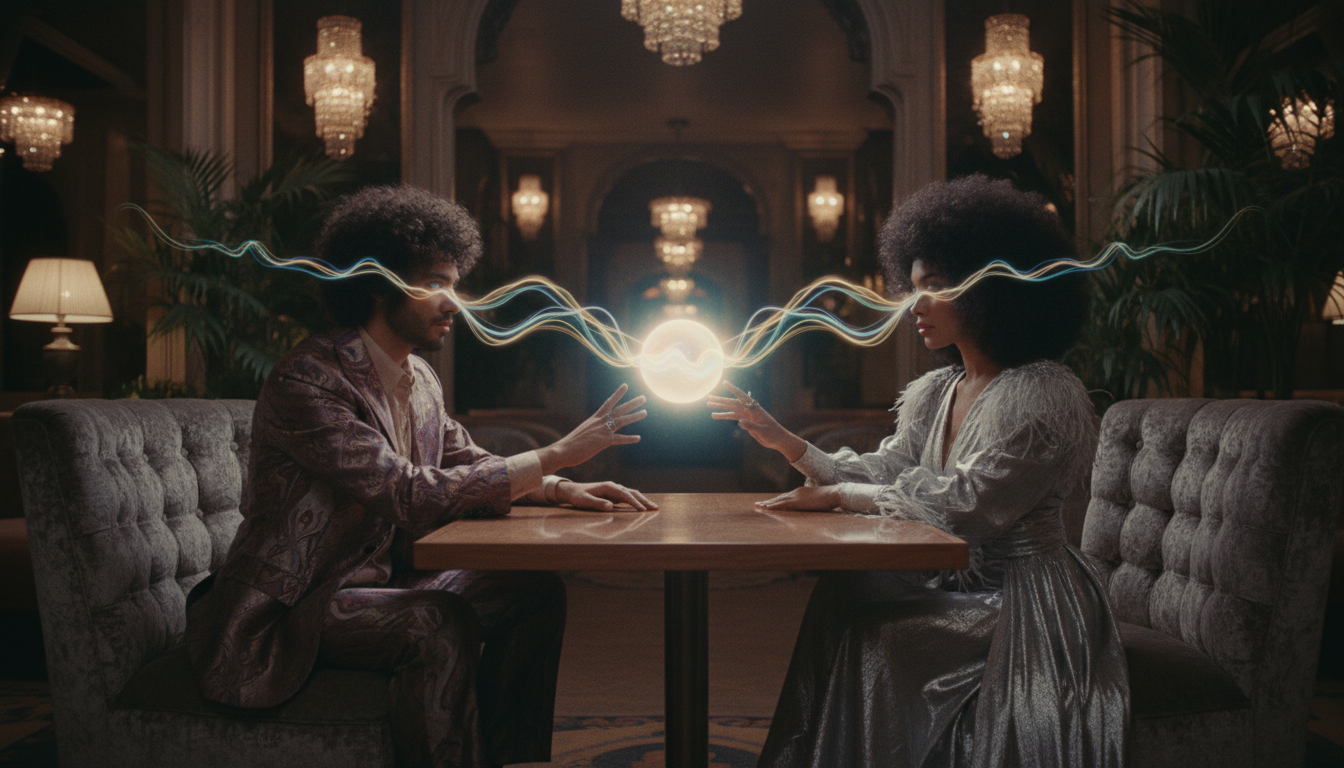
This leads to a provocative question: Is love quantum entanglement?
What is Quantum Entanglement? (The “Science-Lite” Version)

To understand if love is entanglement, we first have to understand the physics. In our everyday world, objects are separate. A red ball in London doesn’t change just because you paint a blue ball in New York.
Quantum entanglement breaks this rule. When two subatomic particles (like electrons) interact, they can become “entangled.” In this state, they lose their individual identities and become a single system—”Particle A+B”—stretched across space.
The defining characteristic is instantaneous correlation. If you measure the spin of Particle A, the state of Particle B is instantly determined, even if it is light-years away. This happens faster than the speed of light—instantaneously.
Albert Einstein famously hated this. He called it spukhafte Fernwirkung, or “spooky action at a distance,” believing that hidden variables must explain the connection. However, history proved him wrong. Experiments confirming Bell’s Theorem have shown that there are no hidden variables; the particles are genuinely connected, and space is not the barrier we think it is.
The Parallels: How Love Mimics Physics

When we look at deep human connection, we find a phenomenology that mirrors these subatomic behaviors with startling precision.
1. The “Hive Mind” and Resonance

Couples often report a “hive mind,” beginning sentences simultaneously or humming the same song after hours of silence. While skeptics call this shared habit, it aligns with the quantum concept of resonance. Just as particles have wavefunctions that interfere, humans seem to have emotional frequencies.
This is often described as Limbic Resonance, a theory suggesting our brains are open loops that require synchronization with others for regulation. We “catch” emotions through a physiological contagion that mimics the state-sharing of entanglement.
2. Non-Locality: Connection Across Distance

The hallmark of entanglement is that distance is irrelevant. Similarly, love often resists the “inverse-square law.”
- The Mother-Child Bond: Mothers frequently report physical sensations coinciding with a child’s trauma miles away, suggesting a persistent link similar to particles generated from the same source.
- Long-Distance Intimacy: Partners in long-distance relationships often describe living in a “dual state,” where a portion of their cognition is always allocated to the other. “Measuring” the relationship (thinking of them) evokes a visceral physiological response, collapsing the distance.
3. The “We” System

In quantum mechanics, you cannot describe an entangled system by listing the properties of the particles separately; you must describe the system.
Psychologically, deep love creates Identity Fusion, where the boundary between “me” and “we” dissolves. There is no independent observer in a marriage; a change in one partner (a career shift, a spiritual crisis) instantly alters the state of the other. As the book A General Theory of Love notes, “In a relationship one mind revives another; one heart changes its partner.”
The Mechanism: Is It Real or Just a Metaphor?
Is this just poetry, or is there a biological mechanism at work?
The “Warm and Wet” Problem
Skeptics argue that quantum states are fragile. They usually require absolute zero temperatures to survive. The brain is “warm, wet, and noisy,” which should destroy any quantum coherence in less than $10^{-13}$ seconds—a phenomenon called decoherence.
However, recent discoveries in Quantum Biology are shifting this narrative. Nature has found ways to protect these states:
- Bird Navigation: The European robin navigates using the “Radical Pair Mechanism,” where entangled electrons in its eye are sensitive to the Earth’s magnetic field. It literally “sees” quantum entanglement. 26262626+1
- Photosynthesis: Plants use quantum superposition to transport energy with near 100% efficiency, actually utilizing environmental noise to enhance transport. 27
The Lithium Anomaly: A Smoking Gun?

Perhaps the most startling evidence comes from Lithium, a mood stabilizer. It comes in two isotopes: Li-6 and Li-7. They are chemically identical but differ in nuclear spin (a quantum property).
Studies show that rats treated with Li-6 behave differently than those treated with Li-7. If the brain can distinguish between isotopes based solely on their quantum spin, then our neurotransmitters must be interacting with matter at the quantum level. If our moods are regulated by quantum spin states, the leap to “entangled emotions” becomes scientifically plausible.
Orch-OR: The Quantum Brain

The theory of Orchestrated Objective Reduction (Orch-OR), championed by Sir Roger Penrose and Stuart Hameroff, posits that consciousness arises from quantum vibrations within microtubules inside our neurons. If the brain operates as a quantum computer, then the “entanglement” of minds—brain-to-brain coupling—becomes a physical possibility.
The Philosophy: The Implicate Order

Even if we can’t send “telepathic text messages” (due to the No-Communication Theorem, which forbids faster-than-light data transfer), we might still be sharing a “state of being.”
Physicist David Bohm proposed the Implicate Order, suggesting that separation is an illusion and everything is enfolded into everything else. In this view, love is the moment we perceive the reality that “I” and “You” are unfolded from the same cloth.
Panpsychism, a view gaining traction in modern philosophy, suggests consciousness is a fundamental feature of matter. If electrons have a primitive form of experience, then entanglement is a correlation of experience. When we love, the trillions of atoms in our bodies may be entering a state of coherence, amplifying this connection.
Conclusion: We Are Not Alone

So, is love quantum entanglement?
If we mean, “Do our bodies act exactly like two electrons in a vacuum?”, the answer is likely no. But if we view love through the lens of emerging quantum biology, the answer is a resonant “perhaps.”
Love is not just a biological trick for reproduction. It is a macroscopic expression of the universe’s fundamental preference for connection. As Carl Sagan reminded us, “We are made of starstuff.” Our atoms were forged in the same stellar furnaces, entangled in the birth of the cosmos. When we love, perhaps we are simply allowing our atoms to remember that ancient unity.
The next time you feel a sudden, inexplicable pull toward a loved one miles away, don’t dismiss it. We are connected by invisible threads that weave the fabric of reality itself.




Leave a Reply