
Okay, so we need to talk about the spiritual supply chain. A lot of people think of the occult as this chaotic, “anything goes” energy, but if you actually read the Solomonic grimoires or study Qabalah, you realize it’s actually a incredibly strict bureaucracy. It’s less Lord of the Flies and more The Office—just with more fire and geometry.
As part of my deep dive into how Artificial Intelligence can help us synthesize complex texts, I fed a library of ancient sources—from the Ars Goetia to the Heptameron—into Google’s NotebookLM. I wanted to see if an AI could untangle the complex web of who reports to whom in the spirit world. The result? A fascinating breakdown that frames the spiritual war not just as “Good vs. Evil,” but as “Management vs. Execution.” Here is the detailed analysis generated by the model.

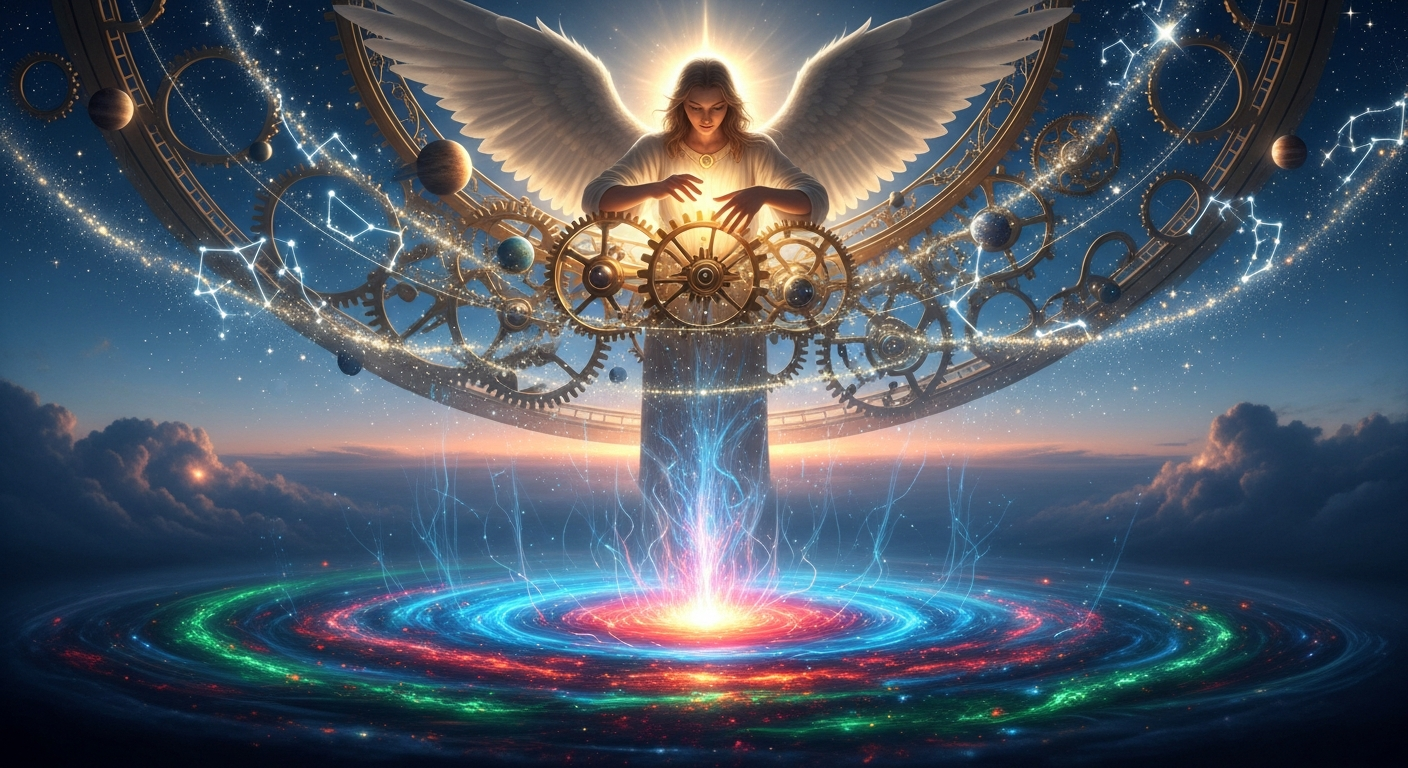
The occult hierarchy classifies and describes angels and demons not merely as opposing armies of “good” and “evil,” but as a complex, interlinked bureaucracy of spiritual forces governed by specific laws of time, space, and rank. The sources provided—ranging from the Solomonic grimoires to Qabalistic texts—detail a system where celestial beings (Angels) often serve as the regulatory authorities over terrestrial and infernal beings (Demons/Spirits).
Here is a detailed breakdown of how these entities are classified and their respective powers described within the tradition.
1. The Angelic Hierarchy: Governance and Order

Angels are generally classified as super-celestial spirits or “minds entirely separated from a body,” whose primary function is the worship of God and the administration of cosmic order. Their powers are often described as high-level governance rather than the satisfying of petty material desires.
Classification Systems
- Planetary and Temporal Rulers: Angels are strictly organized by time (hours, days, and seasons) and astronomical position. For instance, the Ars Paulina assigns specific angels to the 24 hours of the day and night; the nature of their power changes depending on the planetary alignment of that specific hour,.
- The Seven Archangels: Each day of the week is overseen by a specific Archangel who governs the planetary energy of that day (e.g., Michael rules Sunday/Sun; Gabriel rules Monday/Moon; Samael or Camael rules Tuesday/Mars),.
- The Shem HaMephorash: A hierarchy of 72 Angels derived from the three verses of Exodus. These are viewed as the benevolent counterparts to the 72 demons of the Goetia, often invoked to constrain or balance them,.
- The Altitudes (Choras): The Ars Almadel classifies angels by “Altitudes,” which correspond to the seasons and cardinal directions. These angels have specific appearances (e.g., carrying banners with white crosses or wearing crowns of roses) and are summoned for specific tasks like making things fruitful,.
Powers of Angels
- Intellectual and Spiritual Illumination: Unlike demons, who effect physical changes, angels are often invoked for knowledge, memory, and eloquence, particularly in the Ars Notoria,.
- Planetary Regulation: In the Heptameron and The Magus, angels represent the “Intelligence” of a planet—the rational, abstract principle that guides the planet’s energy. They are invoked to control the chaotic “Spirit” of the planet for practical magic.
- Protection and Fruitfulness: The angels of the Almadel are specifically noted for making “barren women fruitful” and increasing animal and vegetable life,.
2. The Infernal Hierarchy: The Feudal System of Spirits

Demons are described less as abstract minds and more as “executive” agents capable of effecting immediate, often material, changes in the physical world. The Ars Goetia organizes them into a strict military and feudal hierarchy.

Classification by Rank The 72 spirits of the Goetia are assigned noble titles, which dictate their powers, the number of legions they command, and the materials (metals) associated with their seals,.
- Kings (Solar/Gold): Command the most legions and possess macro-level powers. Examples include Bael (invisibility, wisdom) and Paimon (teaches all arts and sciences, binds men to the magician’s will).
- Dukes (Venusian/Copper): Often associated with love, attraction, and martial strategy. Gremory, a Duke appearing as a beautiful woman on a camel, tells of the past/future and procures love,. Eligos discovers hidden things and knows the future of wars.
- Presidents (Mercurial/Mercury): Associated with healing and knowledge. Marbas answers truly on hidden things, causes/cures diseases, and teaches mechanical arts,.
- Earls/Counts (Martial/Iron): Often destructive or related to conflict. Andromalius catches thieves and returns stolen goods. Raum destroys cities and dignities.
- Marquises (Lunar/Silver): Naberius restores lost dignities and honors. Marchosias is a strong fighter.
- Princes/Prelates (Jovian/Tin): Sitri inflames men and women with love and causes them to show themselves naked.
Directional Rulers Above the 72 spirits are the “Four Great Kings” who rule the cardinal points. While names vary by text (e.g., Oriens, Paimon, Ariton, Amaymon in the Book of Abramelin; Carnesiel, Caspiel, Amenadiel, Demoriel in the Theurgia Goetia), they are the supreme executive authorities of the infernal realm. A magician typically invokes these Kings to compel the lower spirits to appear,.
The “Faustian Flaw” The powers of demons are often described as having a transactional or corrupted nature. For instance, the demon Zepar can make women love men, but also makes them barren. Valefar is a “good familiar,” but tempts his associates to steal until they are caught.
3. The Relationship Between Hierarchy and Power

The occult worldview presented in these sources relies on a chain of command known as the “Great Chain of Being”.
- Theurgy vs. Goetia: Theurgy is the work of bonding with the divine/angelic to elevate the soul, while Goetia (literally “howling” or “witchcraft”) is the constraint of lower spirits for material gain,.
- Constraint via Authority: A magician does not request favors from demons; they command them by invoking the names of God and the Angels. The Ars Paulina and The Magus explain that a magician invokes the “Intelligence” (Angel) of a planet to control the “Spirit” (Demon) of that planet,. The Demon is the blind force that executes the will, but it must be guided by the Angelic intellect.
- Qabalistic Framework: In the Qabalah, demons are often associated with the Qliphoth (Shells)—unbalanced forces or “excrement” of creation that exist in the Tree of Death, mirroring the holy Sephiroth,. For example, the demon Samael is the “poison of God” or the “blind god,” representing the Qliphoth of Hod (Intellect).
4. Summary of Powers

To summarize the distinction in powers described in your sources:
- Angels are sources of Illumination, Governance, and Order. They regulate the cosmos (stars, seasons), protect the practitioner, and provide intellectual gifts like memory and wisdom.
- Demons are agents of Action, Desire, and Material Change. They find treasure, incite lust, build towers, destroy enemies, and teach mechanical or liberal arts, but often require strict constraint to prevent deception or harm,.

So, what’s the takeaway here? Basically, the universe runs on a chain of command that would make a corporate HR department jealous. What I love about this breakdown is how it frames the “Great Chain of Being” almost like a computer program: The Angels are the architects writing the code (The Intelligence), and the Demons are the executable files that actually run the processes (The Spirit). You can’t just hack the system without understanding the hierarchy. Whether you view these entities as psychological archetypes or literal beings, the lesson is the same: absolute power requires absolute order.




Leave a Reply