
In the mesmerizing expanse of ceremonial magic and esoteric writings, the universe is not a desolate void. Instead, it is a vibrant tapestry. This tapestry is intricately woven with a dazzling hierarchy of spiritual beings. Foundational grimoires, from the Lemegeton to The Magus, passionately delineate this cosmic order. They illuminate the intense struggle between the realms of light and darkness. The benevolent Angels (or good spirits) valiantly stand against the formidable Demons (or evil spirits). Their eternal conflict charges the very fabric of existence.
These systems create a compelling duality. They demonstrate that spiritual power surges through distinct hierarchies. One hierarchy is heavenly and divinely ordained. The other is fiercely infernal and defiantly rebellious.
The Angels: Ministers of Divine Authority

Angels represent the highest order of spiritual beings in the grimoire tradition. They are often described as super-celestial minds entirely separated from a body. Their primary purpose is to worship God. People seek communication with these benevolent entities through “Divine seeking.” This practice is known as Theurgia, a form of high magic focused on achieving unity with the divine.
Roles and Hierarchy
Angels serve as crucial conduits between the divine and the mortal world:
- Divine Messengers: They are capable of revealing sacred knowledge and divine secrets directly from the Most High Creator. The Ars Nova, for instance, was revealed to King Solomon by the angel Michael.
- Rulers of Time and Space: The angelic hierarchy is deeply integrated with the cosmos, with specific angels governing the hours of the day and night, as well as the twelve signs of the Zodiac.
- Michael, Dardiel, and Huratapel rule Sunday, associated with the Sun.
- Gabriel, Michael, and Samael rule Monday, associated with the Moon.
- Planetary and Elemental Governors: Angels are appointed to govern the fundamental forces of nature. For example, Cherub rules the Air, Tharsis rules Water, Ariel rules Earth, and Seraph rules Fire. The angels of the Sun’s domain may manifest in shapes reflecting kingship and power, such as a king with a scepter riding upon a lion, or a crowned king.
- Dynamic Function: A critical doctrine is that an angel is not a static entity. The office and nature of an Angel of the Hour change based on the day of the week, as articulated in the Ars Paulina. For instance, if the angel Samael is invoked during an hour ruled by Mars on a Monday (Moon’s dominion), his powers are attributed to the Moon; if invoked during a Mars-ruled hour on Tuesday (Mars’ dominion), his office shifts entirely to the martial virtues.
The Demons: Rebellious Angels and Infernal Legions

The infernal legions consist primarily of spirits who fell from heaven, retaining a rigid, often terrifying, hierarchical structure. These entities are referred to as Devils or Angels of Darkness.
The Infernal Hierarchy
The demonic realm is organized under kings, princes, and specialized officers:
- Rulers: The principal spirits are the Emperor Lucifer, the Prince Belzebuth, and the Grand Duke Astaroth. Lucifer is named the master of all rebel spirits. Belial was created next after Lucifer and declared that he fell first from among the worthier sort of angels.
- The Four Kings: Four mischievous kings rule according to the four parts of the world. In some texts, these are Oriens (East), Paymon (West), Amaymon (South), and Egin (North).
- Ranks: Demons hold aristocratic and military ranks, including Dukes (like Agares), Marquises, Presidents (like Haagenti), and Earls. They command vast numbers of spirits; Bael, the first spirit in the Lesser Key of Solomon, commands a staggering sixty-six legions.
Manifestation and Malice
Demons specialize in various forms of destruction, deceit, and the teaching of dark arts:
- Physical Appearance: Spirits do not possess a fixed matter or form, and must find a body suitable to their manifestation. Lucifer appears as a fair boy, sometimes red when angry. Belzebuth can appear in monstrous forms, as a giant cow, or a he-goat, and vomits fire when angry. The king Bael is consistently described with the heads of a man, a toad, and a cat, speaking with a hoarse voice. Andras, a Great Marquis, appears as an angel with a Black Night Raven’s head, riding a black wolf and brandishing a sword.
- Abilities: They cause wars, mortality, death, and combustions (Martial spirits). Spirits of Mercury, though affiliated with intellect, can cause horror and fear. They often serve to sow discord, hatred, and evil thoughts. Many demons deceive the exorcist, and some offer “good Familiars” but tempt those familiars to steal, such as Valefor.
- Cosmic Duality: In the Kabbalistic framework, the 72 demons of the Goetia are often viewed as the qlippoth (dark shadows) of the 72 angels of the Shem HaMephorash. This pairing, such as Bael and the angel Vehuiah, embodies the same primordial power of Will, but Bael represents this power inverted and corrupted, acting independently of divine order.
Commanding the Spirits: The Magician’s Authority

The practice of ceremonial magic revolves around establishing control over these hierarchical forces, whether good or evil.
The Source of Power
In the orthodox magical view, the power to command both good spirits (Theurgia) and evil spirits (Goetia) originates exclusively from Divine Authority. The magician compels the fallen spirits by invoking the higher authority and names of God, such as Adonay, Sabaoth, and Tetragrammaton. The exorcist is considered “armed with power from the SUPREME MAJESTY“.
In contrast, a radical interpretation suggests that the power lies entirely within the human brain, where the demonic spirits are considered “portions of the human brain,” and the seals and names are merely mechanisms (vibrations) used to stimulate specific brain changes.
Rites of Evocation and Protection

When dealing with spirits, protection and ritual precision are paramount:
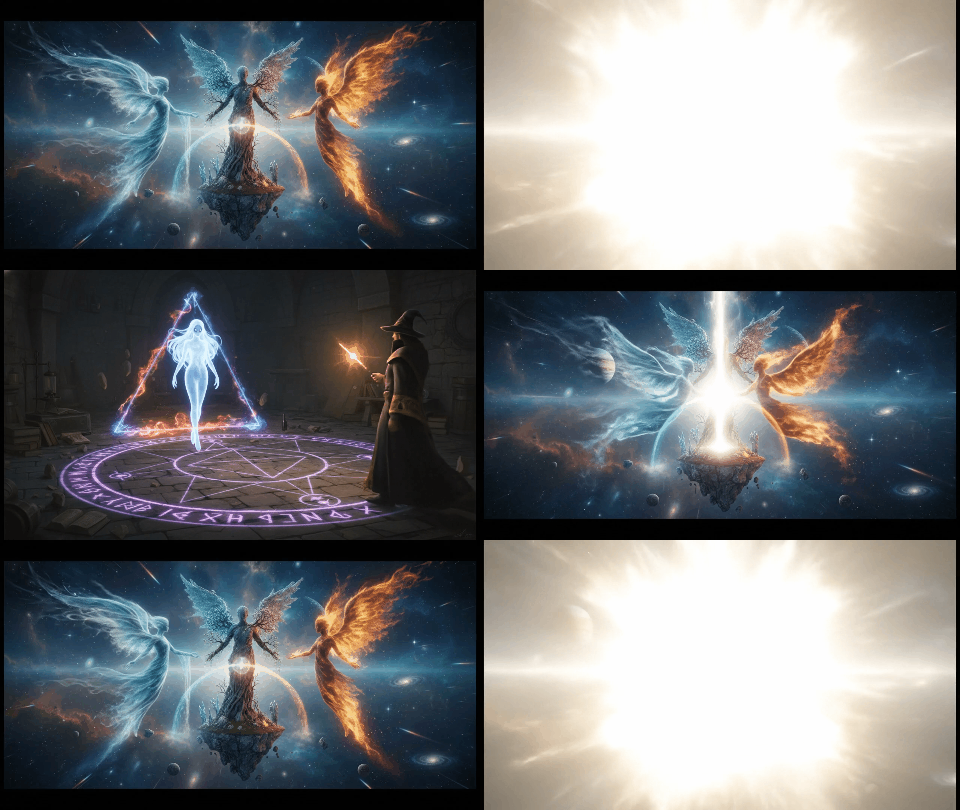
- Circumvention: To compel evil spirits, the magician must use a Magic Circle, which functions as a fortress for defense against evil spirits. The circle is often drawn with charcoal or holy water.
- Compulsion: If a spirit, particularly a Duke or King, is furious or disobedient, the operator must hold a Hazel Wand and strike a triangle outside the circle, commanding the spirit into it. If the demon refuses to obey, the magician uses adjurations, curses, and threats of increased torment for a thousand years in hell, or even eternal condemnation.
- Forms of Appearance: The summoning ritual requires the spirit to appear in a “fair and comely shape” or “beautiful human shape”. If the spirit fails to do so or is suspected of lying, the magician should constrain them.
- Protection: The exorcist must hold a Magic Ring or Disc of Solomon (made of gold or silver) near their face to protect against the “stinking sulphurous fumes and flaming breath” of the evil spirits. Holy names of Jesus and the cross are used for protection within the triangle of the pacts, preventing the spirits from inflicting harm.
In this esoteric worldview, the distinction between angel and demon is vital, yet the practice of magic ultimately treats both, though through different rites, as functionaries within a meticulously cataloged cosmos, awaiting the command of the knowledgeable and determined practitioner.




Leave a Reply