How AI is Augmenting, Not Replacing, Human Expertise

The headlines are all over the place, throwing around a scary idea that AI is gonna make all human jobs disappear. From truck drivers to financial experts, it’s all about this big fear of people getting replaced. But what if that’s totally off base? What if, instead of getting booted out, we’re actually heading into a world where we team up with these machines?
Welcome to the age of the “Centaur.”
The term was coined in the world of chess. After IBM’s Deep Blue defeated world champion Garry Kasparov in 1997, it seemed human dominance in the game was over. Yet, Kasparov later discovered something fascinating. In “freestyle chess” tournaments where players could team up with computers, the winners weren’t the most powerful supercomputers. Nor were the winners the top human grandmasters. The consistent victors were human-AI pairs. A skilled human player, equipped with the analytical power of a computer, became a “centaur”—a hybrid force more powerful than either human or machine alone.
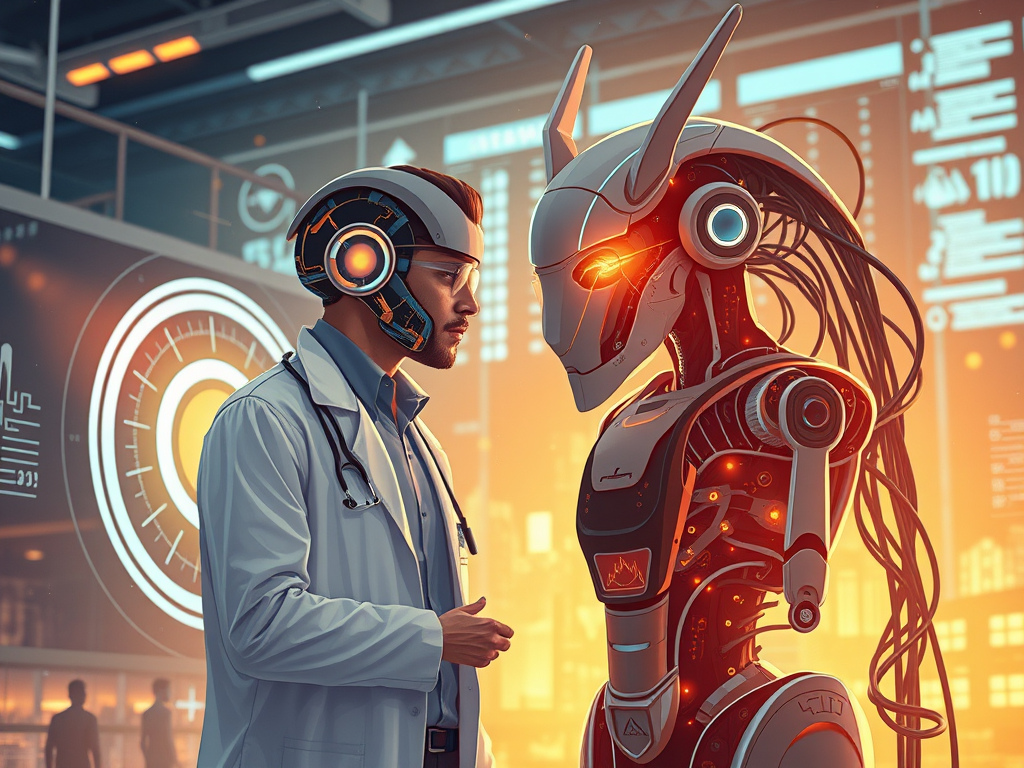
Today, this “centaur” model is joyfully emerging as the new standard across a multitude of high-skill professions. We are witnessing the rise of a workforce where AI shines as an invaluable assistant, acting as a cognitive co-pilot that beautifully enhances human expertise.

Consider these real-world centaurs:
- In Medicine: Radiologists are now using AI algorithms that can scan thousands of medical images—MRIs, CT scans, X-rays—and flag potential anomalies with superhuman speed and accuracy. The AI handles the monumental task of pattern recognition, freeing up the human expert to focus on the complex diagnostics, patient history, and nuanced decision-making that machines can’t replicate. The result is not a replaced radiologist, but a super-powered one.
- In Law: A single corporate lawsuit can generate millions of documents. Previously, armies of paralegals would spend months on discovery. Today, AI can sift through that entire mountain of data in hours, identifying relevant documents and key passages. This allows human lawyers to bypass the grunt work and focus directly on what they do best: building a case, forming a strategy, and arguing in court.
- In Engineering and Design: Architects are using generative design tools to become creative directors for AI. They input a project’s constraints—budget, materials, spatial requirements, energy efficiency—and the AI generates thousands of potential design solutions. The architect then uses their expertise and vision to curate, refine, and select the best options, exploring possibilities they never could have conceived of on their own.
- The magic of the centaur model lies in its division of labor. AI excels at tasks of scale and speed: processing immense datasets, recognizing patterns, and running endless simulations. Humans, on the other hand, provide the essential ingredients of context, critical thinking, ethical judgment, and true creativity…The AI can analyze the “what,” but the human expert understands the “so what.”
The future of work, then, may not be a battle of human vs. machine. It’s a partnership that requires a significant shift in our mindset and approach. The challenge is no longer to compete with AI, but to learn how to collaborate with it effectively, to harness its capabilities for our benefit. As technology continues to advance at an unprecedented pace, the most valuable professionals of the coming decade will be those who embrace their role as the human half of the centaur—guiding these powerful tools to solve complex problems, innovate in ways we have yet to imagine, and reach new heights of expertise. This synergy will enable us to focus on uniquely human skills such as empathy, creativity, and critical thinking, which machines cannot replicate. By embracing this collaborative spirit, we can create a future where human ingenuity and artificial intelligence work hand in hand to propel industries forward and enhance our daily lives in profound ways.




Leave a Reply