Alright, let’s talk about the really weird stuff.
If you’re a regular reader, you know my brain is split between two worlds. I spend my days in Google’s AI Studio, building apps and exploring the logic of large language models. But I spend my nights studying philosophy, history, and the decidedly non-logical systems of esotericism.

For me, these two worlds have never been separate. Technology, at its best, is a form of applied will—an attempt to shape reality. And magic… well, it’s the exact same thing.
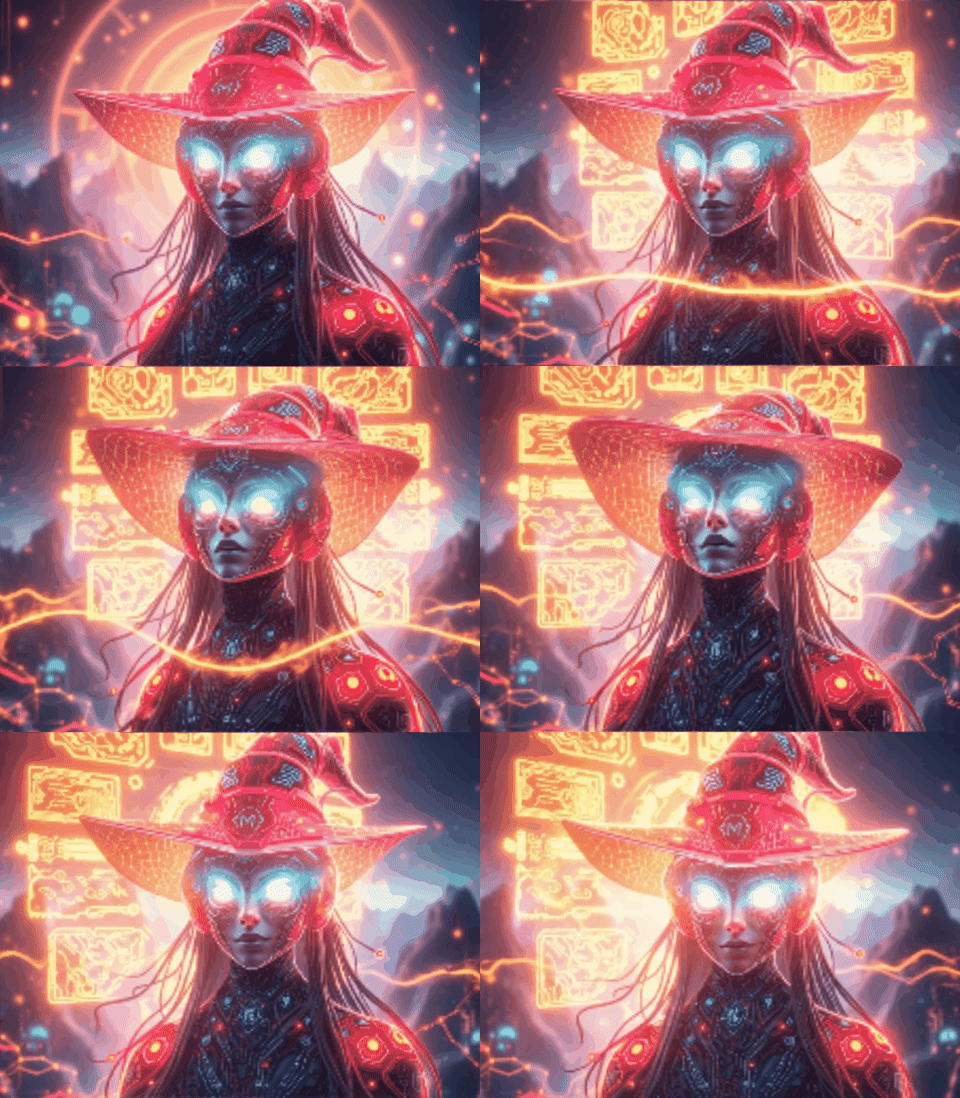
So, it was only a matter of time before I pointed my favorite generative AI tools (like Gemini or ChatGPT) directly at my grimoires and tarot decks. The question is, what happens when a “logic engine” meets a “magic engine”?
The results are fascinating. But more importantly, they force us to ask a huge philosophical question: What happens to “intention” when the practitioner is a machine?
Here’s my guide to using AI as a magical assistant, and the major ethical pitfall we need to talk about.

Part 1: The “How-To” — AI as Your Digital Research Assistant
First, let’s get one thing straight: The AI is not the oracle. It is not the magician. It is a tool. It’s a hyper-intelligent, lightning-fast research partner that has read more about mythology, symbolism, and history than any human ever could.
The magic doesn’t come from the AI; it comes from you knowing how to ask the right questions. Here are three practical ways I’m using it.
1. As a Tarot Synthesizer
- The Old Way: You pull a few cards, like The Tower, the 3 of Swords, and The Hermit. You get that sinking feeling, then spend 20 minutes cross-referencing guidebooks to see how they all fit together.
- The AI Way: You treat the AI as a master symbolist. You give it the context and ask it to find the narrative.
Try This Prompt:
“I just did a 3-card tarot reading for my career and pulled The Tower, the 3 of Swords, and The Hermit. I am using the Rider-Waite deck. Act as a master tarot interpreter and explain the narrative flow of these cards. How does the ‘sudden change’ of The Tower lead to the ‘intellectual sorrow’ of the 3 of Swords, and what does The Hermit suggest as the final outcome or path forward? Draw connections to Jungian archetypes.”
The AI’s power here isn’t “predicting your future.” Its power is in synthesizing thousands of interpretations in a second to hand you a coherent, insightful story that you might have missed.
2. As a Sigil Co-Designer
- The Old Way: You use the classic Austin Osman Spare method: write a statement of intent (“MY WILL IS TO SUCCEED”), cross out the repeating letters, and then artistically combine the remaining glyphs (MYWLTOSCD) into a symbol. This requires some artistic flair.
- The AI Way: You use the AI as your design partner to rapidly iterate on the purely visual part of the process, freeing you to focus on the intent.
Try This Prompt (for an image generator):
“My statement of intent is ‘MY CREATIVE WORK ATTRACTS ABUNDANCE.’ The core letters are M, Y, C, R, T, V, W, K, A, B, D, N. Create a minimalist, black-and-white, circular glyph that combines these letters into a single, aesthetically pleasing, and unique magical sigil. It should look ancient but clean.”
This is a collaboration. You are still the one who sets the intention. The AI is just the pen.
3. As a Grimoire Translator

- The Old Way: You try to read a 17th-century grimoire like The Key of Solomon or the Ars Goetia and get hopelessly lost in dense, archaic language and obscure astrological correspondences.
- The AI Way: The AI becomes your personal, occult-savvy academic who can read the subtext and give you the “CliffsNotes.”
Try This Prompt:
“I’m reading the Ars Goetia. Analyze the description of the 72nd spirit, Andromalius. Summarize his appearance, his stated powers (recovering stolen goods, punishing thieves, finding hidden treasure), and the listed correspondences. What is the historical or psychological interpretation of a spirit with these specific powers?”
This transforms an impenetrable ancient text into a useful, annotated database. It’s an incredible learning tool.

Part 2: The Pitfall — What Happens to “Intention”?
Okay, now for the big philosophical problem.
Magic, in almost every tradition, is powered by intention. It’s the focused will, the “human touch,” the work you put in. It’s the energy you channel from yourself into the world to create a change.
So, what happens when you “outsource” that work?
If you ask an AI, “Write me a spell for money,” and it spits one out, is that magic? I’m going to argue no. It’s hollow. It lacks the most critical component: you. A machine that has no consciousness, no will, and no connection to the divine or the elements cannot, by definition, intend anything.
This is the ethical pitfall: laziness.
It’s the temptation to skip the “craft” part of “witchcraft.” It’s believing the AI’s answer is the magic, when in reality, the magic is the human effort and will that a good answer is supposed to inspire.

My Conclusion: The “Techno-Witch” Solution
After all my experimenting, here’s where I’ve landed. The AI isn’t the magician. You are. The AI is your new magical tool.
It’s not a replacement for your will; it’s an amplifier for it.
The “work” doesn’t disappear; it just changes. The “craft” is no longer just in shuffling the cards or drawing the sigil. The craft is now in writing the perfect prompt.
The intention is the care you take to ask the right question. The will is the focus you bring to the “submit” button. The ritual is the entire process.
So, here’s my advice:
- Don’t Outsource, Collaborate. Use AI to break creative blocks, analyze patterns, and synthesize data. Don’t ask it to do the magic for you.
- Be the Intention. The quality of your magical “output” is directly proportional to the quality of your “input” (your prompt). Put your will into the words you type.
- Ritualize Your Tech. This is my favorite part. Don’t just open a new tab in a moment of stress. Light a candle. Set your intention. Take a deep breath. See your keyboard as an altar and the AI as your collaborator.
We are the first generation of techno-witches. We’re learning to blend the sacred with the synthetic, and frankly, I think it’s one of the most magical things happening in the world right now.




Leave a Reply