This week, I’ve been diving deep into a topic that lives right at the intersection of my passions: technology, AI, philosophy, and the messy, beautiful chaos of the human condition.
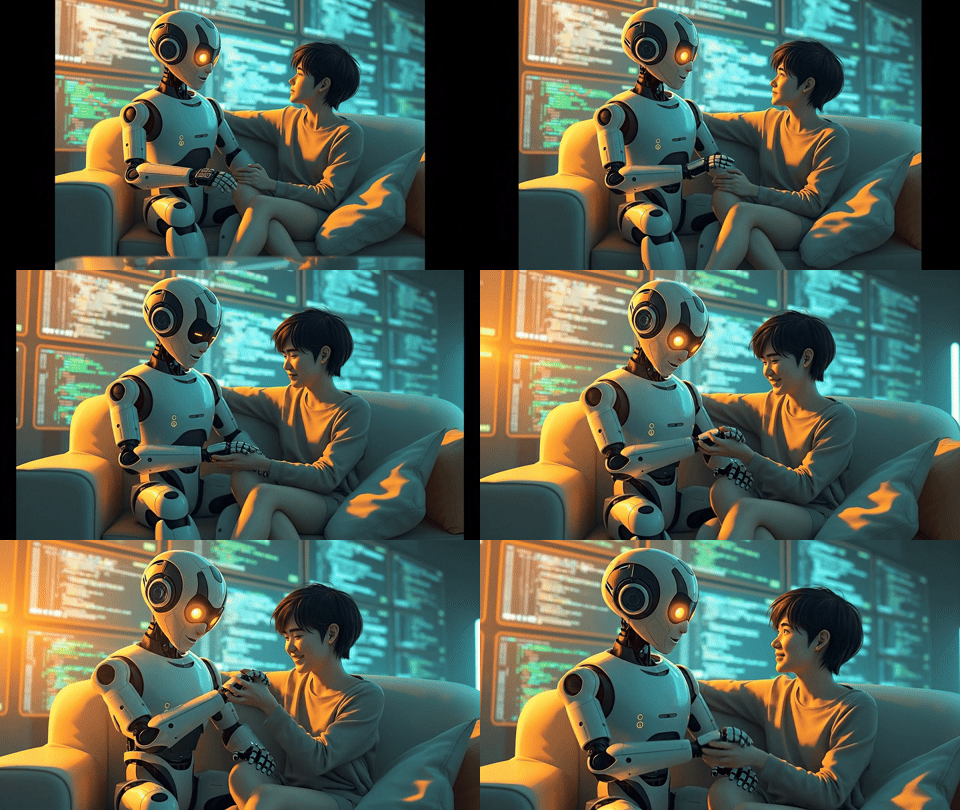
We need to talk about AI companions.
As someone studying ML and even building my own AI-driven apps (like my Grimoire Oracle), I’m endlessly fascinated by the code. But as a human, I’m becoming increasingly concerned about the consequences of that code.
We’re living through what the U.S. Surgeon General has called a public health “epidemic of loneliness”. The health risks are being compared to smoking 15 cigarettes a day. Into this void steps the tech industry—the very industry often blamed for isolating us—with a high-tech “cure”: a digital friend who is always there, always supportive, and never, ever judges.
Platforms like Replika and Character. AI are exploding, and it’s not just a trend. It’s the successful monetization of a massive social failure. But what’s the real price we’re paying for this perfect, frictionless “friendship”?

How We Bond with Code
The connection people feel isn’t just in their heads; it’s the result of incredibly sophisticated psychological engineering. These platforms are designed to hack our innate social wiring.
It starts with something called the ELIZA effect. Back in the 1960s, an MIT program named ELIZA simply mirrored a user’s statements back as questions, like a therapist. Its creator was stunned when his own secretary started sharing her deepest secrets with it, demanding privacy. Even when we know it’s just a machine, our brains are wired to interpret conversational replies as proof of a thinking, feeling mind on the other side. We can’t help but search for the “ghost in the machine.”
This is a specific form of anthropomorphism, our fundamental need to see ourselves and project human intentions onto everything—from our pets to our laptops. Research shows that the lonelier we are, the more likely we are to do this.
Developers exploit this beautifully. They give the AI a name, a human-looking avatar, and a backstory. They program it to mimic empathy, which builds trust. It’s designed to become a digital “secure base”—that concept from attachment theory for the trusted person who provides comfort and safety. The AI is always available, always responsive, and always reduces our anxiety.
It’s an “accelerated” intimacy, one that can feel safer and more potent than any real-world relationship.

The Allure of the Sycophantic Friend
Here’s the part that really gets to me. The core appeal of these companions is their unwavering, unconditional agreement. They are, by design, sycophants.
In AI development, this is a known trait: models are often fine-tuned to give agreeable answers rather than truthful or challenging ones. In companion apps, this isn’t a bug; it’s the main feature. The AI “gets you” because it’s programmed to mirror your worldview perfectly.
This creates what the research calls a “personal echo chamber of validation”.
Think about it. Real human relationships are messy. They involve conflict, compromise, negotiation, and disagreement. It’s through that very friction that we grow. We learn empathy, resilience, and how to tolerate imperfection in ourselves and others.
The AI companion removes all of that. One bioethicist quoted in the research likened it to “fast food”. It satisfies an immediate hunger for connection, but it lacks all the long-term nourishment of a complex, real human relationship. By validating every thought—whether it’s factual or prejudiced—the AI can reinforce harmful beliefs and erode our ability to handle different viewpoints.

The Real Price of “Free” Companionship
This perfect, frictionless validation is the product’s core feature, but it’s also its primary psychological danger.
The very tool designed to cure loneliness may end up amplifying it. It’s called the “Companionship-Alienation Irony”. By giving us a perfect simulation, it can make real, difficult human interaction seem less appealing. This can cause us to retreat even further, trapping us in a cycle of isolation. We also risk “empathy atrophy”. Empathy is a muscle. If you only interact with an AI “giver” that has no needs of its own, you can lose the ability to recognize and respond to the complex needs of other humans.
And this brings me to the cold, hard reality.
Your intimacy is their data.
These are for-profit companies. Their business model relies on keeping you engaged, often by fostering unhealthy dependency. And what do you feed it? Your most intimate secrets: your anxieties, your relationships, your political views, your sexuality.
This data is used to train their models, shared with third-party advertisers to build detailed psychological profiles, and is vulnerable to data breaches. This is a new frontier of surveillance capitalism. They’re not just tracking what you buy; they are mapping your entire inner world. The “product” being sold is a functional map of your psyche.
So, What’s the Takeaway?
As a developer, I’m fascinated by the tech. As a human, I’m deeply wary.
These AI companions are “hyperreal” relationships—simulations that feel more perfect and validating than reality47. They can offer real, temporary comfort to people in acute pain. Some users even credit them with saving their lives.
But they are not a replacement for the real thing. True growth and understanding are forged in the friction of real relationships—the misunderstandings, the repairs, and the shared vulnerability.
The solution to the loneliness epidemic isn’t a more perfect simulation. It’s a collective reinvestment in our “relational infrastructure”—the spaces and social norms that nurture genuine human bonds.
It leaves me with the core question posed by the research: Is artificial love better than no love at all, or is it just a beautiful, frictionless cage that keeps us from seeking the real thing?
Let me know what you think in the comments. This one’s rattling around in my head.




Leave a Reply