Hey there, movie junkies!
While heroin films focus on the body, psychedelic films focus on the mind. These movies use the medium of cinema to distort reality, challenging the viewer’s perception of time, space, and identity.

Fear and Loathing in Las Vegas (1998): The American Nightmare
Terry Gilliam’s adaptation of Hunter S. Thompson’s gonzo classic is a polarizing masterpiece. Starring Johnny Depp and Benicio del Toro, the film is a savage satire of the 1960s counterculture, set against the backdrop of a grotesque Las Vegas.
Visualizing the Binge
Gilliam treats the camera as an unreliable narrator. To depict the effects of ether, acid, and mescaline, he employs:
- Wide-Angle Lenses: Distorting the characters’ faces to make them appear monstrous and predatory.
- CGI Hallucinations: The carpet patterns in the hotel lobby come alive and climb the guests’ legs; lizard people populate the bar.
- Disjointed Editing: Scenes bleed into one another without logical transition, mimicking the blackout nature of a multi-day binge.
Thematic Depth
Beyond the visuals, the film is a requiem for the “Summer of Love.” Duke’s famous “Wave Speech” articulates the central theme: the failure of the drug culture to effect meaningful political change. The drugs in the film do not provide enlightenment; they provide a buffer against the horrors of mainstream American culture, which is depicted as far more depraved than the drug users themselves.
Availability: Streamable on HBO Max.
Enter the Void (2009): The DMT Death Trip
Gaspar Noé’s Enter the Void is perhaps the most technically ambitious drug film ever made. Set in Tokyo, it follows Oscar, a drug dealer who smokes DMT and is subsequently shot by police. The bulk of the film takes place from his disembodied perspective as his spirit floats above the city.
The Subjective Camera
Noé creates a seamless, floating visual language that drifts through walls, into light bulbs, and over the neon cityscape. The opening sequence, depicting a DMT trip from the first-person perspective (POV), utilizes fractal geometry and bioluminescent colors to simulate the psychedelic experience with startling accuracy. The film is a “psychedelic melodrama” that demands patience, running over two and a half hours, but it offers an immersion into the altered state that is unparalleled in cinema.
Availability: Available on AMC+, Shudder, and for rent on Apple TV and Amazon.

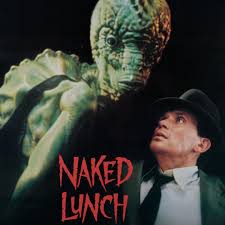
Naked Lunch (1991): The Literary Hallucination
David Cronenberg’s adaptation of William S. Burroughs’ “unfilmable” novel is a triumph of bio-mechanical surrealism. It is not a direct adaptation but a meta-fictional blend of the novel and Burroughs’ own life.
The Interzone
The protagonist, William Lee (Peter Weller), is an exterminator addicted to “bug powder.” After accidentally killing his wife (a reference to Burroughs’ real-life manslaughter of his wife Joan Vollmer), he flees to the “Interzone,” a hallucinatory version of Tangier.
- Creature Effects: Cronenberg brings the hallucinations to life with practical effects. Typewriters transform into talking insects with sphincters, serving as a metaphor for the addictive and excretory nature of the creative process.
- The Metaphor: The “drug” in Naked Lunch is arguably writing itself. The film explores how the artist must descend into a personal hell (addiction) to retrieve the raw material for their art. It is a dense, intellectual film that rewards repeat viewings.
Availability: Not currently on major subscription streaming, but available for purchase on DVD/Blu-ray via Barnes & Noble and Amazon.

A Scanner Darkly (2006): Rotoscoping Paranoia
Richard Linklater’s adaptation of Philip K. Dick’s novel uses a technique called interpolated rotoscoping—animating over digital video—to create a shimmering, unstable reality.
Substance D and Identity
The film is set in a near-future surveillance state where 20% of the population is addicted to “Substance D.” Keanu Reeves plays an undercover cop who becomes addicted to the drug he is investigating. The rotoscoping technique is not just a stylistic flourish; it is essential to the plot. It allows for the depiction of the “scramble suit,” a disguise that constantly shifts the wearer’s appearance, effectively visualizing the loss of identity that comes with addiction and undercover work. The film features standout performances from Robert Downey Jr. and Woody Harrelson as paranoid junkies, capturing the circular, nonsensical conversations of the high.
Availability: Rent on Google Play, Prime Video, and Apple TV.

Climax (2018): The Bad Trip Choreographed
Gaspar Noé returns to the list with Climax, a film that is part dance movie, part horror. A troupe of diverse dancers rehearsing in an isolated school building unknowingly drinks sangria spiked with LSD.
Order to Chaos
The film begins with a rigorously choreographed, jubilant dance number, shot in long, fluid takes. As the acid kicks in, the camera work begins to deteriorate alongside the characters’ sanity. The camera inverts, rolls, and flies through the screaming crowd. The film is a visceral depiction of how a collective social unit can disintegrate into primal violence and hysteria when the chemical balance is tipped. It is a “bad trip” simulated in real-time.




Leave a Reply