
Greetings and salutations oh seekers of truth!
Let’s be real for a second. When most people hear “the occult,” they immediately picture a B-horror movie: spooky basements, people in robes chanting something ominous, and maybe a sacrifice or two. We tend to think of magic as this fringe, chaotic thing that stands in total opposition to “civilized” religion or science.

But as someone who spends her days studying Machine Learning algorithms and her nights reading Hermetic philosophy here in Pasadena, I can tell you that the history of magic is actually much more like a complex code than a horror script.
It wasn’t just about spells and shadows. It was intellectual, it was rigorous, and honestly? It was incredibly organized. (My inner Project Manager loves this part).
Today, I want to peel back the veil on five unexpected truths about Western Esotericism. We are going to debunk the Hollywood myths and look at the actual history—from the “tech stack” of ceremonial magic to the pious monks who wrote the grimoires.
Here are 5 truths that will rewrite everything you thought you knew about the occult.

1. The Biggest Plot Twist: Magic Was Deeply Christian
If you think “occultist” means “atheist” or “devil worshipper,” think again. For centuries, the people practicing high magic weren’t hiding from the Church—they were often running it.
History tells us that most Western occultism was practiced by devout Christians, including clergy members. Those infamous “black books” or grimoires? They weren’t anti-God; they were actually structured within a pious Christian framework.
The Logic: These magicians believed their power came from understanding the Divine Order. They weren’t begging demons for favors; they were using the authority of God (specifically Divine Names) to command spirits.
- They saw themselves as “administrators” of the divine hierarchy.
- Manuals often required the magician to confess their sins and fast before a ritual.
- Even the Grimoire of Honorius (which gets pretty intense) is full of impassioned appeals to God.
To them, commanding a spirit wasn’t rebellion—it was enforcing God’s will.

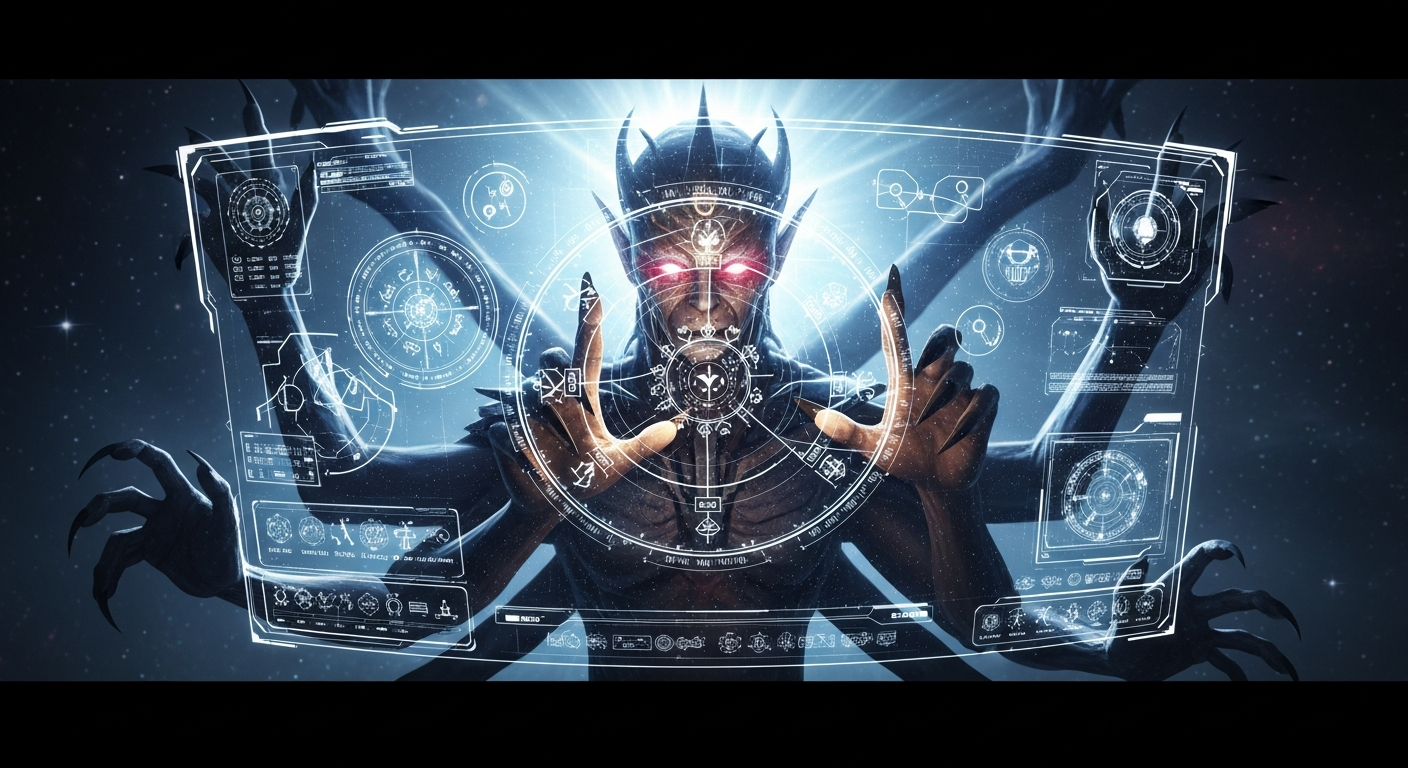
2. “Demons” Were Originally Just System Admins
We have been conditioned to think of a “demon” as a red guy with a pitchfork trying to steal your soul. But that is a relatively new software update in the grand scheme of history.
In the ancient world, the spiritual ecosystem was much more nuanced.
- The Greeks: The word daimōn didn’t mean “evil spirit.” It just meant a divine power or spirit. Socrates even had a daimōnion—a personal guide that stopped him from making mistakes.
- The Egyptians: What we call “demons” were often guardians of Ma’at (cosmic order). They weren’t trying to corrupt you; they were just enforcing the boundaries of the universe.
Think of them less like villains and more like System Administrators. They enforce the rules and permissions of the cosmos. If you don’t have the right clearance, they block you. It wasn’t until later that the Church flattened this complex system into a binary “Angels = Good / Demons = Bad” to secure their own authority.

3. Magic Was a “Learned Practice,” Not Folk Sorcery
Forget the bubbling cauldron and the “eye of newt.” High Ceremonial Magic (especially during the Renaissance) was a discipline as rigorous as engineering or mathematics.
The goal wasn’t chaos; it was perfect alignment with the cosmos. This is where my Project Management brain lights up. Magicians used the doctrine of Planetary Hours to schedule their rituals with absolute precision.
The “Ars Paulina” Protocol:
The power of an angel wasn’t static; it shifted based on the data of the sky.
- Invoke the angel Samael on a Monday (Moon day) during a Mars hour? His output is filtered through Lunar energy.
- Invoke him on a Tuesday (Mars day) during a Mars hour? You get pure Martian energy.
The ritual circle was essentially a laboratory. Success didn’t depend on superstition; it depended on the precise alignment of human will with the gears of the universe.

4. Gnosticism: Direct Access (No Middle Management)
In the early centuries of the Common Era, there was a massive spiritual debate between the Orthodox Church and the Gnostics.
The Church argued that you could only access God through the approved hierarchy (Bishops, Deacons, Priests). The Gnostics, however, proposed a radical alternative: Direct Access.
They believed in the “Light Within.” They taught that salvation came from Gnosis—a Greek word for direct, experiential knowledge. As the scholar Elaine Pagels puts it, “to know oneself, at the deepest level, is simultaneously to know God.”
This was dangerous to the establishment because it cut out the middleman. If the divine database is already inside your own consciousness, why do you need an external institution to grant you access?

5. You Are a Miniature Universe
Finally, we come to the concept that ties it all together: The Macrocosm and the Microcosm.
“As Above, So Below.”
Renaissance magi like Agrippa and Paracelsus taught that the human body is a perfect reflection of the universe.
- The Macrocosm: The Great World (The Universe).
- The Microcosm: The Little World (You).
Manly P. Hall summed it up beautifully: “For every star in the heavens, there is a star in the Earth, and for every planet in space there is a planet within the body of man.”
This is the engine that makes magic work. We aren’t separate from the stars; we are fractal versions of them.
Getty Images

The Bottom Line
When we look at the actual texts, we don’t find a history of chaotic devil worship. We find a lineage of philosophers, mathematicians, and mystics who were trying to understand the source code of reality.
They believed that by understanding themselves, they could understand the universe. And honestly? Whether you are casting a circle or training a Neural Network, that quest for understanding is what makes us human.
What do you think? Does knowing that “demons” were originally just cosmic guardians change how you view the spiritual world? Let me know in the comments!




Leave a Reply