Patterns of Power: A Comparative Monograph on Western Magical Traditions

Foreword: A Note on the Primary Sources
This blog series presents a synthetic analysis of Western ceremonial magic, synthesized from a curated selection of foundational grimoires and texts on occult philosophy, ranging from the Neoplatonic cosmology of Cornelius Agrippa’s Three Books of Occult Philosophy to the explicit ritual instructions of the Solomonic cycle, including the Lemegeton and The Greater Key of Solomon, and later exemplars of the tradition such as The Grand Grimoire.
The objective of this work is not to validate or debunk the supernatural claims contained within these texts. Rather, it is to conduct a comparative analysis of these traditions as historical and philosophical systems. The monograph approaches these documents as primary sources, examining them based entirely on their own internal logic, stated goals, and prescribed methodologies. By treating these grimoires as blueprints for coherent, if esoteric, systems of thought and practice, we can begin to discern the underlying patterns of power that connect them.
——————————————————————————–

Introduction: Defining the Scope of Ceremonial Magic
Ceremonial magic, as depicted in the foundational texts of the Western esoteric tradition, represents a complex and highly structured system of philosophy and practice. Its ultimate aim is to facilitate interaction between the human operator and a spectrum of non-corporeal intelligences, ranging from celestial angels to infernal spirits. This monograph proposes an investigation into how these magical systems construct a “technology of the sacred,” using a shared cosmological and theological language to achieve vastly different ends. It will present a scholarly analysis of the tradition’s core principles, key figures, and diverse practices, treating them as a coherent intellectual and spiritual heritage.
Across the source texts, the concept of “Magic” is presented with a notable duality. On one hand, it is lauded as the pinnacle of human intellectual achievement. Cornelius Agrippa, in his Three Books of Occult Philosophy, describes it as a “sublime kind of Philosophy” and “the most absolute perfection of all most excellent Philosophy.” In this view, magic is a divine science that unites the natural, celestial, and supercelestial worlds. On the other hand, the texts contain stark warnings about its potential for corruption. The preface to the Lemegeton cautions that this “Noble Science often degenerateth, from Natural becometh Diabolical, and from True Philosophy turneth unto Nigromancy.” This monograph will explore this entire spectrum, examining the shared foundations that support both the highest aspirations of divine communion and the darkest arts of demonic coercion.
To that end, this work is divided into four parts.
- Part I, The Philosophical Foundations of Magic, will explore the cosmological model and the crucial role of the operator’s inner state.
- Part II, The Grammar of Ritual, will deconstruct the essential components of magical practice, from the tools of the art to the mandates of astrological timing.
- Part III, A Spectrum of Magical Practice, will provide a comparative analysis of different magical systems, from the divine pursuits of Theurgia to the coercive methods of Goetia and the transactional nature of the pact.
- Part IV, Synthesis and Conclusion, will draw these threads together to reveal the syncretic framework that unifies these seemingly disparate traditions.
By examining these texts on their own terms, we can reconstruct the intricate and systematic worldview that powered these arts, beginning with its very foundations: the map of the cosmos itself.
——————————————————————————–

Part I: The Philosophical Foundations of Magic
1. The Threefold World and the Spiritus Mundi
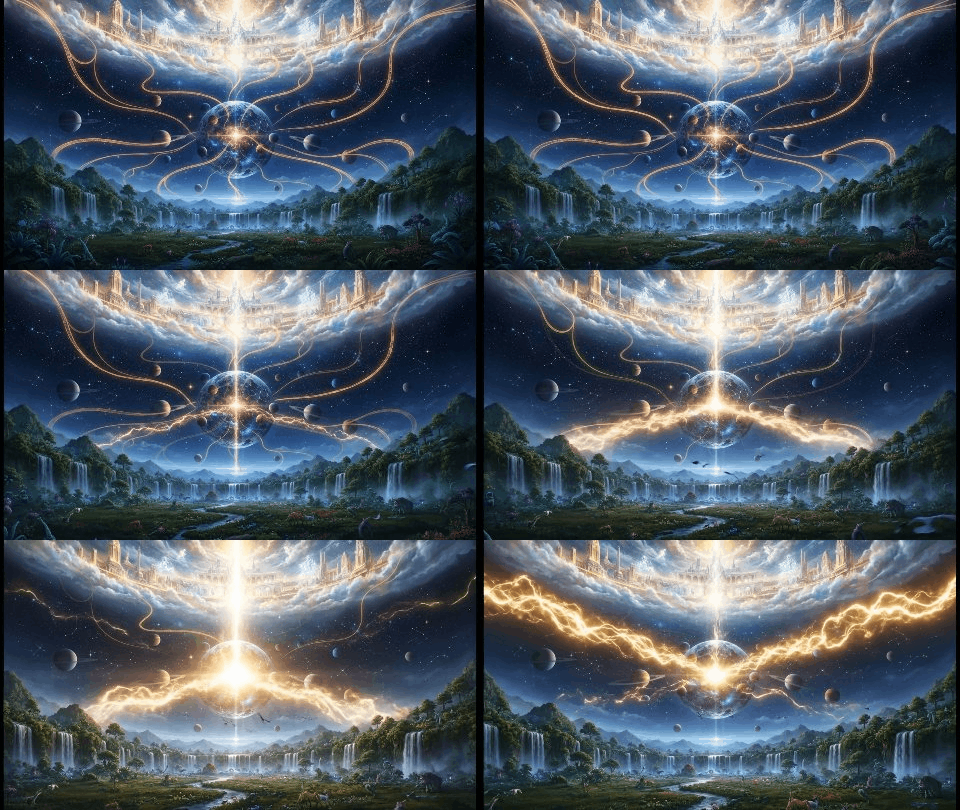
To comprehend the operational logic of ceremonial magic, one must first understand its foundational worldview. The efficacy of the practices described in the grimoires is not arbitrary; it is predicated on a specific cosmological model of a layered universe in which all things, visible and invisible, are interconnected. This worldview posits that influence can be exerted across different levels of reality through a web of sympathies, antipathies, and correspondences, mediated by a universal life-force.
The most coherent expression of this model comes from Cornelius Agrippa, who details a tripartite division of the world. This layered reality consists of three primary realms:
- The Natural (or Elemental) World: This is the lowest, terrestrial sphere of manifest bodies, encompassing stones, metals, plants, and animals. Magic operating on this level primarily involves manipulating the occult properties and natural affinities inherent in these physical substances.
- The Mathematical (or Celestial) World: This is the realm of the heavens, stars, and planets. Its influence descends upon the natural world, imparting virtues and qualities according to its complex motions, aspects, and harmonies. Celestial magic involves aligning operations with these heavenly bodies to harness their power.
- The Theological (or Supercelestial/Divine) World: This is the highest realm of pure intellect, home to God, the angels, and other divine intelligences. This realm is the ultimate source of all power, which filters down through the celestial and, finally, into the natural world.
This cosmological model was not just Agrippa’s; it was a common idea in the broader tradition. The Greater Key of Solomon refers to this layered reality by describing the different kinds of spirits that rule over various realms: “some govern the Empyrean Heaven, others the Primum Mobilé… there are also (Spirits) in the Elements…”

The connection between different realms is made possible by a universal force called the “Spirit of the World,” or Spiritus Mundi. Agrippa refers to this as the “quintessence,” a fifth element separate from the four earthly elements, existing above them. Francis Barrett, in his 19th-century work The Magus, explains this concept further, showing its origins in Agrippa’s writing. He describes it as the medium that links celestial souls to physical bodies and transfers hidden properties into plants, stones, and metals. This spirit serves as a conductor, bringing the qualities of the stars into the physical world and revealing nature’s secret powers.
In this interconnected universe, everything is influenced by Sympathy and Antipathy, which are the natural attractions and repulsions between objects. Agrippa gives examples, such as the dislike between cucumbers and oil, the conflict between wolves and sheep, and the bond between the whale and the little fish. These connections are not just poetic; they represent real laws of nature that can be used in magic. By knowing these affinities, a magician can bring together compatible elements to strengthen a desired outcome or use opposing ones to ward off negativity, forming the core of Natural Magic. This concept of a divinely ordered yet manipulable universe needs a guiding force, which leads us to the central figure in every magical act: the operator.
2. The Operator: Preparation, Purity, and Power of the Mind

Across various Western magical traditions, one key idea persists: the magician is not just a technician but the main actor in the art. The success of any ritual depends on the magician’s spiritual, mental, and physical well-being. The source texts clearly state that the operator’s inner state is crucial, as it is through a prepared mind and a purified body that divine qualities are accessed and dark forces are controlled.
The requirement for ritual purity is a key principle. The Greater Key of Solomon outlines how to prepare the operator, emphasizing nine days of abstaining from physical pleasures and idle talk. This preparation includes fasting, prayers, confession, and immersion in holy water. This cleansing is tied to spiritual readiness, with prayers for renewal and forgiveness so that “no uncleanness may appear upon me in Thy Presence.” Agrippa also highlights the need for a “pure mind” and suggests using “secret prayers” to uplift the soul. He advises the operator to maintain a high standard of mind and to distance themselves from manual tasks and worldly concerns to attain the needed dignity.
Beyond physical and spiritual purity, the source texts place immense emphasis on the power of the mind, particularly the imagination. Agrippa argues that the “passions of the soul, when they are most vehement, can not only change their own body, but also can transcend so, as to work upon another body.” He posits that a vehement imagination, when inflamed with a strong desire, becomes the primary engine of magical effects, capable of impressing its form upon external objects and even altering the natural world. Barrett reinforces this concept, explaining that a “most strong imagination” can conduct the operator’s spirit to a distant object. The mind is thus not merely a tool for reciting formulae but an active, creative force that shapes and directs magical power.
This traditional understanding contrasts sharply with Aleister Crowley’s modern interpretation in his Goetia. His psychological approach offers a new way to read the same texts, viewing them through early psychology and scientific materialism. He denies the spirits’ objective existence, suggesting that “Ceremonial Magic fines down, then, to a series of minute, though of course empirical, physiological experiments.” Here, practices remain similar, but the source of power moves from God and spirits to the operator’s subconscious. The rituals, names, and seals are seen as techniques to stimulate specific parts of the brain. This raises a key question: is the operator engaging with external forces or delving into their own mind? No matter the viewpoint, the disciplined mind of the operator is key in connecting their inner state with the external tools and rituals of the art. The alignment of the sun’s position within the zodiac helps determine which governing angels of the day and hour to call, showing how astrology is woven into the rituals and linking magic’s theories to its real-world practice.
Part 2 coming soon…




Leave a Reply