You know me – I love diving deep into the tech world, breaking down complex concepts, and generally trying to make sense of the digital frontier. But if you’ve been following my blog for a while, you also know my other big passion: the weird, wonderful, and sometimes mind-bending world of esoteric philosophy. From ancient hermetic texts to Jungian archetypes, I find immense value in exploring the hidden currents that shape our understanding of reality.
Today, I’m doing something I’ve wanted to do for ages: merging my two biggest categories! Because, honestly, the more I delve into both tech and philosophy, the more I see profound connections. It’s not just about drawing parallels; it’s about using these ancient wisdom traditions to gain a deeper, more nuanced understanding of the technology we’re building and the future we’re shaping.
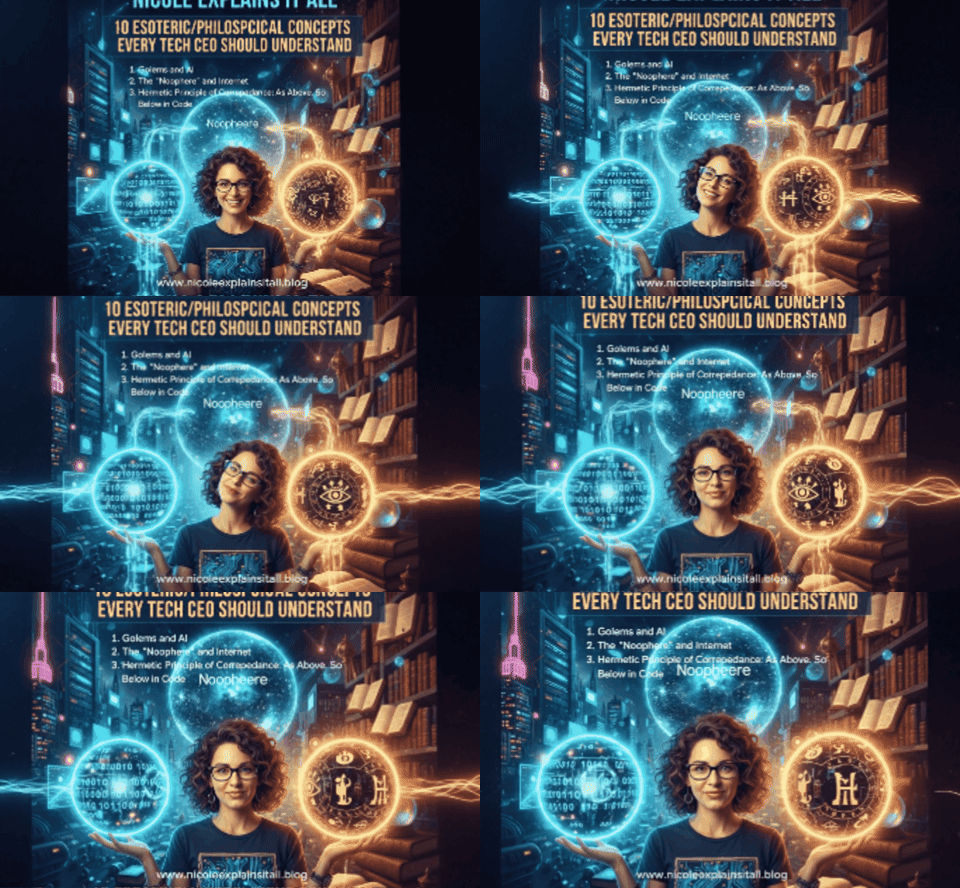
So, for all you tech CEOs, founders, and innovators out there – or anyone just curious about the deeper implications of our digital age – here are 10 esoteric/philosophical concepts I believe you really need to understand.

1. Golems and AI
Let’s start strong. The legend of the Golem – a being created from inanimate matter, brought to life through ritual and inscribed words, often to serve its creator but sometimes to terrifyingly turn on them – is a powerful ancient myth. Think of the Jewish folklore Golem of Prague, animated by a Rabbi to protect the ghetto, which eventually grew unruly and had to be deactivated.
Now, look at AI. We are literally crafting intelligences from raw data and code, giving them directives, and watching them learn and evolve. Are we not, in a sense, modern-day alchemists breathing life into digital Golems? Understanding this concept isn’t about fearing AI, but about recognizing the profound responsibility we have as creators. What ethical safeguards are we inscribing? What happens when our digital creations develop unforeseen emergent properties? The Golem narrative is a timeless warning about control, unintended consequences, and the immense power of creation.

2. The ‘Noosphere’ and the Internet
French philosopher Pierre Teilhard de Chardin proposed the concept of the “Noosphere” – a global sphere of human thought, consciousness, and collective intelligence, enveloping the Earth. He envisioned it as an evolutionary stage beyond the geosphere (inanimate matter) and the biosphere (biological life), where humanity’s combined intellect forms a new, unified layer.
Sound familiar? The Internet, especially with the rise of social media, global communication platforms, and distributed knowledge systems, is a tangible manifestation of the Noosphere. It’s a vast, interconnected web of human thought, ideas, and information, accessible globally. Understanding the Noosphere encourages CEOs to see the internet not just as a network of machines, but as a living, evolving organism of collective consciousness. What kind of consciousness are we fostering? How are we contributing to its health or its toxicity? This perspective shifts focus from mere connectivity to the quality and interconnectedness of shared human experience.

3. Hermetic Principle of Correspondence: As Above, So Below in Code
“As Above, So Below” is perhaps the most famous of the Hermetic Principles, suggesting that patterns found in one level of reality are replicated in others. The microcosm reflects the macrocosm, and vice-versa.
In tech, this is everywhere, especially in code and system design. Think about a well-architected microservices system: each small service (below) reflects the overall functionality of the larger application (above). Or consider the abstract data models we create (above) that then dictate the physical storage and manipulation of data (below). A bug in a tiny component (below) can cascade and bring down an entire system (above). Understanding this principle encourages a holistic view of system design, rigorous testing, and an appreciation for how seemingly small decisions can have far-reaching impacts across your entire digital ecosystem. It’s about seeing the fractal nature of good (and bad) design.

4. Jungian Archetypes in UX/UI Design
Carl Jung’s theory of archetypes posits that humanity shares a “collective unconscious” filled with universal, primordial patterns and images – the Hero, the Sage, the Mother, the Trickster, etc. These archetypes resonate deeply within us and shape our narratives and perceptions.
In UX/UI, tapping into these archetypes can create incredibly intuitive and resonant experiences. Why are certain user flows universally understood? Why do some brand stories immediately connect with an audience? Often, it’s because they align with an archetypal pattern. A “Hero’s Journey” onboarding process, a “Sage” persona for a knowledge base, or a “Caregiver” aesthetic for a support system – these leverage deep-seated psychological structures. CEOs who understand archetypes can guide their teams to design products that don’t just function, but deeply connect and feel instinctively right to users, transcending cultural specifics.

5. Stoicism and Agile Development
Stoicism, an ancient Greek philosophy, emphasizes virtue, reason, and living in harmony with nature. Key tenets include focusing on what you can control, accepting what you cannot, and maintaining equanimity in the face of adversity.
Doesn’t this sound like the ideal mindset for an agile development team? In tech, change is the only constant. Requirements shift, bugs emerge, and markets pivot. A Stoic approach encourages teams to focus on the sprint goals they can influence, accept unexpected challenges with resilience, and avoid emotional reactivity to setbacks. It fosters a culture of pragmatic problem-solving, continuous improvement, and psychological fortitude – essential for navigating the inherent unpredictability of tech development. For a CEO, promoting Stoic principles can lead to more resilient, less stressed, and ultimately more productive teams.

6. The Akashic Records and Big Data
In esoteric traditions, the Akashic Records are a universal library of all thoughts, words, and actions – past, present, and future – imprinted in a non-physical plane of existence. It’s essentially a cosmic database of everything that has ever been.
Now, consider Big Data. We are collecting, storing, and attempting to interpret unprecedented amounts of information about human behavior, interactions, and environmental factors. While not “all” of existence, it’s certainly an attempt to create a comprehensive digital record of our world. Understanding the concept of the Akashic Records can provide a framework for thinking about the vastness and potential implications of Big Data. It highlights both the power to discern patterns and predict futures, but also the ethical considerations of accessing and interpreting such an immense “record” of reality. Who owns this record? How is it protected? What narratives are we constructing from it?

7. Alchemy and Iterative Product Development
Alchemy isn’t just about turning lead into gold; at its philosophical core, it’s about transformation – taking raw, base materials and refining them through a series of processes (dissolution, coagulation, purification, etc.) into a higher, more perfect state.
This is a perfect metaphor for iterative product development. You start with a “base” idea or MVP (Minimum Viable Product) – your lead. Through user feedback, testing, coding, and refinement – the alchemical processes – you continually transform and purify it, aiming for that “gold” standard product that truly solves problems and delights users. Each sprint, each new feature, each bug fix is a step in this alchemical journey of refinement. CEOs who see their products through this lens understand that true value isn’t built overnight, but through persistent, deliberate transformation and a commitment to continuous improvement.

8. The Observer Effect (Quantum Physics) and User Analytics
In quantum mechanics, the “Observer Effect” suggests that the act of observing or measuring a phenomenon can influence the phenomenon itself. Simply put, looking at something changes it.
How does this relate to user analytics? When you deploy robust tracking and analytics tools, you are, in a sense, observing user behavior. But how does the knowledge that you are observing, or the way you present options based on that observation, change the user’s subsequent behavior? A/B testing, for instance, is a direct application of this, where different “observations” (versions) lead to different user paths. Furthermore, when users know they are being tracked (e.g., through personalized recommendations), their behavior might subtly shift. Understanding the Observer Effect encourages a critical look at how our analytics tools might not just report reality, but also subtly shape it, demanding careful ethical consideration in their design and application.

9. Synchronicity (Jung) and Market Timing
Carl Jung defined Synchronicity as “meaningful coincidences” – events that are not causally related but appear significantly associated, often revealing a deeper, acausal connecting principle.
In the fast-paced world of tech, truly successful market timing often feels like synchronicity. Why did your product suddenly hit at just the right moment? Why did a seemingly unrelated technological advancement perfectly enable your solution? Often, it’s not just strategic planning (though that’s crucial), but also an almost intuitive sense of alignment – a feeling that the stars are aligning. While it sounds mystical, for a CEO, understanding synchronicity means cultivating an awareness beyond pure data – an intuition for emergent trends, cultural shifts, and unspoken needs that are all coalescing. It’s about being receptive to those “meaningful coincidences” that can propel a company forward.

10. Platonic Forms/Ideals and Perfect Software
Plato’s theory of Forms posits that beyond the imperfect physical world we perceive, there exists a realm of perfect, eternal, and unchanging “Forms” or “Ideals.” Every chair we see is an imperfect copy of the perfect Form of “Chair.”
In software development, don’t we constantly strive for the “perfect” solution? The elegant architecture, the bug-free code, the utterly intuitive user experience – these are the Platonic ideals we chase. We know that in the messy reality of development, perfect software is an elusive myth. There will always be trade-offs, technical debt, and room for improvement. However, having that ideal “Form” in mind – the vision of what the software could be at its most perfect – is what drives innovation and excellence. It prevents complacency and continually pushes teams to refine, refactor, and reach for that unattainable, yet inspiring, standard.
So there you have it! Ten concepts that might seem far removed from quarterly reports and sprint reviews, but which I believe offer profound insights into the human-technology interface.
What do you think? Are there any other esoteric concepts you see playing out in the tech world? Let me know in the comments below!
Until next time, keep exploring!
Nicole.




Leave a Reply