
Happy Halloween Week!
When most people think of Halloween, they envision plastic skeletons and horror movie marathons. They also think of a truly shocking amount of high-fructose corn syrup. And don’t get me wrong—I love a good Giallo film festival as much as anyone. For many who study spirituality and esotericism, this time of year is profoundly significant. To me, it holds a deeper meaning.
The holiday we call Halloween is a modern and commercial echo of an ancient festival. This powerful festival is known as Samhain (pronounced ‘SAH-win’ or ‘SO-win’).
This isn’t just “spooky season.” This is a deeply philosophical and magically potent time of year. As an explainer, I aim to reveal the underlying pop culture elements. I want to examine the “college-level” concepts behind the costumes.

What is Samhain? The Great “In-Between”
Let’s do a quick “Explains It All” breakdown. Samhain is one of the four great cross-quarter fire festivals of the ancient Celtic year. It sits halfway between the Autumn Equinox and the Winter Solstice.
It’s not just a day; it’s a liminal space.
Samhain marked the end of the harvest season and the beginning of the “darker half” of the year. For the pastoral Celts, this was a deadly serious transition. The harvest was collected. The flocks were brought in from the fields. The “death” of the sun’s power was tangible. It was the pivot point of the entire year, a moment of profound uncertainty and transition.
This is the first key: Samhain is not a celebration of “evil.” It is a meeting with darkness. It involves facing death and finality, not as a terrifying end, but as a necessary part of a cycle.

The “Thinning Veil”: A Metaphysical Deep Dive
This is the concept I really want to focus on, as it’s the core of the holiday’s magical power.
You’ll often hear witches and pagans say that at Samhain, the “veil between the worlds is at its thinnest.” But what does that mean from a philosophical or Hermetic perspective?
Think of the “veil” as the perceived barrier between our consensus, physical reality. This is what we can touch, see, and measure. It separates us from the other realities. These realities include the astral plane and the collective unconscious. They also include the land of the Fae (the Aos Sí). We might simply call all these the spirit world.
This concept aligns perfectly with the Hermetic principle, “As Above, So Below.”
- As Above (The Macrocosm): The sun is dying. The earth is going dormant. Nature itself is in a state of suspended animation. The physical world is literally “giving up the ghost.”
- So Below (The Microcosm): Our own perception, our inner world, reflects this. The boundaries of our consciousness become more porous. The rigid logic of the “daylight world” (the reign of the sun) gives way to intuition and dreams. Shadows emerge in the “night world” (the reign of winter).
The “thinning veil” isn’t just a spooky metaphor. It is a philosophical statement that at this liminal moment, the “rules” of reality are relaxed. The line between past, present, and future blurs. The barrier between the living and the dead becomes permeable.

Why Samhain is the Witches’ New Year
Because this veil is thin, Samhain holds a critical place in both traditional witchcraft and ceremonial magic. For many practitioners, this is the true New Year.
Here is its practical, magical importance:
- Ancestor Work: This is the primary focus. With the veil thin, it’s believed that our ancestors, the beloved dead, can cross over to visit and commune with us more easily. This is why Samhain is a time of remembrance. It’s a time to set a place at the table for those who came before, to honor their memory, and to understand that we are the product of their lives. It’s about genealogy as a spiritual practice.
- Divination: If the veil between worlds is thin, it means the veil between the conscious and unconscious mind is also thin. This makes it the single best time of year for all forms of divination—tarot, scrying, or rune-casting. The “signal” from the other side, or from your own deep intuition, is clearer. This is when you look ahead to see what the “dark half” of the year (the period of introspection and internal growth) will bring.
- The Final Harvest: In magical terms, this is a time to ritually “clear the dead wood” from your own life. It’s a time for banishing. You look back at the “harvest” of the past year and decide what you’re taking with you into the “winter” and what dead habits, old grievances, or failed projects need to be left behind to rot and become fertile soil for the spring.

How We Got from Samhain to Halloween
So, how did we get from this profound spiritual event to haunted houses and sexy-nurse costumes? It’s a classic story of religious and cultural syncretism.
- Christianity Arrives: In the 8th century, Pope Gregory III moved the feast of All Saints’ Day (a day honoring all saints and martyrs) to November 1st, right on top of Samhain. The night before, October 31st, became “All Hallows’ Eve” (or Hallowe’en).
- Echoes of Magic: The old traditions didn’t die; they were just rebranded.
- Costumes (“Guising”): The original purpose of “guising” was to wear a mask or costume to imitate or blend in with the spirits and fairies walking the earth. If you looked like one of them, they’d pass you by.
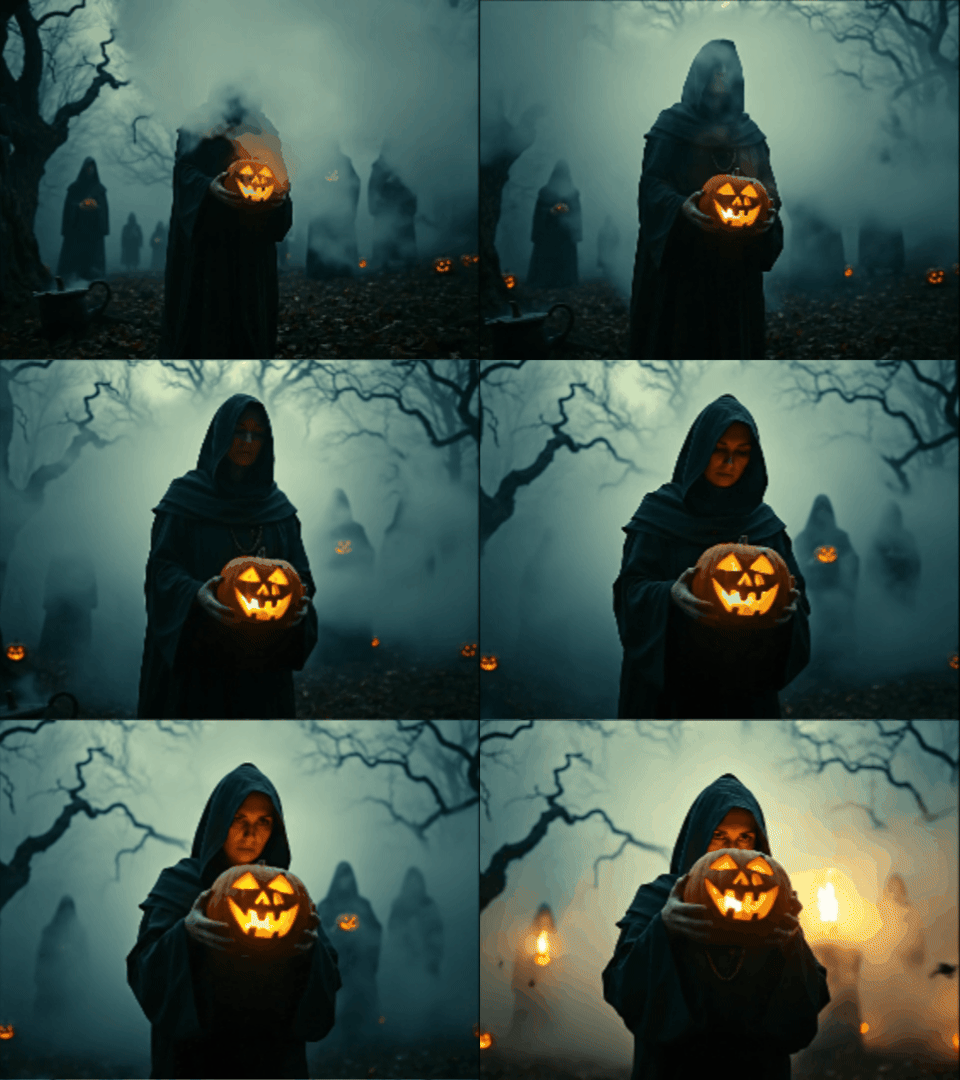
- Jack-o’-Lanterns: Carved turnips (later pumpkins in America) were carried as lanterns. Their gruesome faces were meant to ward off malevolent entities.
- Trick-or-Treating: This is a faded echo of leaving food and drink offerings out for the ancestors and the spirits to ensure their good favor for the coming winter.
When Irish and Scottish immigrants brought these traditions to America, the commercial, pop-culture version of Halloween we know today was born.
But beneath the plastic and the sugar, the old, powerful currents of Samhain remain. It is an invitation, once a year, to confront our own mortality, to honor our past, and to listen closely to the whispers from the other side of the veil.
This Halloween, by all means, enjoy the party. But maybe also take a quiet moment. Light a candle for your ancestors. Pull a tarot card. Reflect on what you’re ready to let “die” in your own life so that something new can be born in the spring.




Leave a Reply