Happy Halloween Week!
If you’re looking for something to watch this Halloween, you could put on a familiar American slasher film. There’s a masked killer, a Final Girl, and a series of jump-scares you can set your watch to. And that’s fine. But if you’re like me and you want your horror to be a “college-level” experience—something more akin to a beautiful, violent, and deeply unsettling fever dream—then you need to be watching Giallo.
Giallo (which just means “yellow” in Italian, a nod to the cheap, yellow-covered pulp mystery novels of the 1930s-60s) is a genre of Italian thrillers that flourished in the 1970s. On the surface, they are murder-mysteries. But in reality, the “whodunit” plot is almost secondary.
In Giallo, the real star is the killer’s weapon: style.
The fear in Giallo doesn’t come from a monster jumping out of a closet. It comes from a disorienting, over-saturated color palette, a camera that prowls like a predator, and a jarring, often prog-rock or synth-heavy score that attacks your senses. It’s about psychological terror, sexual paranoia, and the unreliability of memory.
Forget jump-scares. Giallo is an aesthetic assault. It’s the perfect, sophisticated genre for a spooky night in. Here are 5 essential films to get you started.

1. Blood and Black Lace (1964)
Directed by Mario Bava


This is, for many, the foundational text. If Giallo is the parent of the American slasher, Blood and Black Lace is the glamorous, chain-smoking grandparent. The plot is simple: a masked, black-gloved killer stalks and murders the models at a high-fashion house in Rome.


But Bava, a genius cinematographer, wasn’t interested in a simple mystery. He was interested in color. The film is a masterpiece of art direction, drenched in lush, unreal jewel tones. Murder scenes are not hidden in shadow; they are lit like high-fashion advertisements, using fields of deep red, emerald green, and cobalt blue. The killer’s white, featureless mask is a terrifying blank canvas. Bava turns a fashion salon into a surreal tomb, proving that true horror can be beautiful.

2. The Bird with the Crystal Plumage (1970)
Directed by Dario Argento


This is the film that made Dario Argento a superstar and defined the Giallo formula. An American writer in Rome witnesses an attempted murder in a brightly lit, modernist art gallery. He’s trapped between two panes of glass. It is a perfect metaphor for his role in the film. He is a passive observer who knows he saw something important but can’t place what it was.


This film is all about the philosophy of perception, exploring how our senses shape our understanding of reality. The mystery hinges on a flawed, suppressed memory that resurfaces unexpectedly, prompting the characters to question their past experiences and the nature of truth itself. As the plot unfolds, viewers are drawn into a web of misinterpretations, illustrating how perception can be both a window to the world and a barrier to understanding.


Argento’s camera forces you into the protagonist’s point-of-view, making you obsessed with the one crucial detail he missed. It’s a true thriller that’s more interested in the psychology of the witness than the actions of the killer.

3. Deep Red (Profondo Rosso) (1975)
Directed by Dario Argento


If Bird was the formula, Deep Red is the opera. Many (myself included) consider this Argento’s greatest Giallo. A jazz pianist witnesses the brutal murder of a psychic and becomes obsessed with solving it, dragged into a dark past of a disturbing, half-remembered children’s song.


Everything in this film is “too much” in the best way possible. The score by the band Goblin is a character in itself—a jarring, funky, terrifying prog-rock assault that blares during moments of high tension. The violence is elaborate, and the camera lingers on strange details: a grotesque laughing doll, a child’s drawing on a wall, a single hanging-glass prism.


It’s a film about how trauma echoes from the past, and it is a masterpiece of sustained, stylish dread. Through its haunting visuals and carefully crafted narrative, the movie delves deep into the psychological scars left behind by unresolved pain, portraying the characters’ struggles as they confront their demons. Each scene resonates with an atmosphere of suspense, inviting the audience to experience the weight of history bearing down on the present.

The cinematography captures both the beauty and terror of its settings, emphasizing the intricate relationship between memory and reality, ultimately leaving viewers with a lingering sense of unease that reflects the pervasive nature of trauma in our lives.

4. Don’t Torture a Duckling (1972)
Directed by Lucio Fulci

While Argento and Bava are known for their operatic urban fantasies, Lucio Fulci’s Giallo is often grittier, meaner, and more cynical. This film is a fantastic, and deeply upsetting, example. Set in a superstitious, rural Southern Italian village, it follows a series of child murders.

The film is a brutal critique of institutions. It pits “modern” characters (a journalist, a “liberated” rich woman) against the forces of backward tradition, mob justice, and the corrupt Catholic Church. The horror here is less about a stylish “whodunit” and more about the real, tangible evil that hides in “decent” society. It’s a sour, powerful, and unforgettable film.

5. Suspiria (1977)
Directed by Dario Argento


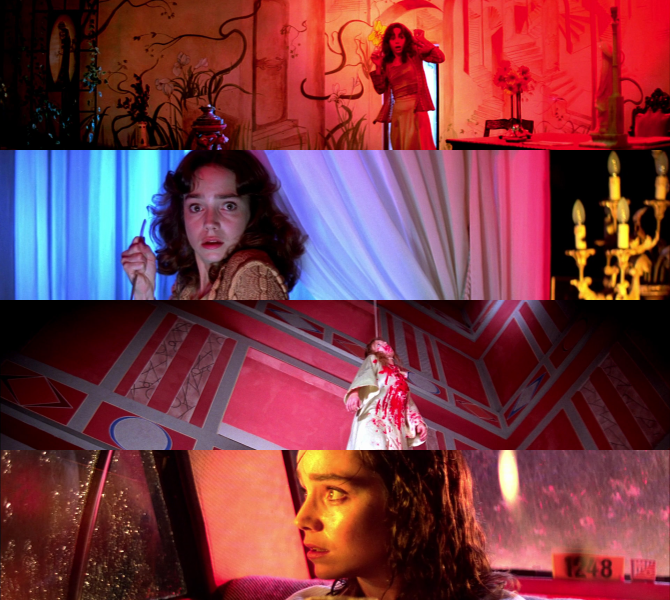
This is my “college-level” pick, the film that pushes Giallo beyond the “mystery” genre and into pure supernatural art-horror. An American ballet student arrives at a prestigious German dance academy, only to find it’s a front for a coven of witches.


Forget plot. Suspiria is not a story; it is an experience. Argento famously used 1950s Technicolor film stock to create a hyper-saturated, primary-colored nightmare. The film is a relentless, 98-minute sensory attack. The architecture is impossible, the colors are violent, and Goblin’s score is a cacophony of whispers, bells, and thundering drums. Suspiria is the ultimate example of “style as substance”—the film’s aesthetic is the horror.


It feels less like you’re watching a movie and more like you’re having a panic attack in an art museum. It is, in my opinion, one of the most terrifying films ever made.
For a little more on the Giallo genre, check out this video exploring Giallo films. It gives a good visual overview of the style I’ve been discussing.




Leave a Reply