
Happy Halloween Week!
If you’ve ever watched a horror movie and been struck by its intoxicating style—its obsessive use of color, a pulsating synth score, and a killer who seems to be an artist of the macabre—chances are you’ve seen the influence of Giallo.

For the uninitiated, Giallo (Italian for “yellow,” a nod to the cheap, yellow-covered pulp mystery novels of post-war Italy) is a film subgenre that defined Italian horror in the 60s and 70s. But these aren’t your standard slashers. Giallo is a fever dream of high fashion, psychological trauma, and brutalist architecture, all set to a prog-rock beat.

As a blog that sits at the crossroads of style, philosophy, and the unseen, I find Giallo to be one of the most fascinating movements in pop culture. It’s a genre that’s less about the “who” and more about the “how”—and, most importantly, the “why” of it all.
Let’s explain it all.
The Giallo Formula: Style Over Sanity

At its core, a Giallo film is a murder mystery. But directors like Mario Bava (Blood and Black Lace) and Dario Argento (Deep Red) weren’t just interested in a simple whodunit. They were obsessed with the aesthetics of the whodunit.

The key ingredients are:
- The Look: This is where the “preppy goth” in me finds its cinematic roots. The victims are almost always impossibly stylish, often models or artists, living in stunning, modernist apartments. The killer, conversely, is a shadow: black trench coat, black leather gloves, and a gleaming blade. It’s high-fashion glamour juxtaposed with brutal, intimate violence.
- The Camera as Voyeur: The killer’s point-of-view shot is a Giallo staple. We see the murders through the killer’s eyes, making the audience complicit. This isn’t just a technical choice; it’s a philosophical one. It forces us to question the nature of voyeurism and our own dark impulses.
- The Sound: Forget subtle strings. Giallo is famous for its jarring, complex, and often beautiful scores from bands like Goblin. The music doesn’t just build tension; it attacks you, creating a disorienting, almost psychedelic state.
- The Psychology: The killer is rarely a monster. They are a product of deep psychological trauma, often sexual in nature. The films are obsessed with fractured identities, unreliable narrators, and the fallibility of memory. The protagonist who witnessed the crime is often told they “didn’t really see” it, plunging them (and the audience) into a paranoid spiral of “what is real?”

The Esoteric Exception: When Giallo Met the Occult
Here’s where it gets really interesting for us. For most of the genre, the answer to “what is real?” is firmly terrestrial. The supernatural is almost always a red herring, a distraction from the very human, psychologically-broken killer.
And then Dario Argento made Suspiria (1977).


Suspiria is the grand, esoteric exception. It takes all the stylistic tools of Giallo—the saturated, unreal colors (so much red!), the subjective camera, the intricate death set-pieces, and a legendary Goblin score—but it breaks the one cardinal rule.

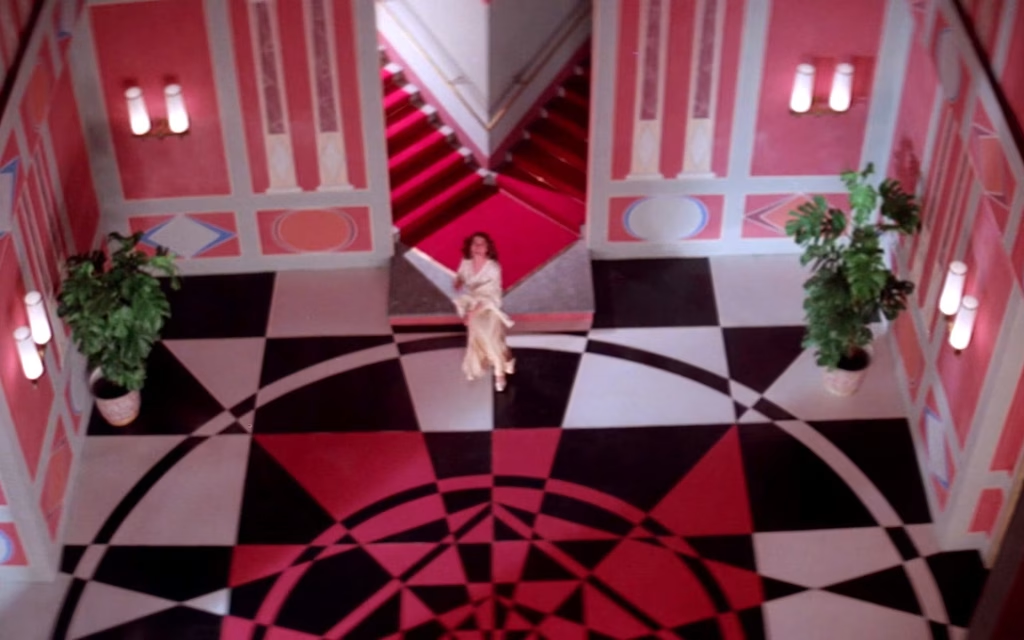
The killer isn’t just a traumatized human. It’s a coven of witches.
Suspiria is what happens when you pour pure occultism into a Giallo framework. It transforms the genre’s psychological dread into supernatural, spiritual dread. The film’s logic isn’t the logic of a detective story; it’s the logic of a dark fairy tale or a magical ritual. The German dance academy isn’t just a beautiful set; it’s a functioning coven, a place where magic is the true operating system.

Why It Still Haunts Pop Culture
Giallo’s influence is everywhere. It’s the spiritual father of the entire American slasher genre (John Carpenter’s Halloween is deeply indebted to it). You can see its DNA in the stylish nightmares of directors like Nicolas Winding Refn (The Neon Demon) and the neon-soaked thrillers of today (Edgar Wright’s Last Night in Soho is a direct homage).
Giallo endures because it’s a perfect synthesis of pop culture, high art, and deep philosophical questions. It argues that aesthetics and psychology are deeply intertwined. It suggests that our darkest traumas are often hidden behind the most beautiful, stylish facades.
And in its most potent form, it reminds us that sometimes, just sometimes, the monster in the shadows isn’t just a person—it’s the ancient, unknowable magic we’ve been trying to explain away.
What’s your favorite Giallo film? Do you prefer the psychological-thriller Bavas or the supernatural-horror Argentos? Let me know in the comments.


Leave a Reply