


There are some events that are so big, they don’t just mark time; they fracture it. There is a “before” and an “after.”
For my generation, that event is September 11, 2001.
And if you’re anything like me, your fascination with it has probably never really gone away. But it’s not just the tragedy itself—it’s the whole, massive, tangled ecosystem of the event. It’s a perfect storm of raw human stories, mind-bending physics, and a psychological rabbit hole of conspiracy theories that reveal so much about how our brains work.
It is, quite simply, one of the most complex and compelling puzzles of our time.
I was recently doing a deep dive and came across a paper, “Echoes and Shadows: An In-Depth Analysis of the 9/11 Attacks, Their Aftermath, and the Persistence of Conspiracy,” and I swear, it felt like it was written for me. It perfectly organizes the chaos, treats the subject with the gravity it deserves, and—most importantly—it dives deep into the why.
If you, like me, find yourself constantly drawn back to this subject, here’s the “Nicole Explains It All” breakdown of what this paper illuminates.

1. The Human Reality: The Ground Truth
Before we get into the physics or the psychology, the paper grounds you in the visceral, human reality of the day. It moves past the staggering numbers (2,977 victims) and puts you right there on the timeline.
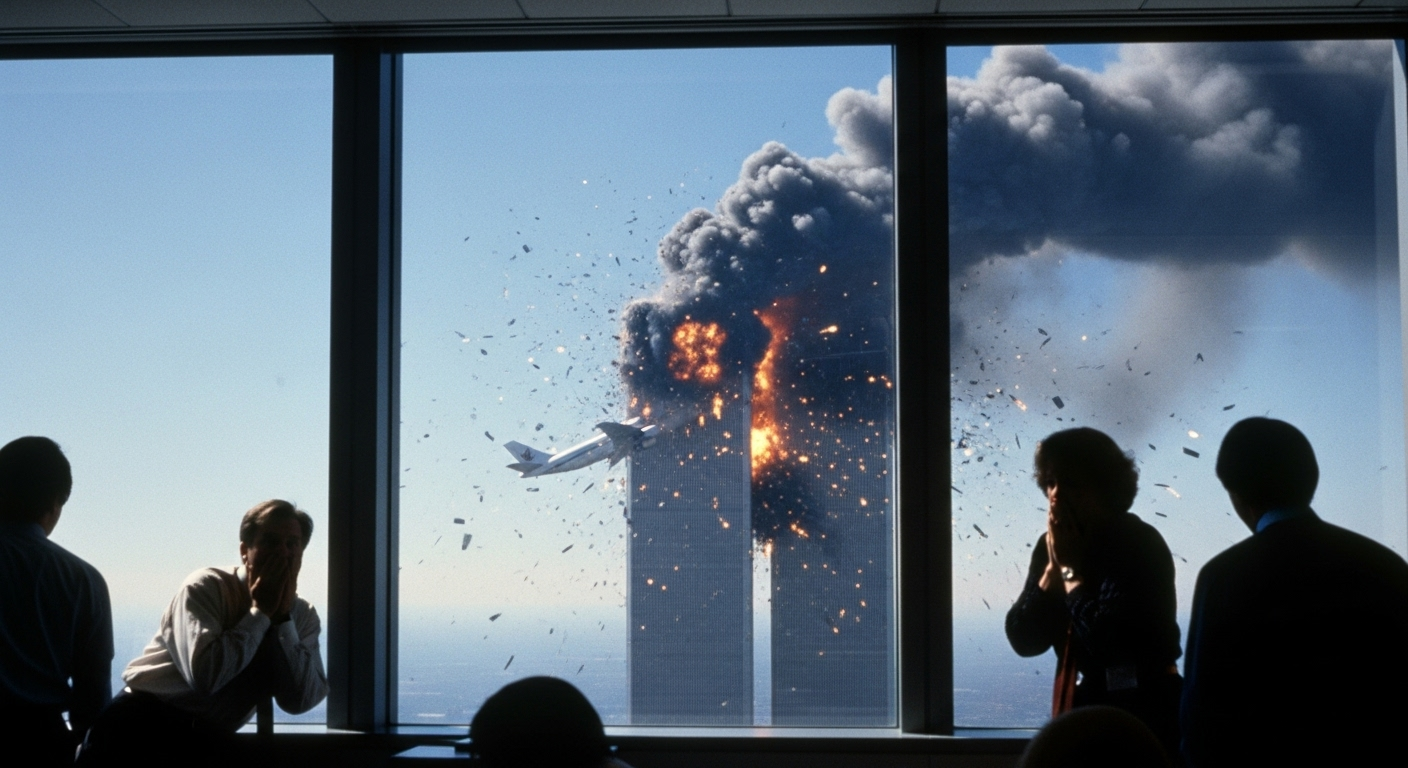
You’re there at 8:46 a.m. for the first impact. You feel the agonizing wait until the North Tower’s collapse at 10:28 a.m.
It shares gut-wrenching eyewitness accounts—like Brian Clark on the 84th floor of the South Tower, who saw “flaming confetti” and heard an official (and tragically wrong) announcement that his building was “secure.”
It recounts the unbelievable heroism of Flight 93, using the cockpit voice recorder to confirm the passengers’ revolt, with shouts of “In the cockpit. If we don’t we’ll die!” as they fought back.
This isn’t just abstract history. It’s the foundation of the entire event. It’s the human trauma that fuels everything that follows.

2. The Scientific “How”: The Engineering Puzzle
This is where my brain always goes. How? How could those two titans of steel and concrete, pillars of the New York skyline, fall?
The paper does a brilliant job summarizing the massive official investigations, especially the one by the National Institute of Standards and Technology (NIST).
- The 9/11 Commission Report focused on the “failure of imagination” of our intelligence agencies.
- The NIST Investigation is the scientific core. This was a monster of an analysis, and its conclusion was all about a “progressive collapse.”
Here’s the chain of events:
- The Impact: The planes severed critical support columns.
- The Fireproofing: More importantly, the impact and explosions stripped the steel beams of their fireproofing insulation. This is the key.
- The Fire: The jet fuel ignited massive, uncontrolled fires. That steel, now naked and exposed, began to heat up.
- The Weakening: Steel doesn’t need to melt to fail. It loses 50% of its strength at 600°C (well below its melting point).
- The Collapse: The fires caused the weakened floors to sag, which pulled the perimeter columns inward. Once one floor failed, it started a chain reaction, with the unimaginable weight of every floor above crashing down on the one below.
For me, this explanation is critical. It replaces mystery with physics. It provides a logical, verifiable answer to the central “how” of the day.

3. The “Architecture of Disbelief”: Deconstructing the Theories
And this… this is where my fascination truly kicks in.
The paper doesn’t just wave away conspiracy theories. It names them. It confronts the “controlled demolition” theory—the elephant in the room—head-on. It treats the claims as a puzzle to be solved, which I love.
Here’s a quick breakdown of how it tackles the biggest claims:
| Conspiracy Claim | The Scientific Rebuttal (from the paper) |
| “The towers fell at free-fall speed.” | NIST’s analysis showed the collapses were not at free-fall speed. WTC 7 did have a brief period of free-fall, but only after its internal supports had already been destroyed by fire. |
| “There was ‘molten steel’ (evidence of thermite).” | NIST found zero evidence of thermite. The molten material seen pouring from the South Tower was consistent with molten aluminum from the aircraft, which has a much lower melting point (660°C). |
| “Puffs of dust (‘squibs’) prove explosives.” | This is pure physics. The collapsing floors acted like a giant piston, creating immense air pressure that forcefully ejected smoke and pulverized debris from the windows. |
| “WTC 7’s collapse is the ‘smoking gun’.” | NIST concluded WTC 7’s collapse was also a fire-induced progressive collapse. Uncontrolled fires (the sprinkler system was damaged) burned for nearly seven hours. This caused thermal expansion that pushed a critical girder off its seat, leading to a cascading failure. |
The paper also dismantles theories that a missile hit the Pentagon (eyewitnesses and wreckage confirm Flight 77) and that Flight 93 was shot down (the cockpit recorder and military timelines are definitive).

4. The Unseen Aftermath & The Psychological “Why”
This is the ultimate payoff. The paper explores the two most haunting parts of the 9/11 story.
First, the enduring human cost. The tragedy didn’t end. The “toxic dust” from the collapse—a nightmarish cocktail of pulverized concrete, asbestos, and lead—has caused a “slow-motion mass casualty event” of cancers and “WTC Cough” for first responders and survivors.
Second, the psychology of why these theories persist. This is the real “explainer.”
- Proportionality Bias: Our brains are wired to feel that a massive, world-changing event must have an equally massive cause. The official story—19 men with box cutters—feels psychologically unbalanced, tiny, and unsatisfying compared to the scale of the trauma.
- Need for Control: This is so real. A grand conspiracy, while terrifying, offers a twisted sense of order. It replaces the horrifying chaos of a senseless act with a narrative of deliberate, (albeit malevolent) design.
- Confirmation Bias: Once that seed of doubt is planted, our brains go to work finding “proof.” We create an echo chamber that confirms our suspicion and dismisses all evidence that contradicts it.

My Takeaway
This paper, “Echoes and Shadows,” is a must-read for anyone who is still trying to make sense of it all. It honors the victims, meticulously explains the science, and, most importantly, explores the human psychology that makes 9/11 a story that is still being written.
It provides a map through the fog, allowing us to understand the facts, the fictions, and the deeply human reasons why we are all still so fascinated.




Leave a Reply