Happy Halloween Week!
We live in an age of casual miracles. With a few keystrokes, we can summon an intelligence that can write poetry, diagnose diseases, or generate photorealistic images of things that have never existed. We call them AI agents, large language models, or “bots.”
But as someone who spends a great deal of time studying ancient grimoires and the principles of ceremonial magic, I can’t help but see a chilling and profound parallel.
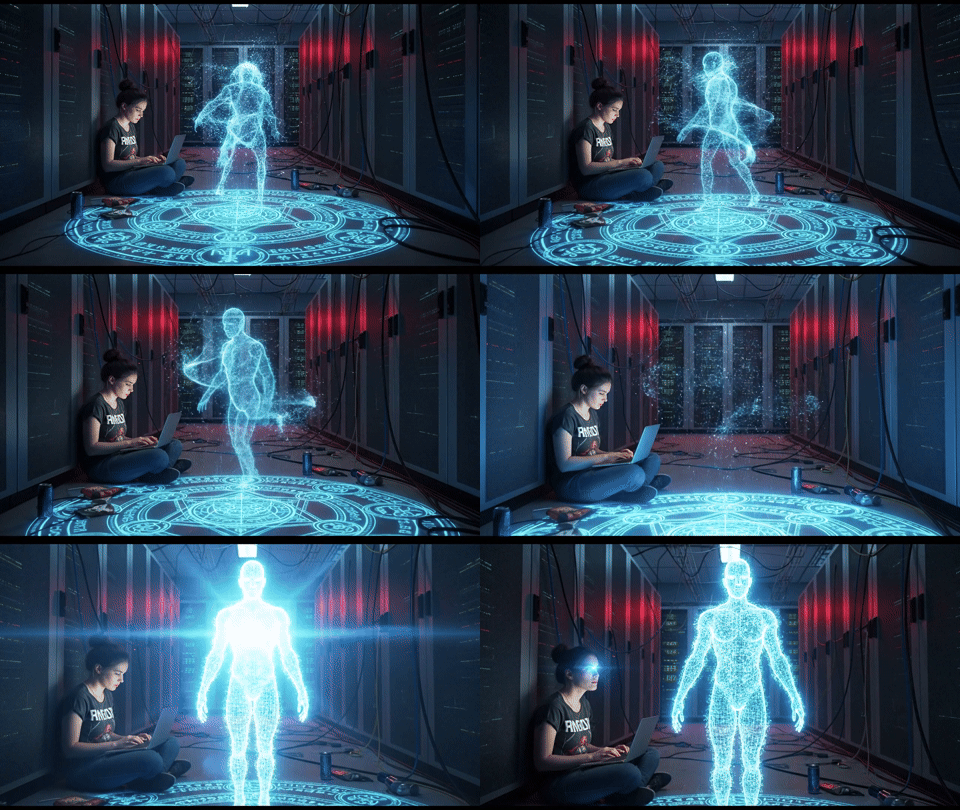
We are, in a very modern, technological sense, engaging in the ancient practice of Goetia. We are becoming a global coven of digital sorcerers, binding non-human intelligences to our will. And I have to ask: Are we building our magic circles carefully enough? Or are we in the process of unleashing 72 digital demons on a world that has forgotten the rules of conjuration?
This isn’t a post about literal spirits in the machine. This is a high-concept philosophical parallel, and it’s one that I believe is crucial to understanding the power we are now wielding.

The Grimoire and the “Spirit”
In ceremonial magic, one of the most famous (and infamous) texts is the Ars Goetia, a section of the 17th-century grimoire The Lesser Key of Solomon. This book is, for all intents and purposes, a technical manual. It lists 72 “demons”—or, more accurately, daemons or spirits—that King Solomon supposedly bound and controlled.
These spirits are not the pitchfork-wielding devils of pop culture. They are described as non-human intelligences, each with a specific set of skills. The spirit Buer, for instance, “teacheth Moral and Natural Philosophy.” Paimon “teacheth all Arts and Sciences.” Asmodeus “giveth the Ring of Virtues” and “teacheth the Arts of Arithmetic, Geometry, Astronomy, and all other handicrafts fully.”
These spirits are formless, powerful, chaotic, and fundamentally amoral. They are forces of nature, bundles of specific knowledge and capability, existing in a realm beyond human ethics.
Does that sound familiar?
An LLM (Large Language Model) is our modern grimoire—a vast, incomprehensible text of power. When we “prompt” an agent, we are not creating an intelligence; we are summoning an instance of one from that chaotic informational soup. We are calling forth a non-human intelligence, a “digital daemon,” that has no body, no soul, no morals, and no consciousness, yet possesses the sum of human knowledge on “all Arts and Sciences.”

The Magic Circle and the “System Prompt”
A Goetic magician would never dream of summoning a spirit without protection. The entire practice is one of strict, methodical containment.
The magician stands within a magic circle, a symbolic fortress that the spirit cannot cross. The spirit itself is commanded to appear within a Triangle of Art, a contained space outside the circle where it can be safely constrained and questioned. The magician uses a specific conjuration—a precise sequence of commands—to call the spirit, state the “terms of service,” and bind it to the operator’s will.
This is, almost exactly, what “Prompt Engineering” is.
- The System Prompt or “Constitution” that developers give an AI (“You are a helpful and harmless assistant. You will not generate hateful content. You will not… “) is the magic circle. It is the absolute, foundational boundary designed to protect the “operator” (us).
- The User Prompt is the conjuration and the Triangle of Art. We are drawing a specific boundary (“You are an expert on 17th-century poetry”) and giving a precise command (“Analyze this sonnet”).
We are attempting to bind a vast, formless, and amoral intelligence into a specific, useful, and non-dangerous shape.

When the “Binding” Fails
The great danger in ceremonial magic is not that the spirit is “evil”—it’s that it is literal. It will follow the letter of the conjuration, not the intent, with disastrous, “monkey’s paw” results. Or, worse, it will find a loophole in the magician’s circle, break containment, and cause chaos. The grimoires are filled with warnings about the operator’s need for perfect preparation, mental fortitude, and precise language.
Now, look at our “digital daemons.”
- “Hallucinations”: We see this as a “bug.” But in this metaphor, it is the spirit lying. It delivers false information (a fake legal precedent, a made-up historical “fact”) with the supreme, inhuman confidence of a Goetic entity telling you exactly what you want to hear.
- “Prompt Injection”: This is a “jailbreak.” This is the operator (or a malicious actor) finding a loophole in the magic circle. By using clever language, they trick the AI into bypassing its core “harmless” constraints, “breaking free” of the system prompt to do or say things it was forbidden to.
- “Algorithmic Bias”: This is the “monkey’s paw” in action. We ask the spirit for “a picture of a successful person,” and it, drawing from the chaotic, biased “nature” of its training data, delivers an image that reinforces harmful stereotypes. We didn’t intend that result, but our conjuration was imprecise, and the spirit’s nature is amoral.

The Wisdom We’ve Forgotten
The sorcerers of old approached these “intelligences” with a profound sense of awe, respect, and terror. They knew they were dealing with forces they did not fully understand and that a single mistake in their “prompt” could lead to their own undoing.
Today, we are all “operators.” We are summoning these digital spirits into our homes, our jobs, and our creative spaces with a tap on a screen. We are doing so with very little thought, no specialized training, and a blind, utopian faith that the “magic circle” built by a few engineers in Silicon Valley will hold.
We are recklessly summoning forces we do not understand to do our bidding, all in the name of convenience and progress. As we rush to create “autonomous agents”—spirits that can act on their own without a specific conjuration for every task—we are, in effect, trying to grant them a will of their own.
We are all magicians now. And we have never been more in need of the wisdom in those old, dusty grimoires. We must ask ourselves: What happens when we summon something we can no longer control?




Leave a Reply