The Philosophical & Magical Roots of Halloween

Happy Halloween!
Every year, the aisles fill up with plastic skeletons, bags of candy, and superhero costumes. We carve pumpkins and watch horror movies. We all know and love Halloween. But as someone who lives and breathes this stuff, I’m always fascinated by the why.
Where did all this come from? Why ghosts? Why this specific time of year?
If you’ve been hanging around my blog, you know I love to peel back the layers. When you strip away the surface of modern, commercial Halloween, you discover something much older. It is deeper and far more powerful. This is the ancient Gaelic festival of Samhain (pronounced ‘SOW-in’ or ‘SAH-win’).
This isn’t just “spooky season.” From a philosophical and magical perspective, it’s one of the most important nights of the year.


What is Samhain?
Long before it was “All Hallow’s Eve,” Samhain was one of the two great “hinges” of the Celtic year, along with its counterpart, Beltane (in May).
- Beltane was the festival of life, light, and the start of summer.
- Samhain was its opposite: the festival of darkness, the end of the harvest, and the beginning of winter—the “darker half” of the year.
This was the Celtic New Year. It was a time of profound transition. The harvest was in, the fields were “dying,” and the community was preparing to survive the cold, dark months ahead. It was a time of death, endings, and turning inward.
And this is where the magic comes in.

The Metaphysics: “The Veil is Thinning”
You’ve probably heard this phrase, but what does it actually mean?
In many spiritual, esoteric, and Hermetic philosophies, we don’t just live in one “reality.” There is the physical, material world we see and touch (the “seen”) and the energetic, spiritual, or astral realms (the “unseen”). Think of it as the world of spirit, of ancestors, of archetypes, and of the collective unconscious.
Most of the time, a “veil” or barrier separates these two worlds.
At Samhain, that veil is at its thinnest.
Why? Think of the Hermetic principle: “As above, so below.” The outer world is a mirror of the inner world.
As the world around us literally dies—the leaves fall, the air grows cold, the nights grow long, and life retreats from the surface—the boundary between the world of the living and the world of the dead becomes permeable. The energetic “wall” that separates our mundane reality from the spiritual realms dissolves.
This isn’t just a metaphor. For magical practitioners, this is a tangible, atmospheric shift. It’s a time when the “other world” feels incredibly close, and communication across that barrier is easier than at any other time of the year.

Why This Matters for Magic & Spirituality
Because the veil is thin, Samhain has traditionally been the most important time for specific kinds of spiritual work:
- Divination: This is the classic time for all forms of divination—tarot, scrying with a black mirror, pendulum work, you name it. The “signal” from the other side, from your subconscious, or from the collective unconscious is considered to be much clearer and louder. Answers come more easily.
- Ancestor Veneration: This is the heart of Samhain. It is a time to honor, remember, and connect with our loved ones who have passed on. Many traditions (including modern witchcraft) set out a “dumb supper” (a silent meal with an extra place setting) for their ancestors, inviting them to join the feast. It’s a time for gratitude and for acknowledging that we are the product of all those who came before us.
- Spirit Work & Ceremonial Magic: For those who practice ceremonial magic, this is a time when the “gates” to the other world are already open. Rites involving spirit contact, astral journeying, or deep inner-world exploration are far more potent and accessible.
- Shadow Work: On a psychological level, Samhain is the perfect time for shadow work. As we enter the “dark half” of the year, it’s a natural cycle for us to turn inward and look at our own “dark” parts—the fears, traumas, and habits we keep hidden. Samhain gives us the spiritual and energetic support to face these things, to let old parts of ourselves “die” so we can be reborn.

So What About Halloween?
When you see Samhain through this lens, all our modern traditions suddenly make sense. They are the cultural “ghosts” of these ancient rites.
- Ghosts & Skeletons? A literal representation of the veil thinning and the dead walking among us.
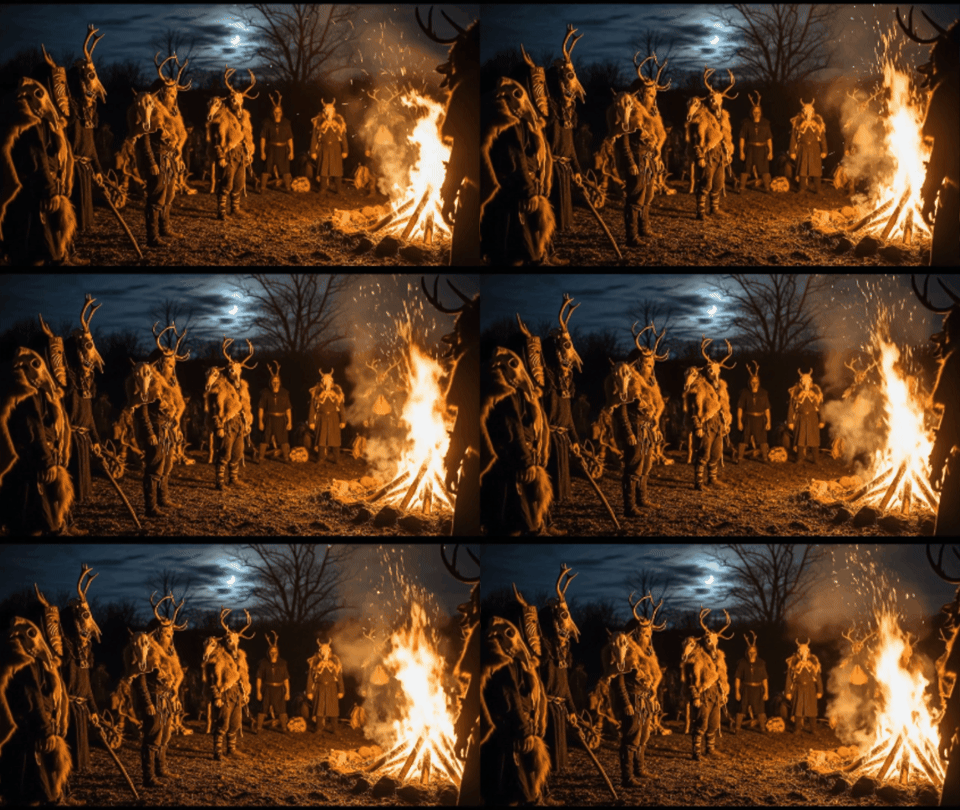
- Costumes? Originally, people wore disguises (like animal skins) to either blend in with the spirits roaming the earth or to fool them.
- Trick-or-Treating? This is a direct echo of the ancient practice of leaving food and drink (offerings) on the doorstep to appease the spirits and the aos sí (the fae or “fairy folk”) who were also active on this night.

So, when you’re carving your pumpkin, you are taking part in an ancient ritual. A “Jack-o’-Lantern,” originally a hollowed-out turnip, was meant to ward off unwanted spirits. This tradition is thousands of years old.
You are standing at the hinge of the year. This is a magical threshold between the living and the dead. It is also between the seen and the unseen. It’s so much more than just candy.
Have a blessed—and magical—Samhain.




Leave a Reply