
Happy Halloween Week!
As the wheel turns to Samhain, the air thins. This is not just folklore; it is a description of a perceptible shift in spiritual and psychic energy. The boundary between our world and the Otherworld becomes permeable, and the voices of our ancestors, of spirits, and of our own deepest intuition grow louder.
For the serious practitioner, Halloween is not about spectacle but about listening. Divination on this night is less about predicting a mundane future and more about engaging in a profound dialogue with the unseen.
Here are three esoteric techniques, explored through the philosophy that gives them power.
1. Scrying the Void: The Philosophy of the Dark Mirror

While many know of crystal gazing (spheromancy), the use of a dark mirror or a bowl of water (catoptromancy) is a more focused and introspective art.
The Philosophy:
A clear mirror reflects the self; a dark mirror reflects the shadow. Unlike a reflective surface that shows you what is in the material world, a black mirror, obsidian sheet, or a bowl of blackened water acts as a focused void. It is a sensory deprivation tool for the conscious mind.

The goal is not to “see” images in the mirror, but to use the mirror as a gateway through which the “inner sight” can project.
- The Gateway: The practitioner enters a liminal, semi-trance state by staring fixedly at the dark surface. This fatigues the optic nerve, causing the conscious, analytical mind to recede.
- Projective Imagination: The scryer’s gaze turns inward. The “images” that appear are the subconscious and, potentially, the collective unconscious, projecting symbols onto the blank canvas of the void.
- Hermetic Principle: This practice engages the principle of “As Above, So Below.” The microcosm of the dark mirror becomes a focal point for the macrocosm of the astral plane or the “spirit world.” You are not just looking at a reflection; you are looking into a representation of the primordial darkness from which all things emerge.
Practical Application:
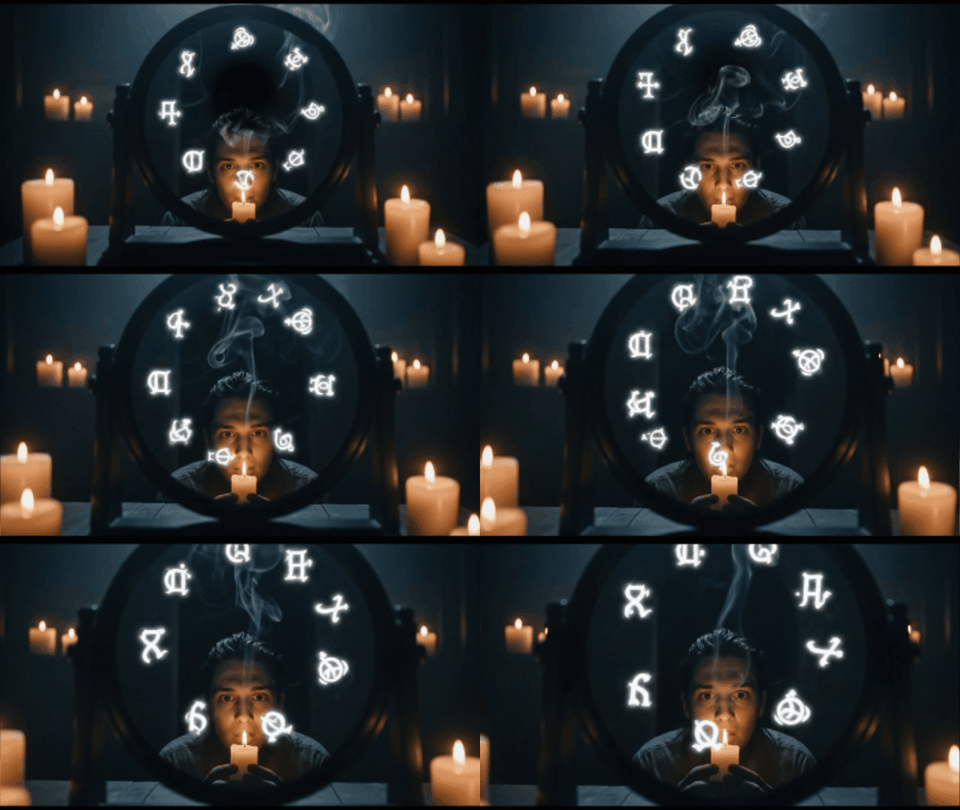
In a dimly lit room, consecrate a black mirror or a simple bowl of water mixed with dark (non-toxic) ink. Light a single candle behind you, so its reflection is not visible on the surface. Gaze softly, not staring, but into the depth of the darkness. Let your eyes relax and unfocus. Be a passive receiver. Note any symbols, faces, or scenes that drift into your mind’s eye without judgment.

2. Weaving the Bloodline: Tarot for Ancestral Connection
On Halloween, the tarot deck shifts its function. It becomes less a tool for divination of future events and more a medium for communicating with those who came before.
The Philosophy:
This practice assumes that our ancestors are not truly “gone” but exist as a living part of our spiritual and genetic makeup—a “blood-memory.” They have wisdom, but they no longer speak the same language we do.

The 78 cards of the Tarot provide a universal symbolic language, a framework of archetypes that can bridge the gap.
- The Deck as Translator: The cards become a “switchboard.” You are not asking the cards “What will happen?” You are asking your ancestors, “What do you need me to know?” The cards that appear are the symbolic translation of their non-verbal message.
- Beyond Archetypes: The High Priestess may not just be the traditional archetype of intuition; she may be the specific face of your great-grandmother, a folk magic practitioner whose wisdom you inherited. The 10 of Swords may not be “ruin,” but a representation of a specific, shared trauma your lineage is asking you to heal.
- Active Dialogue: This is not a passive reading. It is an active, sacred conversation. The spread itself is an act of setting a table, inviting your ancestors to sit and speak through the language of the cards.
Practical Application:
Cleanse your space and your deck. Hold the deck and state your intention aloud, inviting the wise and loving ancestors of your bloodline to speak. Shuffle the cards while focusing on your lineage.
Try a simple 3-card “Ancestral Message” spread:
- The Root: What is the primary gift or strength my ancestors have given me?
- The Wound: What is the unresolved burden or challenge they ask me to heal?
- The Message: What is the single most important piece of guidance they offer me right now?

3. Understanding the Dialogue: The Theory of “Polite” Necromancy
This is the most misunderstood of the three techniques. Modern “necromancy” in this context is not about the grisly, physical reanimation depicted in fiction. It is about the theory and practice of dialogue with the dead.
The Philosophy:
From a historical and grimoire perspective, necromancy ($nekrós$, “dead,” and $manteía$, “divination”) was purely a divinatory art. The core theory is that the shade or spirit of a departed person, existing on another plane, retains the knowledge it had in life and potentially gains a broader perspective in death.
- Ceremonial vs. Folk: Magical traditions distinguished between “low” necromancy (attempting to manipulate the physical corpse) and “high,” or ceremonial, necromancy. This latter form involved creating a safe, consecrated space and respectfully inviting the spirit to communicate.
- The Grimoire Model: Texts like the Hygromanteia or the Key of Solomon outline complex (and often dangerous) rites, not to “raise” a body, but to compel a specific spirit to appear to the magician’s sight and answer questions. The elaborate circles, tools, and incantations were all designed to protect the magician and ensure the spirit’s obedience.
- The Modern Re-frame: For the modern practitioner, especially on Samhain, this theory is applied as ancestral veneration. It is “polite necromancy.” We do not seek to command or bind; we seek to honor and listen.

Practical Application (Honoring the Theory):
The safest and most respectful application of this theory is the simple act of setting a “dumb supper” or an ancestral altar.
- Set a place at your table, or create a small altar with photos or heirlooms of your deceased loved ones.
- Place offerings of food and drink (traditionally, what they loved in life—a glass of whiskey, a piece of bread, a cup of coffee).
- Light a white candle and speak their names. Thank them for the lives they lived and the legacy they left.
- Ask for their collective wisdom and protection. Then, sit in silence and listen—not with your ears, but with your intuition. This act honors the dead, acknowledges their continued presence, and opens a respectful, two-way line of communication.

Would you like me to elaborate on one of these techniques, perhaps by suggesting a specific ancestral tarot spread or digging deeper into the history of black mirrors in divination?




Leave a Reply