
Well, it’s that time of year again. As the air gets crisp and Halloween approaches, the plastic skeletons, store-bought “witch” costumes, and—of course—the “Voodoo” decor emerge. We see the shelves fill with pin-stuck dolls and sensationalized imagery of zombies, all reducing a complex spiritual tradition to a cheap horror trope.
As a Creole woman, and as a Christian witch who deeply respects the complex spiritual landscape of Louisiana, this season always makes me sigh. The Hollywood version of “Voodoo” is a caricature, a distortion that has more to do with racist propaganda than reality.
This Halloween, I want to use my platform to explain it all—to look beyond the myths and talk about the real history, the real faith, and the powerful practices that are part of my heritage. It’s time to separate the sacred from the sensational.
(Note: The information here is based on extensive research, which you can read in-depth in the attached PDF: “Researching New Orleans Voodoo Myths.”)

Part 1: “Voodoo” is a Religion, Not a Spooky Spell
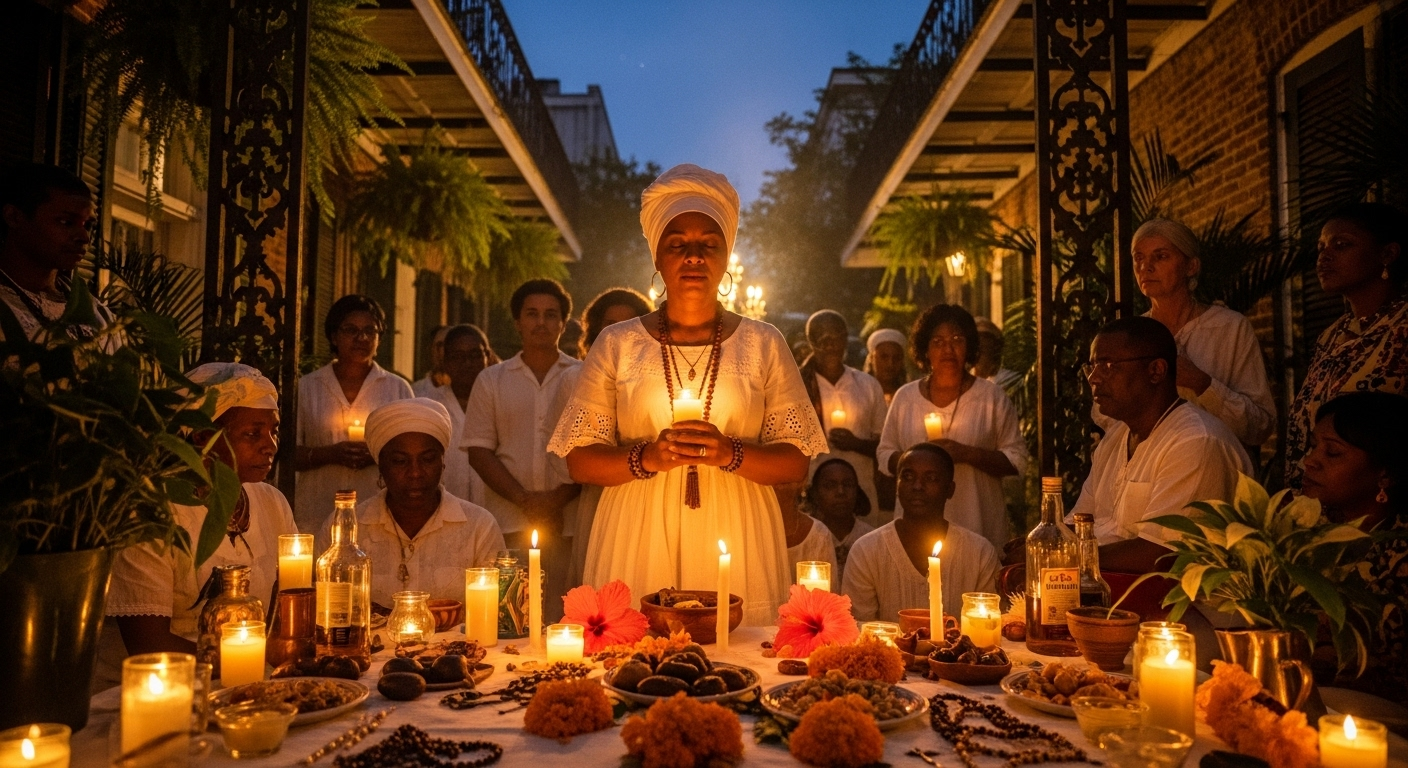
First, let’s get the biggest thing straight: New Orleans Voodoo is a formal religion. It’s not just a collection of spells or “black magic.” Like any faith, it has a sophisticated theology, a priesthood, and communal worship.
At its heart, it is fundamentally monotheistic.
Practitioners believe in a single, supreme creator God known as Bondyé, a name from the French Creole Bon Dieu, or “Good God”. In Voodoo theology, Bondyé is the architect of the universe, but is considered too vast and remote to be involved in the daily affairs of humanity.
Because Bondyé is distant, practitioners interact with a pantheon of intermediary spirits called the Lwa (or Loa). Think of them as being similar to the angels in Christianity or the saints in Catholicism—they are not gods themselves, but intermediaries who serve as a bridge between the human world and the divine creator. Each Lwa has a distinct personality and governs a specific domain, like love, wisdom, or the crossroads.
This is a faith centered on community, healing, and honoring the ancestors.

Part 2: The “Christian” in Christian Witch: Syncretism as Survival
So, how does this all fit with Christianity? This is the part that, as a Christian witch, I find most brilliant. The Voodoo practiced in New Orleans is a syncretic faith, born from one of the most brutal chapters in history.
Its foundations come from the traditional religions of West and Central Africa, carried by enslaved peoples from groups like the Fon, Ewe, and Yoruba. In Louisiana, under French and Spanish rule, the Code Noir (Black Code) mandated that all enslaved people be forcibly baptized and converted to Roman Catholicism. The practice of their ancestral religions was forbidden.
In an ingenious act of spiritual resistance, they developed a “Catholic mask”. This wasn’t a dilution of their faith; it was an active strategy for survival. They masked their own Lwa behind the images of Catholic saints who shared similar attributes:
- Papa Legba, the indispensable gatekeeper of the spirit world, was syncretized with St. Peter, who holds the keys to the kingdom of heaven1818.
- Damballah, the powerful serpent deity representing creation and wisdom, was associated with St. Patrick, who is famously depicted with snakes19191919.
- Erzulie Fréda, the spirit of love and beauty, was often associated with the Virgin Mary (specifically, Mater Dolorosa, Our Lady of Sorrows).
This weaving together of faiths is the very soul of Creole spirituality. They used the oppressor’s religion as a shield to preserve their own.

Part 3: Voodoo, Hoodoo, and Creole Magic: What’s the Difference?
This is a crucial distinction, and it’s where I, as a witch, situate my own understanding. The terms are often jumbled, but they are not the same.
- Voodoo (or Vodou): As we’ve covered, this is the formal religion. It has a priesthood (Houngan and Mambo), a system of initiation, and a communal worship structure centered on Bondyé and the Lwa.
- Hoodoo (or Rootwork/Conjure): This is a system of African American folk magic, not a religion. Its focus is on practical, tangible results: healing, attracting luck, gaining protection, or even cursing an enemy. It uses herbs, roots, minerals, and personal items, but it doesn’t require devotion to the Lwa or a religious hierarchy.
- Creole Magic: This is the unique, results-oriented expression of these spiritual practices as they manifested in New Orleans. It’s the practical application of spiritual power, deeply infused with the city’s syncretic blend of Catholic, European folk, and Native American influences.

This is why it’s possible for someone like me to be a Christian Creole witch without being a Voodoo practitioner. My path is one of folk magic, rooted in the same fertile spiritual ground, but distinct from the initiatory religion of Voodoo.

Part 4: Debunking the Hollywood Halloween Myths
Now, let’s bust the three biggest myths you’ll see this Halloween.
Myth #1: The “Voodoo Doll”
- The Myth: A pin-stuck effigy used to inflict pain on an enemy.
- The Reality: This is not a central practice in Louisiana Voodoo. The use of “poppets” for magic has a long history in European folk magic, and its association with Voodoo is largely a Hollywood invention. In New Orleans, dolls are almost always used for benevolent purposes: to focus energy for healing, to bless someone, or to attract love. The pins are used to attach a personal item (like a photo or a lock of hair) or a written petition to the doll, connecting it to the person who is to receive the blessing.

Myth #2: Zombies
- The Myth: A Voodoo priest reanimating corpses to create a mindless army of slaves, as seen in films like White Zombie (1932).
- The Reality: Zombies play no part in the formal religious practices of Voodoo. The zonbi does exist in Haitian folklore, but it is not a monster; it is a tragic victim. The zonbi is said to be a person whose soul has been stolen by a malevolent sorcerer, leaving a soulless body behind. This concept is widely understood as a powerful and haunting metaphor for the horrors of slavery: the complete loss of free will, identity, and humanity. It is a figure to be pitied, not feared.

Myth #3: Devil Worship and “Black Magic”
- The Myth: That Voodoo is a form of Satanism, dedicated to evil and cursing.
- The Reality: This is fundamentally false. As we established, Voodoo is monotheistic and honors a supreme creator, Bondyé. There is no Devil figure in Voodoo theology that is equivalent to the Christian Satan. This myth has its roots in the racist propaganda spread after the Haitian Revolution (which was empowered by Vodou), designed to dehumanize the successful rebels. The religion’s primary focus is overwhelmingly positive: healing, fostering community, and seeking guidance from the spirits and ancestors.

My Final Thought
New Orleans Voodoo is a profound story of spiritual endurance. It’s a living, breathing faith that was forged in the fires of oppression and stands as a testament to the resilience of the human spirit.
The grotesque caricatures that pop up every Halloween aren’t just “harmless fun”; they are the lingering ghosts of a propaganda campaign designed to demonize an African-diasporic religion.
So this season, as a witch and a Creole woman, I ask you to be respectful. When you see that plastic “voodoo doll,” remember the real tradition it mocks: a complex faith of survival, community, and spirit.




Leave a Reply