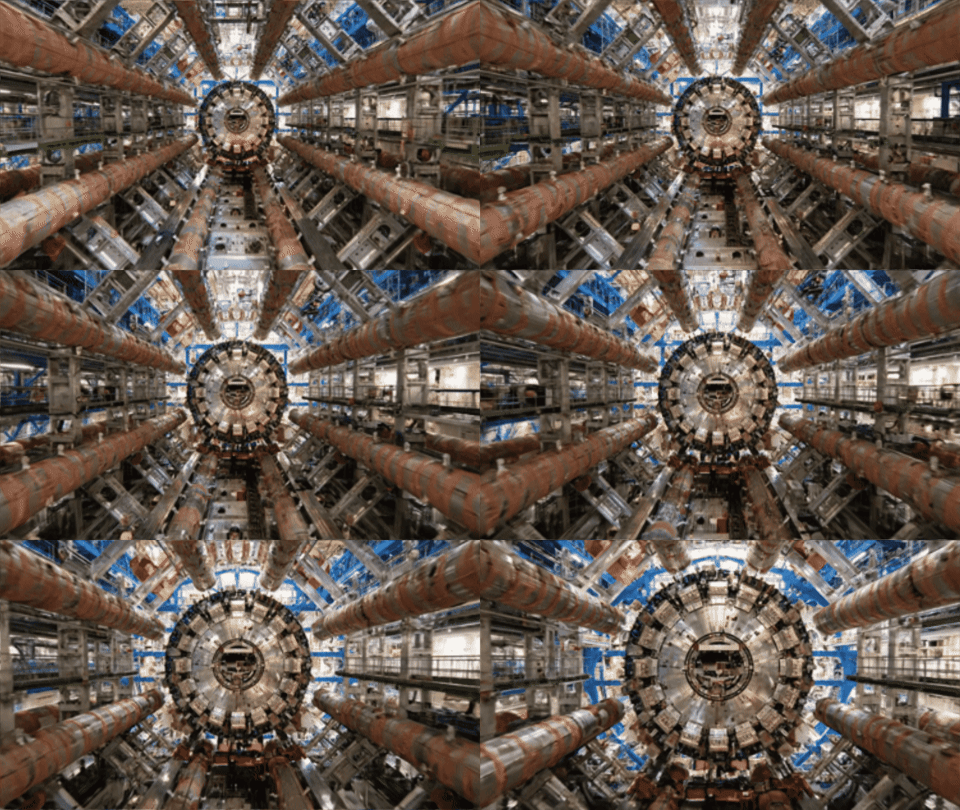
Deep beneath the border of France and Switzerland lies the largest, most complex machine ever built by humankind: The Large Hadron Collider (LHC) at CERN. It’s a 17-mile-long (27-kilometer) ring of superconducting magnets designed to smash particles together at nearly the speed of light. Its mission? To unlock the most fundamental secrets of the universe—how it began, what it’s made of, and the laws that govern it.

In 2012, it succeeded spectacularly with the discovery of the Higgs boson, the elusive particle that gives mass to all other particles. It was a Nobel Prize-winning triumph that confirmed our best model of physics.
But for a place dedicated to an almost priestly search for knowledge, CERN has become a magnet for some of the wildest, darkest, and most compelling conspiracy theories on the planet. From world-ending black holes to demonic portals, the public’s imagination has run wild.
So, what’s really going on at CERN? Is it a monument to human ingenuity or a sci-fi doomsday device? Let’s separate the physics from the phantoms.
The “Real” World: Budgets and Scientific Droughts
Before we get to the portals, it’s worth noting that the real controversies at CERN are much more grounded.
- The Billions-Dollar Question: The LHC cost billions to build and costs over a billion dollars a year to run. Critics argue that in a world with pressing issues like climate change and disease, spending this much money to find exotic particles is a luxury we can’t afford. Proponents argue that this is the price of fundamental knowledge, and the technological-spin-offs (like the World Wide Web, which was invented at CERN in 1989) pay for the investment many times over.
- The Great Physics “Drought”: After the massive high of finding the Higgs boson, the LHC has entered a bit of a “physics desert.” Scientists hoped to find all sorts of new, exciting things like “supersymmetry” (a theory that suggests every particle has a “super-partner”) or evidence of dark matter. So far… nothing. This has led to a quiet crisis in theoretical physics: Is our understanding of the universe wrong, or do we just need an even bigger collider?

The “Weird” World: Black Holes, Demons, and the Mandela Effect
This is where things get strange. The sheer scale and power of the LHC—operating at energy levels never seen before on Earth—has created a fertile ground for public fear.

1. The Apocalypse Machine: “It’ll Make a Black Hole!”
This is the most famous fear. The theory goes that by smashing particles with such force, the LHC could accidentally create a micro black hole that would, with its runaway gravity, devour the lab, then Switzerland, and then the entire planet in a matter of minutes.
- The Scientific Rebuttal: Scientists at CERN have debunked this completely. First, if micro black holes can be created, they would be unimaginably small and, thanks to a principle called “Hawking radiation,” would evaporate almost instantly (in about 0.000000000000000000000000001 seconds).
- Second, the Earth is already being hit by cosmic rays from deep space that are far more powerful than anything the LHC can produce, and it’s still here. The LHC is just recreating these natural events in a controlled lab.

2. The Shiva Statue and Portals to Hell
Outside the CERN headquarters sits a prominent statue of the Hindu deity Shiva, the “cosmic dancer” who both creates and destroys the universe.
For conspiracy theorists, this is a massive red flag. They see it not as a gift from India celebrating the “cosmic dance” of subatomic particles, but as a pagan idol—a symbol of destruction. This theory claims CERN’s true goal is to use the collider’s magnetic forces to “rip the veil” between dimensions and open a gateway, letting in… well, demons, extra-dimensional beings, or the H.P. Lovecraft monster of your choice.
This idea was supercharged by a bizarre, unauthorized video filmed on CERN grounds in 2016. It appeared to show a group of cloaked figures staging a mock “human sacrifice” in front of the Shiva statue. CERN immediately condemned the video, confirming it was a prank staged by visiting researchers with a “warped sense of humor.” But for those already suspicious, the damage was done.

3. Pop Culture and the Mandela Effect
Pop culture hasn’t helped calm anyone’s nerves.
- In Dan Brown’s thriller “Angels & Demons,” CERN is the place where a canister of antimatter (something CERN actually creates in tiny, tiny amounts) is stolen to be used as a time bomb to destroy the Vatican.
- In the beloved anime/visual novel “Steins’ Gate,” a shadowy European organization called “SERN” (sound familiar?) uses its particle collider to master time travel and create a dark, totalitarian future.
This has all fed into the “Mandela Effect,” the bizarre phenomenon where large groups of people misremember a key fact (like “Berenstain” vs. “Berenstein” Bears). One of the most popular (and strangest) theories is that CERN’s experiments are smashing us into different, parallel universes, subtly altering our shared timeline and history.

So, What’s the Truth?
CERN is a lightning rod because it represents the absolute, bleeding edge of human knowledge. The work being done there is so complex and so far removed from our daily lives that it feels like magic. And like any powerful magic, it inspires both awe and terror.
The reality is that CERN is a place of profound curiosity. It’s not trying to summon demons or end the world. It’s trying to answer the biggest question of all: “Why?” But in a world where science often looks and feels like science fiction, it’s no wonder that CERN has become the star of its own, very weird, conspiracy thriller.




Leave a Reply