Hey there,
If you have ever explored the roots of Western occultism with me, ceremonial magic, or esoteric philosophy, all roads eventually lead back to one source: the Corpus Hermeticum.
Often called the “spiritual bedrock” of the Western esoteric tradition, this collection of texts provides the framework for everything from the Renaissance revival of magic to the modern Golden Dawn. But what exactly is it, and why does a text written in Roman Egypt nearly 2,000 years ago still hold the keys to spiritual liberation?
Let’s open the books of Hermes and explore the mind of the All.
Part I: The Origins and The Sage
What is the Corpus Hermeticum?
The Corpus Hermeticum (CH) is not a single book, but a collection of seventeen (sometimes listed as eighteen) Greek treatises. These texts were written between approximately 100 and 300 CE in Roman Egypt—a time and place where Greek philosophy, Egyptian religion, and various mystical traditions were blending into a potent spiritual cocktail.

These writings are traditionally attributed to a legendary figure: Hermes Trismegistus (“Hermes the Thrice-Greatest”).

Who is Hermes Trismegistus?
Hermes Trismegistus is a syncretic deity—a fusion of two distinct gods of wisdom:
- Hermes: The Greek messenger god, ruler of communication and travel.
- Thoth: The Egyptian ibis-headed god of writing, magic, and wisdom.

In the dialogues of the CH, Hermes serves as the spiritual master, instructing his disciples—primarily Tat (his son) and Asclepius—on the nature of reality.

Part II: The Core Philosophy (The All is Mind)
The theology of the Corpus Hermeticum is Monistic—meaning it emphasizes the divine unity of all things. It moves away from the pantheons of squabbling gods and points toward a single source.
1. The Doctrine of Mentalism
Perhaps the most famous concept to emerge from Hermeticism is the idea that “The All is Mind; the Universe is Mental.”
The CH teaches that the Cosmos is a creation that resides within the Mind (Nous) of God. Everything that exists is a thought within the Divine Mind. God is described as characterless, possessing only the quality of pure goodness.

2. Cosmogony: How the Universe Was Made
In the first book of the collection, the Poimandres, we are given a creation story.
- The Act of Will: God creates primary matter and separates it into the four elements.
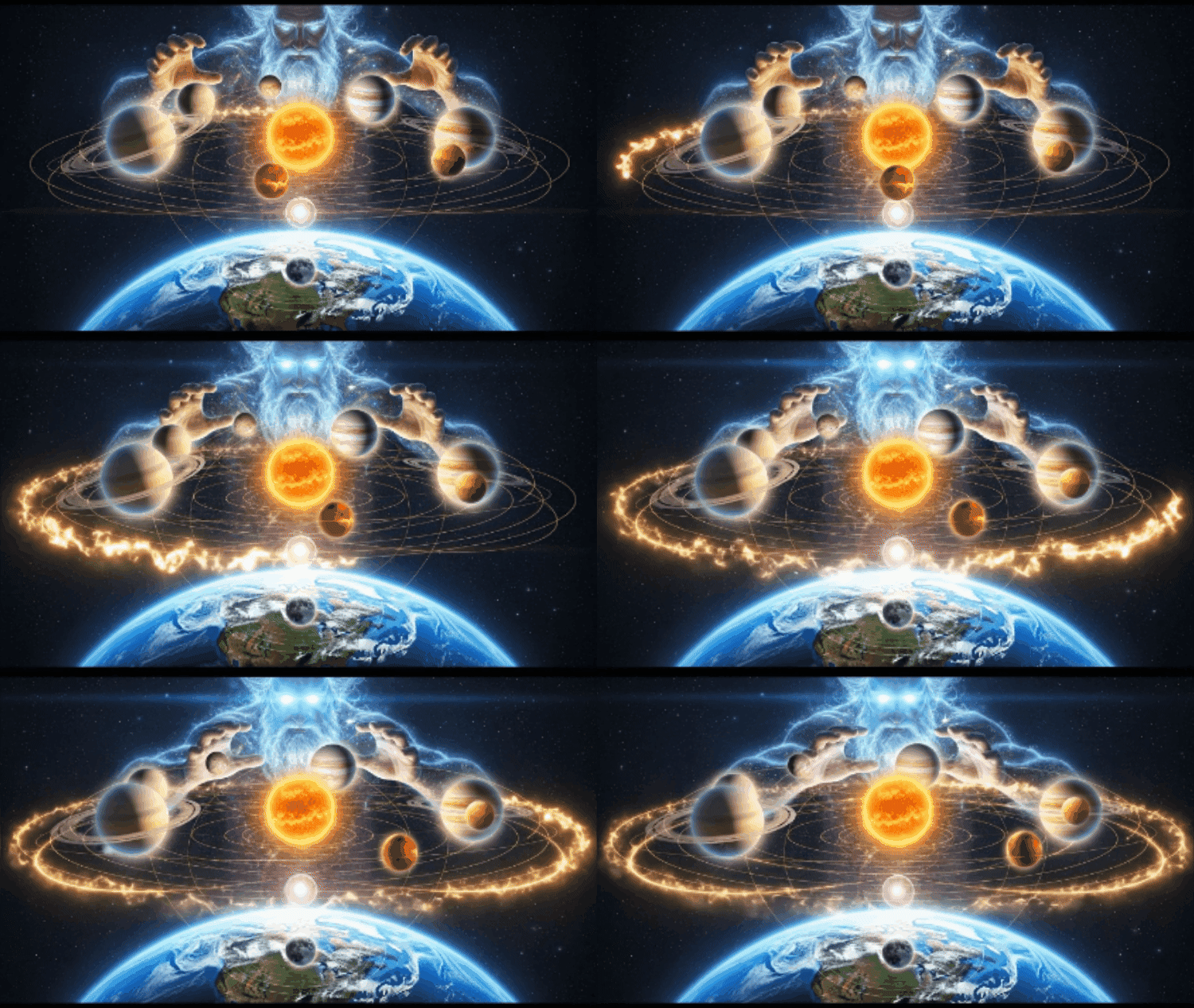
- Ordering the Cosmos: The Divine Mind uses a “Demiurge” (a craftsman) to order the universe into seven heavens.
- The Spheres: These seven heavens correspond to the classical planets (Saturn, Jupiter, Mars, Sun, Venus, Mercury, Moon). These spheres constitute the “machinery” of fate that governs the material world.

3. As Above, So Below
While the phrase comes from the associated Emerald Tablet, the principle permeates the CH. Human beings are a microcosm (a small universe) that perfectly reflects the macrocosm (the great universe). Because we are made in the image of the Divine Mind, we possess the unique ability to understand the cosmos.
Part III: The Human Condition and The Goal
The Corpus Hermeticum offers a specific view of anthropology (what it means to be human) and a clear path for what we are supposed to do with our lives.
The Trap of Materialism
The text posits that humans are dual in nature: we have a divine intellect (Nous) but are trapped in a material body.
- Good and Evil: Nous brings forth good. However, evil actions stem from desire and ignorance.
- The Great Sin: The only thing that truly offends God is focusing entirely on material life (spiritual sterility). Since God is a generative power, we are meant to create and do positive works.

The Ultimate Goal: Gnosis
The purpose of the Hermetic path is not just faith, but Gnosis. Gnosis is not intellectual data; it is a direct, intuitive, transformative knowledge of the Divine. It is a “light bulb moment” of the soul.
To achieve Gnosis, one must undergo Spiritual Rebirth. This involves:
- Awakening: Realizing your divine nature.
- The Ascent: A process where the soul ascends through the seven heavenly spheres. At each sphere, the soul sheds the negative material influences associated with that planet, eventually reuniting with the One.

Part IV: The Legacy
Why are we still talking about these texts?
When the Corpus Hermeticum was translated into Latin by Marsilio Ficino in the 15th century, it exploded like a spiritual bomb across Europe. Scholars believed it represented a prisca theologia—a pristine, ancient theology that predated Moses and Plato.
This translation laid the foundation for:
- Renaissance Occult Philosophy.
- Ceremonial Magic.
- Neoplatonic thought.
- Modern orders like the Hermetic Order of the Golden Dawn.

Final Thought
The Corpus Hermeticum is more than a history book, it is a spiritual map. It reminds us that we are not merely biological accidents, but thoughts in the mind of the Divine, capable of breaking the chains of fate through the power of knowledge.




Leave a Reply