Why is Gravity So Weak? (And Why the Answer Might Be “Extra Dimensions”)
One of the biggest mysteries in physics is actually something you probably witness every time you walk into your kitchen. It’s the “Fridge Magnet Paradox.”
Think about it: A tiny little magnet can effortlessly pick up a paperclip, defying the gravitational pull of the entire Earth. How is that possible? How can the gravity of a massive planet be so easily overpowered by a piece of magnetized metal the size of a coin?
This puzzle is known in the scientific world as the Hierarchy Problem. It asks why gravity is so profoundly weaker than the other fundamental forces, like electromagnetism.
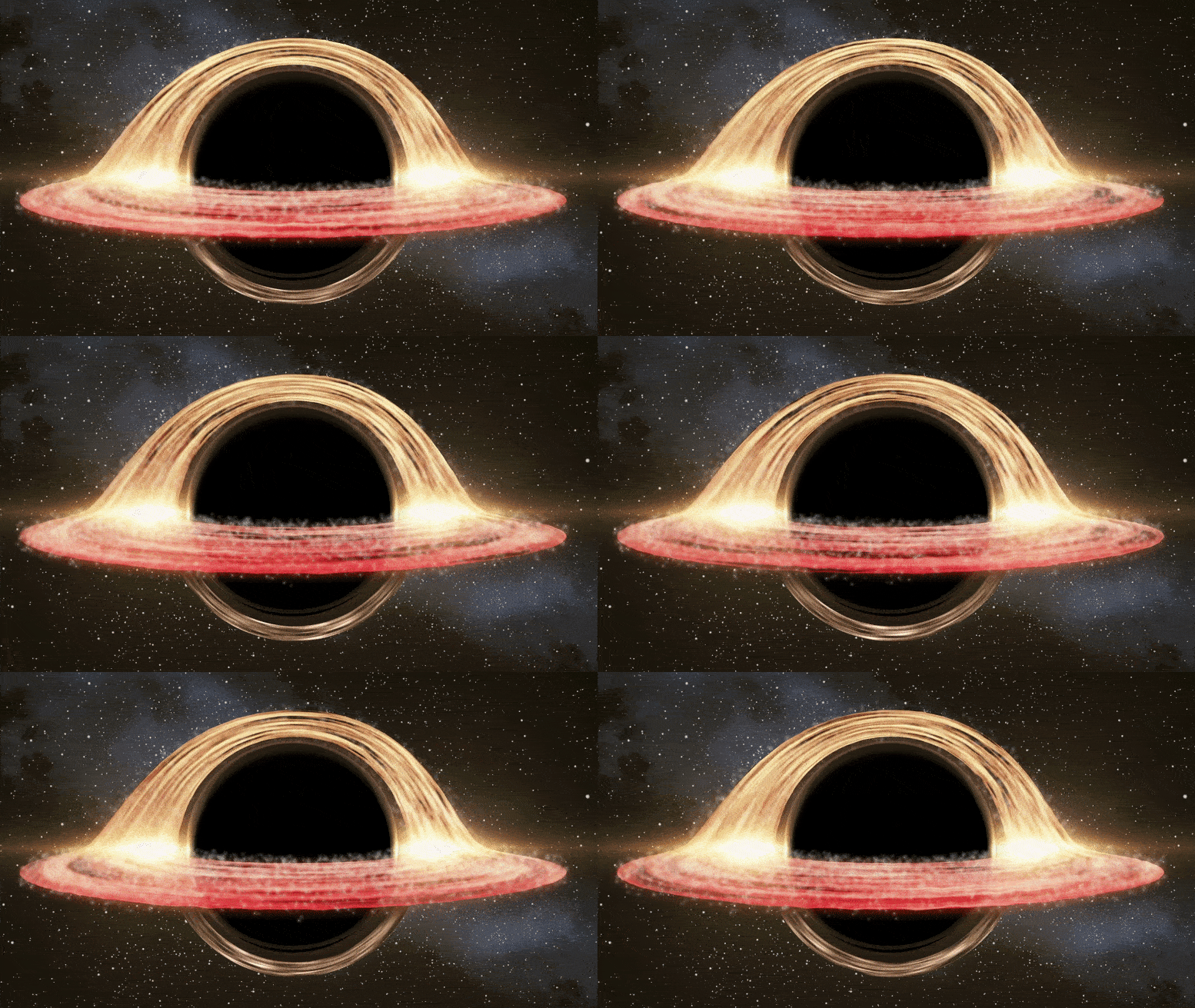
To solve this, scientists at the Large Hadron Collider (LHC) are hunting for something that sounds straight out of a sci-fi novel: microscopic black holes. The leading theory? Gravity isn’t actually weak—it’s just leaking into extra dimensions we can’t see.
Here is how I wrap my head around this wild search and what it means for our understanding of the universe.
The “Leaking” Gravity Theory
So, why do we think extra dimensions are the culprit?
The search is driven by theoretical frameworks like the ADD model (Arkani-Hamed, Dimopoulos, and Dvali) and the Randall-Sundrum (RS) model. In simple terms, these theories suggest that our entire observable universe is a three-dimensional “brane” (membrane) floating inside a higher-dimensional space called the “bulk.”
Here is the kicker:
- The Leak: According to these models, particles like electrons and quarks are stuck here on our 3D brane. But gravity? Gravity is unique. It might be able to travel—or “leak”—into those extra dimensions in the bulk.
- The Dilution: Because gravity is spreading out into a much larger volume than the other forces, it appears weak to us. It’s not that it lacks strength; it’s just diluted.
Smashing Particles to Find Black Holes
If gravity is actually strong but just hiding in other dimensions, the energy level where it becomes powerful (the Planck scale) might be much lower than we traditionally thought. Instead of being unreachable, it might be around 1 TeV—an energy level the Large Hadron Collider can actually reach.
This turns the LHC into a “strong gravity” machine.
The idea is that if you smash two particles together with enough energy, gravity might overcome the other forces and cause those particles to collapse into a microscopic black hole. If these theories are right, creating these tiny black holes wouldn’t be a rare, freak accident—it would be a dominant effect at the collider.
How Do We Spot a Tiny Black Hole?
Don’t worry, these aren’t the “eat the earth” kind of black holes. Scientists aren’t looking for a hole in the ground; they are looking for how these things die.
- Instant Evaporation: Theoretical models predict these quantum black holes would be incredibly unstable. They would vanish almost instantly via Hawking Radiation.
- “Democratic” Decay: This is my favorite term in physics. Because gravity cares about mass, not charge, these black holes should be “democratic.” They should treat everyone equally, decaying into a spray of all types of particles—quarks, leptons, bosons—in roughly equal amounts.
- The Fireball: Detectors like ATLAS and CMS are looking for “fireballs”—spherical explosions of energy. They specifically hunt for high “transverse energy,” which is basically the sum of the energy of everything flying out of the collision.
The Verdict (So Far)
So, have we found them?
Not yet. Despite extensive searches, the LHC hasn’t spotted these signatures. This non-discovery is actually helpful science—it helps physicists set limits. We now know that if these black holes exist, they must be heavier than about 3.5 to 4.5 TeV.
And for anyone worried about safety: even if we did make them, they are harmless. We know this because high-energy cosmic rays have been bombarding our atmosphere for billions of years with way more energy than the LHC, and Earth is still here.
An Analogy to Bring It Home
If your brain hurts trying to visualize 4D space, try visualizing a garden sprinkler instead.
Imagine a sprinkler spraying water (gravity). If you confine that water to a thin hose (1D), the pressure at the end is intense. But if the hose bursts and sprays water into the open air (3D), the stream feels weak at any single point because that same amount of water is being shared across a huge volume.
That is what might be happening to gravity. It’s “spraying” into extra dimensions we can’t see. To us, on our little 3D “hose,” it feels like a weak drizzle. But if we could zoom in close enough to where the leak starts—like we try to do at the LHC—we might find that the pressure is actually incredibly intense.




Leave a Reply