For those of you who have journeyed with me through the labyrinthine corridors of Western Occultism, deciphering ancient grimoires and understanding the subtle energies of the cosmos, you know the power of a well-defined term. Just as “Qliphoth” isn’t merely “evil,” and “Aura” transcends a simple feeling, so too does the burgeoning world of Artificial Intelligence possess its own lexicon, often veiled in technical jargon.
Fear not, fellow seekers of knowledge! Just as we illuminated the shadows of the unseen, we can cast a clear light on the mechanisms of the algorithmic. This glossary is designed to bridge the gap, offering simple, accessible explanations of key AI terms, drawing parallels where possible to concepts you might already intuit from your esoteric studies. Think of it as your first grimoire for understanding the digital daemons and spirits that are increasingly shaping our world.
The Core Concepts: Understanding the AI Mind
Artificial Intelligence (AI): At its heart, AI is the creation of machines or software that can perform tasks traditionally requiring human intelligence. Just as a scrying mirror might offer a glimpse into the unseen, AI offers a new lens through which to process information and make decisions, often at speeds and scales beyond human capacity.
Machine Learning (ML): This is a subset of AI where systems “learn” from data without being explicitly programmed. Imagine a diviner who, after years of observing patterns in tea leaves, begins to instinctively understand their meanings. ML algorithms are given vast datasets, and through statistical analysis, they discern patterns and make predictions or classifications. It’s learning through experience, albeit digital experience.
Deep Learning (DL): A subfield of Machine Learning, Deep Learning employs artificial neural networks with multiple layers (hence “deep”) to learn from data. Think of it like a complex magical sigil, with interconnected lines and symbols, each layer processing information and passing it on to the next. These networks are particularly adept at tasks like image recognition and natural language processing.
The Voices and Visions: How AI Communicates and Creates
Large Language Model (LLM): This is a type of deep learning model designed to understand, generate, and process human language. Imagine a skilled orator who has memorized countless texts, speeches, and conversations, and can then weave new narratives, answer questions, and even compose poetry. LLMs are trained on enormous datasets of text and can predict the next word in a sequence, allowing them to generate coherent and contextually relevant prose. These are the digital scribes and storytellers.

Diffusion Model: These are generative AI models capable of creating realistic images, audio, and other data. Imagine a sculptor who starts with a block of raw material (noise) and through a process of gradual refinement and shaping, brings forth a detailed and beautiful form. Diffusion models work by taking a noisy input and iteratively “denoising” it, guided by a text prompt or other conditioning, until a clear image emerges. These are the digital alchemists of visual creation.

Enhancing Intelligence: Making AI More Potent
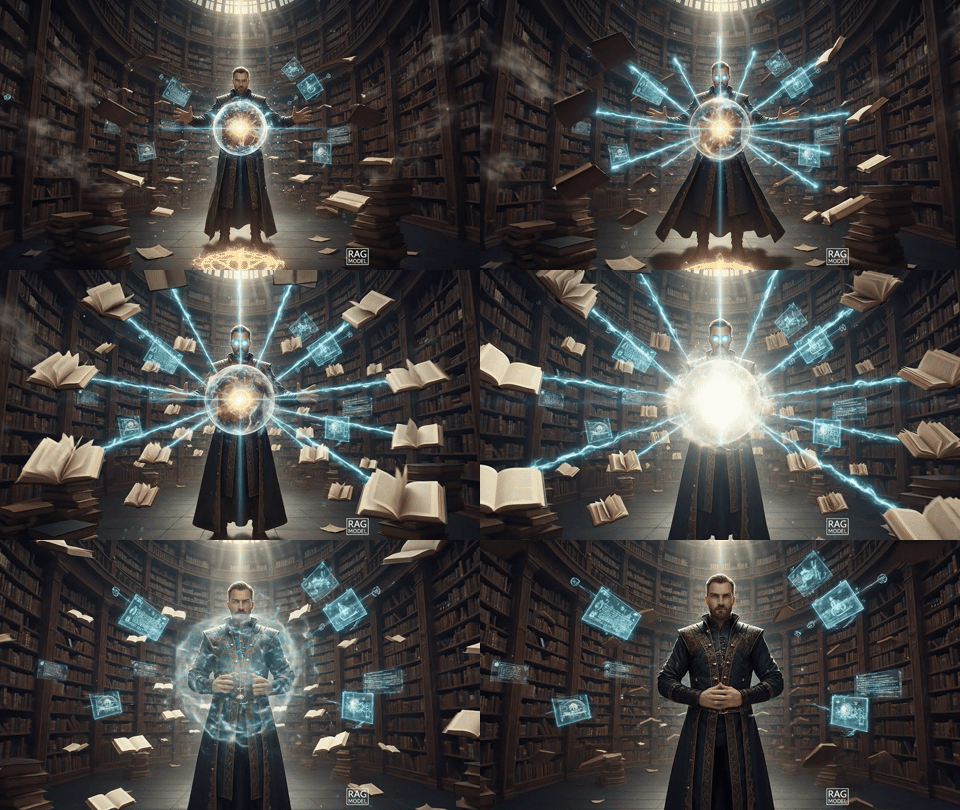
Retrieval Augmented Generation (RAG): This is a technique that enhances the capabilities of an LLM by giving it access to external knowledge bases during the generation process. Imagine an oracle who, when asked a question, doesn’t just rely on their own inherent wisdom, but can also instantly consult a vast library of ancient scrolls and forgotten texts to provide a more accurate and detailed answer. RAG allows LLMs to retrieve relevant information from a separate corpus of data before generating a response, leading to more factual and up-to-date answers.

Agent (in AI): An AI agent is a system that can perceive its environment, make decisions, and take actions to achieve specific goals. Think of it as a trained familiar or a homunculus, imbued with a specific purpose. It operates autonomously within defined parameters, observing its surroundings and then choosing the best course of action from its repertoire to move towards its objective. An AI agent might be designed to book appointments, manage a smart home, or even play a complex strategy game.

The world of AI, like any esoteric pursuit, often seems daunting at first glance. But by breaking down the terms and understanding their underlying principles, we can begin to appreciate the intricate dance between algorithms and intelligence. As with any powerful tool or knowledge, understanding is the first step towards mastery and discerning its true potential.
What other AI terms have you encountered that you’d like to demystify? Share your thoughts in the comments below!




Leave a Reply